The Ghost in the Machine: Mayo and Berliner Re-Embody Jazz at Miner
A double bill of contrast and convergence: Mayo and Berliner redefined the acoustic boundaries of the Miner Auditorium on Saturday night.
The mandate of the modern jazz institution has shifted. In an era when the machinery of major-label development deals has largely evaporated, organizations like SFJAZZ have stepped in as "gap fillers"—entities obligated to provide the infrastructural support that record companies no longer offer. This is the explicit logic behind Terence Blanchard’s "UpSwing" series: a curatorial intervention that leverages the institutional weight of Miner Auditorium to accelerate the broader recognition of artists who might otherwise remain siloed in the club circuit.
On Saturday night, that intervention took the form of a double bill featuring vocalist Michael Mayo and vibraphonist Sasha Berliner. On paper, the pairing seemed like a study in dialectical opposites: Mayo’s "sunshine" aesthetic versus Berliner’s metallic density; the ethereal loop versus the percussive strike. Yet in the Miner’s acoustics—a room of crystalline transparency that allows sound to bloom rather than compress—the performance revealed a shared, deeper thesis. Both artists are engaged in a project of "re-embodiment," grafting the logic of digital music onto acoustic instruments to mutate the tradition rather than preserve it.
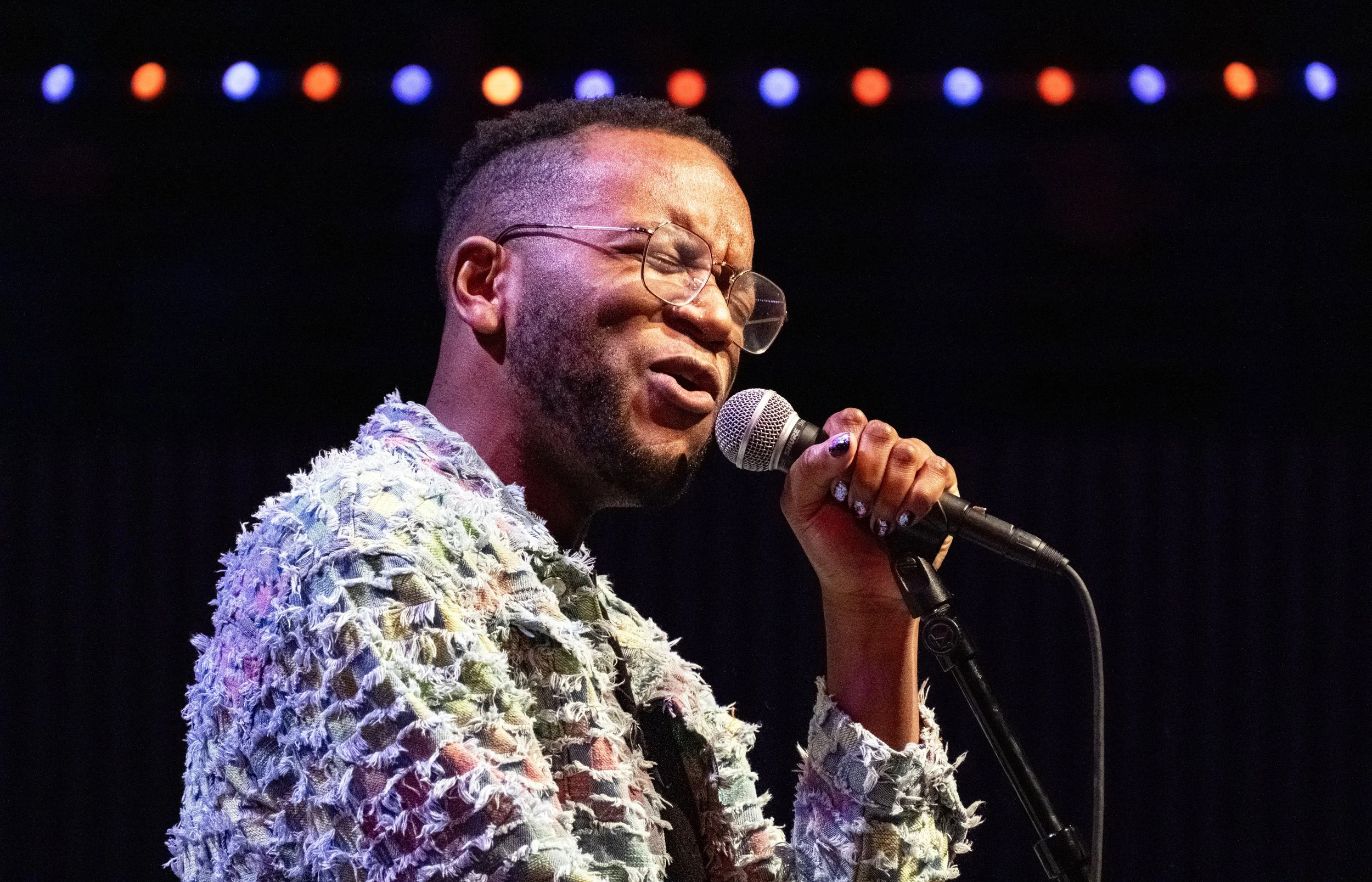
Michael Mayo. Photo: Steve Roby
Michael Mayo, fresh off two Grammy nominations, opened the evening with a set that felt like a master class in architectural vocalism. Mayo does not use the loop station as a gimmick; he uses it as a compositional tool, allowing the audience to witness the song's construction in real time. When he introduced his gear—humorously sampling his own explanation ("This is a looper and this is what it does") before asking the audience to sing the Jeopardy theme as he programmed it—he demystified the process. He treats the technology not as a cheat code but as an extension of his body, effectively removing the distance between the singer and the song.
Mayo’s set, drawn mainly from his 2025 album Fly, navigated the tension between complex harmonic structures and a pop-soul presentation. On "Bag of Bones," he showcased a post-bop writing sensibility wrapped in an earnest, radio-friendly exterior. The sound in the hall was pristine, with Mayo’s clear tenor cutting through the mix without being swallowed by the room’s reverb. However, the true test of his re-embodiment thesis came with the standards. His reading of Miles Davis’s "Four" was less a cover than a restructuring; by replacing the traditional horn section with a wall of self-generated vocal harmony, he turned the bebop anthem into a slow, groovy meditation on the lyrics.
The success of Mayo’s set relied heavily on a rhythm section capable of breathing within the grid. Drummer Robin Baytas stood out, tasked with locking in with the loop pedal’s rigid time while still injecting a human swing. On tracks like "I Wish," Baytas navigated odd meters and ghost notes, keeping the music feeling fluid despite its digital backbone. Bassist Kyle Miles provided the necessary melodic anchor, filling the midrange space often reserved for a guitar with a distinct, soul-infused tone. The set concluded with "Unrequited Love," where Mayo broke the fourth wall, coaching the audience to sing backing parts. This move transformed Miner Auditorium from a polite viewing space into a communal choir.
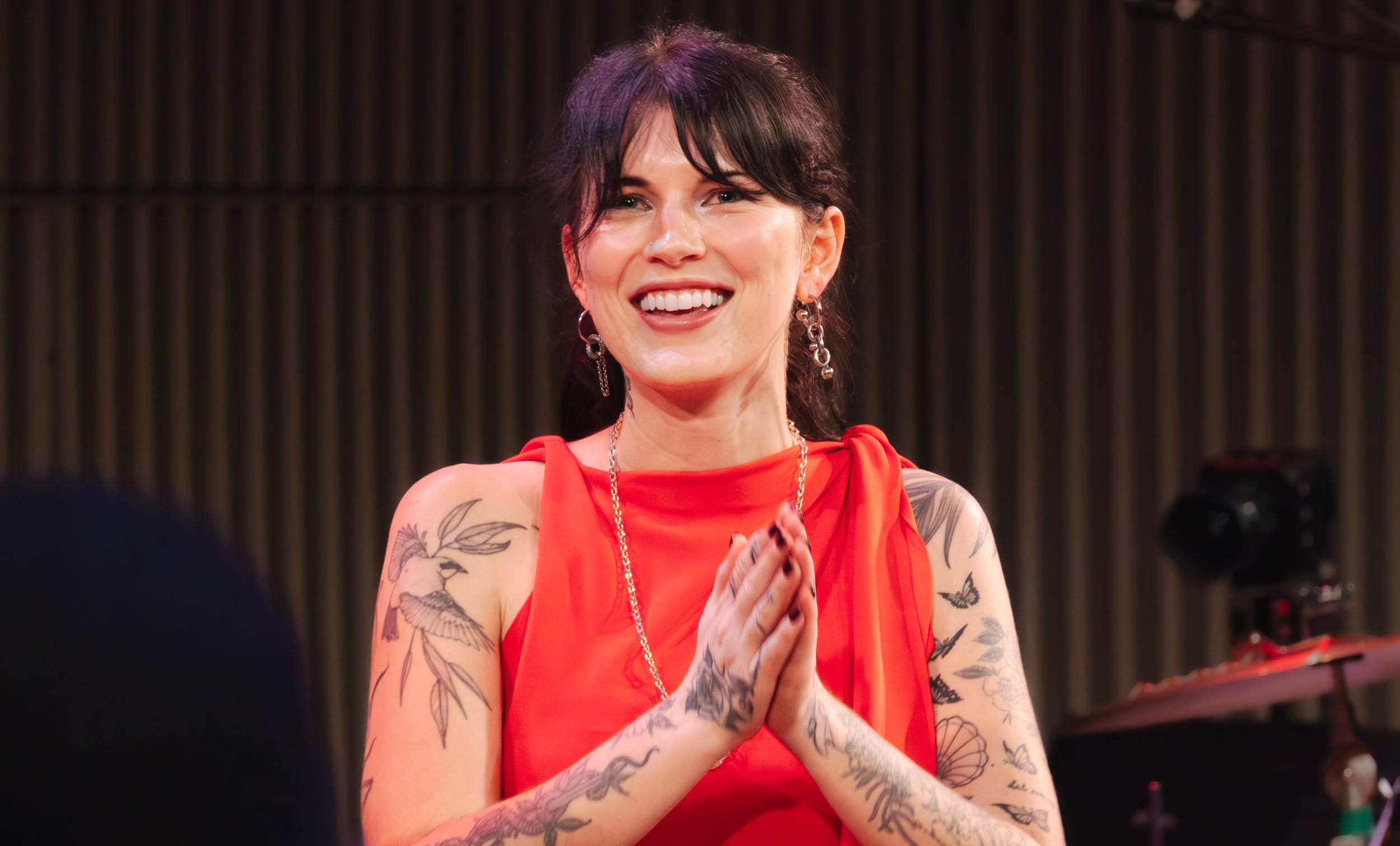
If Mayo represented the expansion of the acoustic tradition into the ethereal, Sasha Berliner represented its physical disruption. Taking the stage after a brief intermission, the San Francisco native approached her homecoming not with nostalgia but with aggression. Berliner has long rejected the "calming" or "magical" tropes associated with the vibraphone, preferring to treat the bars as anvils and the mallets as hammers.
Her set was strong and physically impactful—a direct challenge to the chamber jazz expectations of Miner Auditorium. Opening with Billy Childs’ "Backward Bop," Berliner immediately established a sound that was less about the instrument’s natural sustain and more about its percussive attack. She approaches the vibes as a drummer would, focusing on rhythm and texture over the pretty vibrato of the Lionel Hampton era. She rarely uses the motor, preferring a straight, piercing tone that cuts through dense textures.
The highlight of the set was "Seraphine," a new composition destined for her 2026 electric album. Here, the West Coast unit she assembled for this date proved its worth. Bassist Giulio Xavier Cetto (an SF local with a "thug jazz" aesthetic) and drummer Myles Martin provided a heavy, rock-inflected rhythmic floor, pushing the acoustic limits of the hall. Saxophonist Tristan Cappel was an essential foil, his electronic music background allowing him to blend his tone with Berliner’s vibes in a way that felt textural rather than merely melodic.
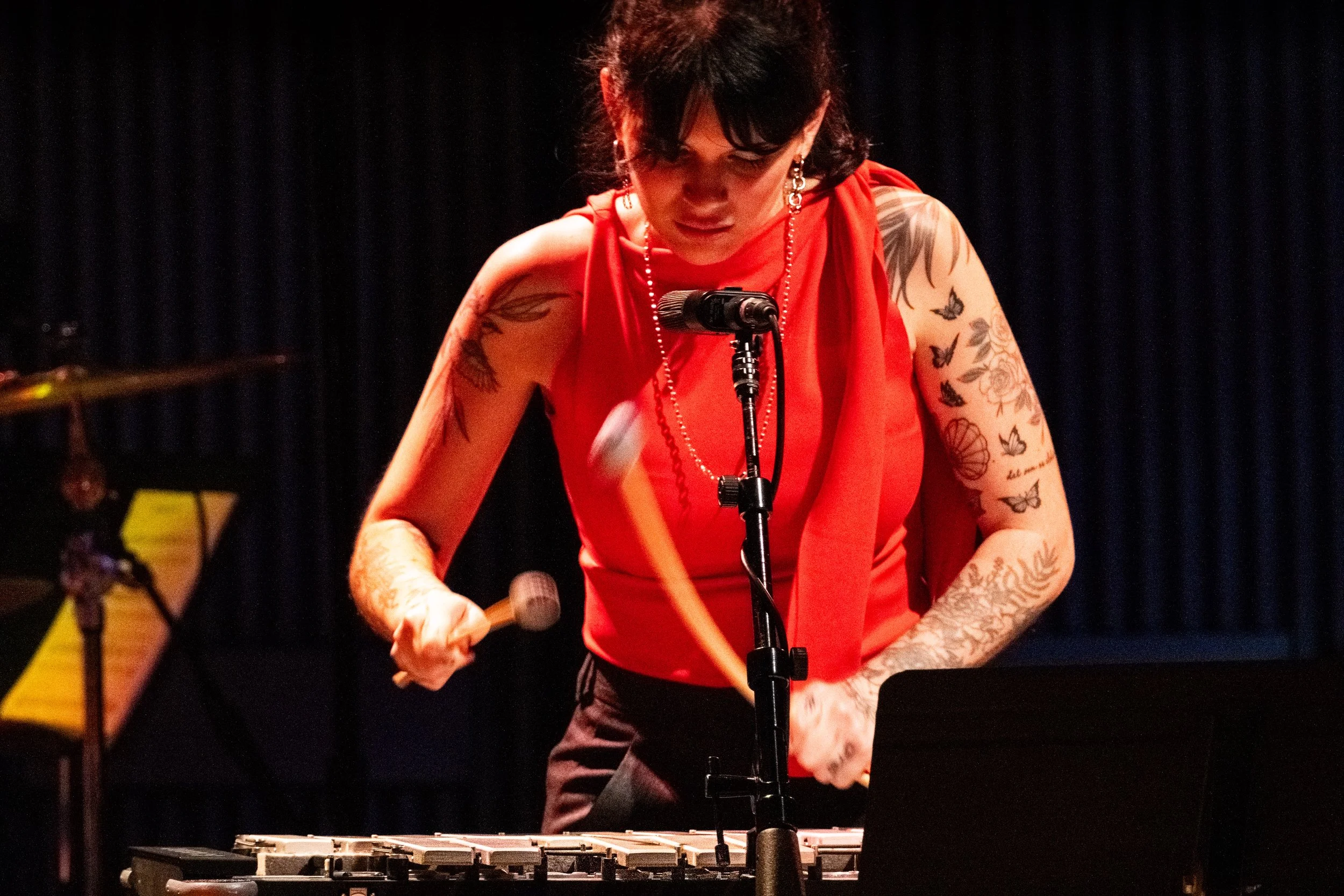
Sasha Berliner. Photo: Steve Roby
Berliner’s banter offered the evening’s sharpest contrast to Mayo’s California sunshine optimism. Introducing "The Worst Person in the World"—a track defined by its sustained and weeping soundscape—she made a pointed joke that the title wasn’t about Donald Trump. This moment underscored her willingness to let reality intrude on the concert experience. This is part of her Fantôme aesthetic: an acknowledgment that the "ghosts" of the past are present, but they don't dictate the future. The set closed with "Did You Get It," featuring a fantastic, muscular drum solo by Myles Martin that solidified the band's kinetic energy.
Ultimately, the double bill validated Blanchard’s gap filler strategy. The audience, notably younger than the typical SFJAZZ subscriber base, was energized by a presentation that bridged the gap between the intimacy of the Tiny Desk concert they experience online and the high-art scrutiny of the concert hall.
What linked Mayo and Berliner was a shared philosophy of "Post-Digital Acousticism." Mayo makes his voice sound like a synthesizer; Berliner makes her vibraphone sound like a sampler. They are re-projecting digital logic through acoustic instruments, recasting the genre's future as a hybrid engine fueled by the friction between the organic and the synthetic. As the night ended with Berliner signing albums in the lobby, it was clear the institution had successfully identified the architecture of the next phase. The ghost of the jazz tradition was present in the room, but the machine of the future was driving the car.
Program Notes
Event: Terence Blanchard's UpSwing Series: Sasha Berliner / Michael Mayo
Date: December 27, 2025; Showtime: 7:30 p.m.
Location: Miner Auditorium, San Francisco, California
Personnel
Michael Mayo band: Michael Mayo (vocals), Andrew Freedman (keys/piano), Kyle Miles (bass), Robin Baytas (drums).
Sasha Berliner band: Sasha Berliner (vibraphone), Myles Martin (drums), Julio Xavier Chetto (bass), Javier Santiago (piano and keys), Tristan Cappel (sax).
Michael Mayo Setlist: “Bag of Bones,” “Just Friends,” “Silence,” "I Wish,” “Four,” “I Didn't Know What Time It Was,” “You and You.”
Sasha Berliner Setlist: “Backwards Bop,” "Seraphim," “The Worst Person in the World,” “Ask Again,” “Did You Get It”
Listen to our interview with Michael Mayo here.
Listen to our interview with Sasha Berliner here.