Marcus Shelby’s Orchestral Memory: Blues, Structure, and Community at SFJAZZ

Reimagining Duke Ellington and Billy Strayhorn’s Nutcracker Suite through the lens of Bay Area history and global tradition, the Marcus Shelby New Orchestra offered a performance rooted in remembrance, resilience, and communal joy.
On Sunday evening at Miner Auditorium, Marcus Shelby and his New Orchestra offered more than a seasonal concert; they presented a carefully crafted meditation on memory, lineage, and the elasticity of the big band tradition. Framed by Duke Ellington and Billy Strayhorn’s Nutcracker Suite, the performance traced a through-line from classical form and blues expression to the Bay Area’s social history. Shelby – bassist, composer, and musical director – made his intentions clear early on: this was music meant not only to swing but to remember.
Before a note was played, Shelby asked the audience to observe a moment of stillness in honor of two Bay Area figures whose lives embodied endurance and community service—Betty Reid Soskin and Vernon Bush. Soskin, the 104-year-old park ranger, singer, and former record-label owner, and Bush, a longtime vocal leader at Glide Memorial, were invoked as living bearers of cultural memory. Shelby recalled collaborating with Soskin on his Port Chicago project in 2020, noting her central role in civil rights organizing and her creative independence well into old age. The dedication grounded the evening in local history, subtly reminding listeners that Ellington’s music has always thrived where artistry and social consciousness intersect.
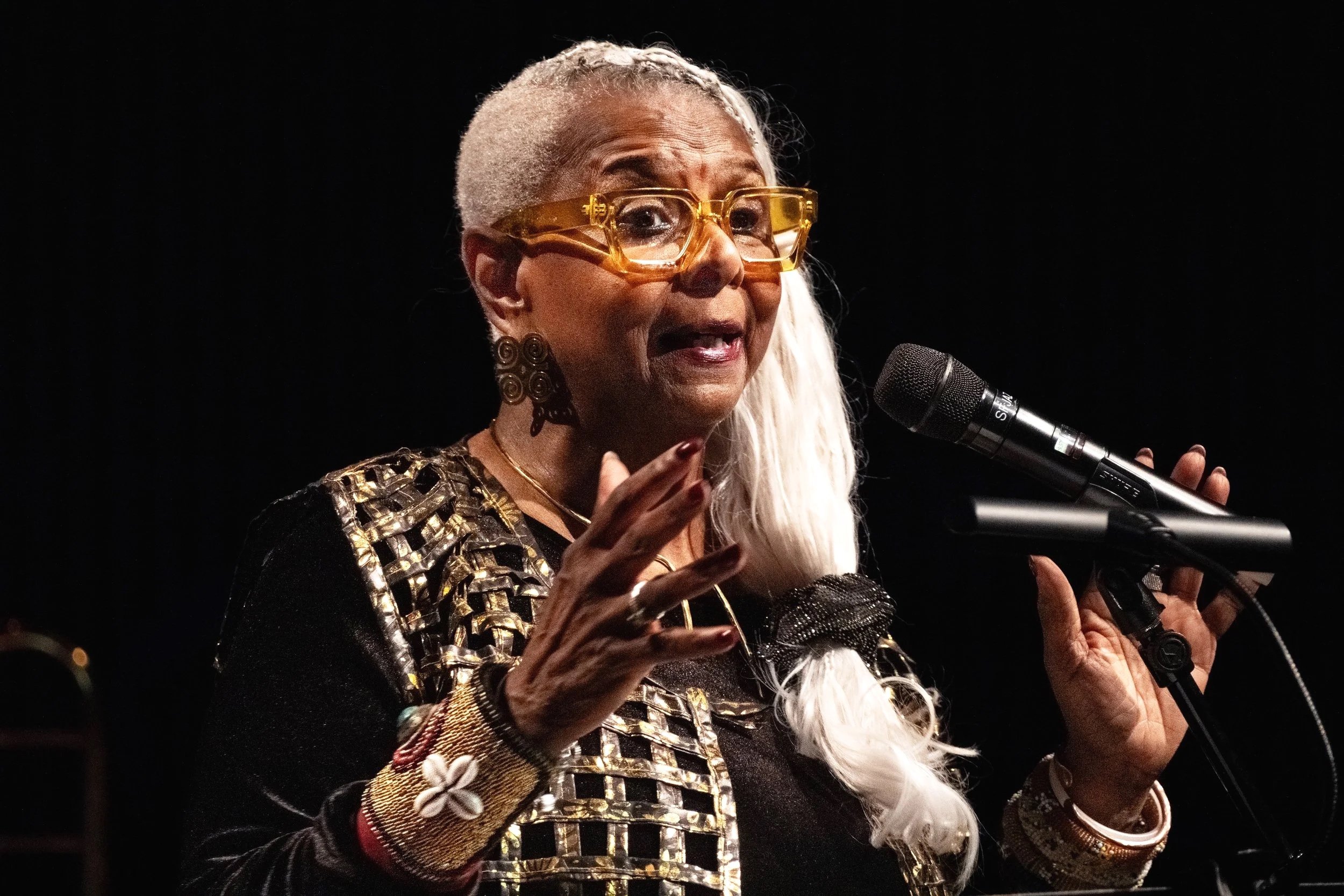
Enid Pickett. Photo: Steve Roby
That sense of narrative continuity deepened with the arrival of Enid Pickett, Healdsburg Jazz Poet Laureate, whose spoken-word interludes served as connective tissue between European classicism and Black modernism. Wearing a floor-length gold vest and a long white braid, Pickett recited “Once Upon a Masterpiece,” evoking Ellington and Strayhorn’s “dreamy Negro night visions.” Her poetry framed their 1960 Nutcracker Suite as a cultural intervention—one that transformed Tchaikovsky’s themes into something unmistakably Harlem Renaissance in spirit and, notably, granted Strayhorn equal billing for the first time. Pickett’s delivery framed the Suite not as a novelty but as a historical pivot, a “double dream” that drifted between worlds while belonging fully to jazz.
When the Marcus Shelby New Orchestra launched into the suite proper, the 15-piece ensemble’s physical presence became part of the experience. Shelby described the movements as “miniatures”—compact, through-composed works that embed classical motifs within blues phrasing, swing rhythms, and orchestral color. In “Volga Vouty,” the Russian Dance, Shelby cued the brass to raise their rubber plungers—what he jokingly called “bathroom instruments”—to sculpt vocalized timbres. The effect recalled Ellington’s signature use of mutes to bend pitch and approximate field hollers and work-song cries, transforming the brass section into something both human and historical. These rough-edged sounds underscored Ellington’s genius for translating lived experience into orchestral language.
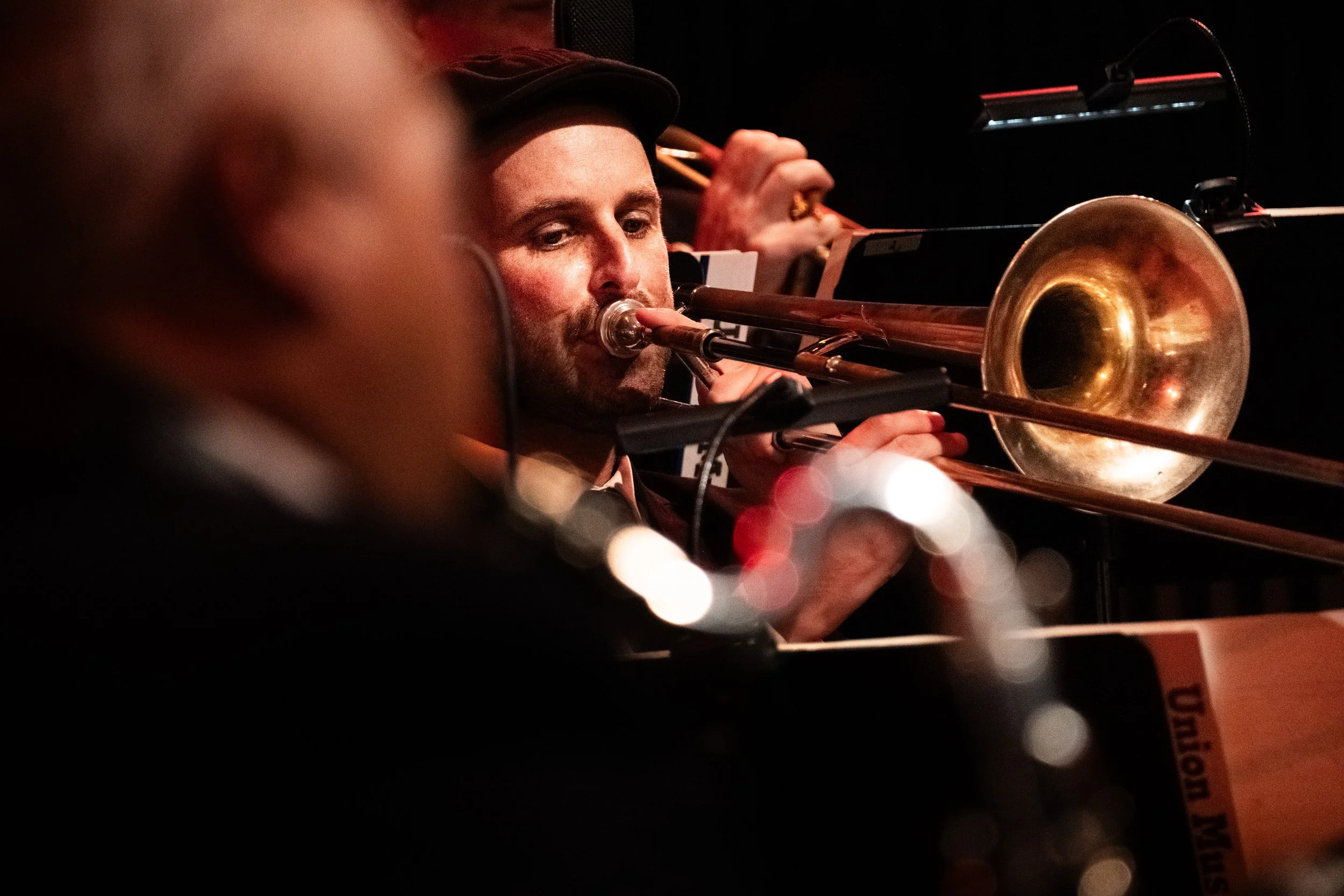
Riley Baker. Photo: Steve Roby
Throughout the first set, the orchestra’s internal communication stood out. Pieces such as “Peanut Brittle Brigade” and “Sugar Rum Cherry” moved with buoyant precision, driven by a responsive dialogue between the reeds and brass. Even in tightly written arrangements, Shelby emphasized the importance of improvisational space, and the rhythm section delivered. Pianist Greg Jacobs and drummer Jemal Ramirez established a flexible, propulsive foundation that let the ensemble navigate the rhythmic intricacies of “Toot Toot Tootie Toot” with ease. The group breathed as a single organism, negotiating the complex voicings of “Arabesque Cookie” and “Danse of the Floreadores” with an intimacy more often associated with small-group jazz than with a full orchestra.
The concert’s second half repositioned its focus, moving from Ellington’s refracted classicism to a global, contemporary lens via vocalist Tiffany Austin. Austin approached the material as a storyteller, guiding the orchestra through cultural explorations that extended the holiday theme beyond Western tradition. After an initial song in Japanese, "Oshogatsu," came “Sizalewe,” inspired by South Africa, in which she introduced a resonant rin, a bell-like bowl used in Buddhist meditation. By rotating a mallet around its rim, Austin produced pure tones that cut through the orchestral texture, sounding both ceremonial and disarming. As the arrangement built from sparse percussion to full saxophone and trumpet statements, the band shifted meters fluidly, locking into the groove.

Tiffany Austin. Photo: Steve Roby
Austin’s performance of “Déjà Vu,” celebrating Diwali, the Festival of Lights, reinforced the evening’s recurring theme of light overcoming darkness. Her vocal approach—rooted in jazz phrasing yet informed by contemporary soul—balanced restraint and emotional clarity, especially in the dramatic solo passages within Shelby’s arrangement. Addressing the audience, she framed the piece as an inward call to resilience, urging listeners to let their “lights shine” year-round and to begin the work of renewal within themselves.
The concert’s closing stretch leaned into collective joy. “Christmas Time in New Orleans” and the Shelby/Austin original “Kwanzaa Time” unfolded with polyphonic energy drawn from traditional New Orleans brass-band language. Trombone and trumpet lines interwove in celebratory counterpoint, creating a sound that felt both rooted and immediate. By the encore, a jubilant “Jingle Bells,” Shelby invited the audience to stand and sing along, dissolving the barrier between stage and hall. Enid Pickett returned to the stage, joining Austin and the full orchestra in a finale that fused Ellington’s architectural rigor with communal exuberance.
Taken as a whole, the performance affirmed Marcus Shelby’s dual role as both a historian and a modernist. By treating the Ellington–Strayhorn canon as a living archive and weaving global rhythms and contemporary narratives into the big-band format, the Marcus Shelby New Orchestra demonstrated that this music remains not only viable but vital—capable of carrying memory forward while making room for new light.
Program Notes
Band: The Marcus Shelby New Orchestra
Event: Duke Ellington's Nutcracker Suite Featuring Tiffany Austin and Enid Pickett
Date: December 21, 2025
Showtime: 8:00 p.m.
Venue: Miner Auditorium, San Francisco, California
Personnel: Marcus Shelby (Bass, Musical Director); Tiffany Austin (Vocals); Enid Pickett (Poetry). The Orchestra: Tony Peebles, Max Ngyuen (Alto); Patrick Wolff, Danny Brown (Tenor); Melecio Magdaluyo (Baritone); Danny Lubin-Laden, Remee Ashley, Riley Baker (Trombone); Erik Andrews, Mike Olmos, Chris Clark, Darren Johnston (Trumpet); Greg Jacobs (Piano); Jemal Ramirez (Drums).
Setlist: "Once Upon A Masterpiece (part 1)," "Overture," "Toot Toot Tootie Toot," "Peanut Brittle Brigade," "Sugar Rum Cherry (Dance of the Sugar-Plum Fairy)," "Once Upon A Masterpiece (part 2)," "Entr'acte," "Volga Vouty," "Chinoiserie," "Danse of the Floreadores," "Arabesque Cookie,"
With Tiffany Austin: "Blues For Christmas," "Oshogatsu," "Sizalewe," "Diya," "Déjà vu," "Christmas Time In New Orleans," "Kwanzaa Time," "The Christmas Song," "Jingle Bells.”
Once Upon a Masterpiece: A poem for Duke & Billy is a poem by Enid Pickett.