Gunhild Carling’s SFJAZZ Stomp
On May 24, Gunhild Carling brought her family band, six instruments, and an impromptu stomp to SFJAZZ’s most intimate room.

Gunhild Carling at Joe Henderson Lab. Photo: Steve Roby
About 45 minutes before showtime, Gunhild Carling was her own roadie. Meticulously, she arranged her merchandise table at the Joe Henderson Lab—custom-designed ties in the center, posters, bags, and her paintings to the left, and albums and CDs filling the right. After a brief chat with early arrivals, she disappeared into her dressing room to prepare.
What followed was a one-hour performance that bridged the distance between a Swedish jazz family and a San Francisco Sunday night, transforming SFJAZZ’s most intimate venue into something closer to Mardi Gras in May.
When Carling stepped onstage for the 6 p.m. set, the visual declaration was immediate. While her bandmates entered in suits, ties, and sleeveless dresses, Carling commanded attention in a one-shoulder silver sequined dress slit up the thigh, multi-strand pearls, and cascading platinum curls styled in 1940s Victory rolls, with a red flower tucked behind her right ear.
The set list read like a love letter to the music Carling has played since she was ten: “Way Down Yonder in New Orleans,” “Beale Street Blues,” “Cornet Chop Suey,” and “Basin Street Blues.” The Dixieland vibe was set before the third song even finished. Through the Lab’s street-facing windows, passing pedestrians peered in, as the crowd inside loved it from the first downbeat.

Idun and Gunhild Carling. Photo: Steve Roby
Three songs in, Carling introduced her band, and the project’s family dimension snapped into focus. Her son Viggo, 18 and two weeks from graduating from high school, held down the drum chair with an ease that belied his age. Nearest to Carling on stage, her daughter Idun sang and switched between trombone and trumpet, her French chanteuse look completed by beret, pencil skirt, and tube top. Johan Carling Bloome—dad—sat on a stool and strummed the banjo. Rounding out the septet were Neal Fontano on piano from Petaluma, Chloe Feoranzo on clarinet, and Lakshmi Ramirez on upright bass.
Idun proved she is more than a supporting player. On “Just a Closer Walk with Thee,” her breathy, Billie Holiday-tinged vocals gave the old spiritual a sense of weightlessness that suited the room. She later took a solo on “East of the Sun (West of the Moon)” that held the audience without any theatrical assistance from her mother.
Throughout the set, Carling’s role as bandleader was evident and unambiguous. She decided direction, confirmed mic stand positions, and cued solos with gestures that ranged from a conductor’s precise flick of the wrist to a proud parental point. During “Cornet Chop Suey”—the Louis Armstrong classic—she directed the band with her right hand, then turned and pointed emphatically toward Viggo as his drum solo built. He delivered.
On her original composition “Blues for Harmonica,” Carling played a few bars, then thrust her hand toward the audience, then mock-admonished them for their silence. “When I did that, you should have said ‘Yeah!’” she told the room. “Let’s redo.” The call-and-response worked loudly on the second attempt.
Between songs, Carling’s introductions were as entertaining as the music. Before “Samba De Orfeu”—the theme from the film Black Orpheus—she drew a laugh by describing her family of fifteen musicians: “You mix us up with the Jackson Five, but that is totally wrong. We play medieval music, so I brought a medieval recorder because I’m going to play a 1000-year-old song on a 1000-year-old instrument.” She played it. It sounded ancient, charming, and oddly right.
Toward the end of the set, the evening shifted into something between a masterclass and a vaudeville revue—and Carling clearly relished the blur.
She balanced and plucked an upright bass, swayed her hips while playing the trumpet, then played three trumpets simultaneously, her lips somehow managing the logistics of what the eyes refused to believe.

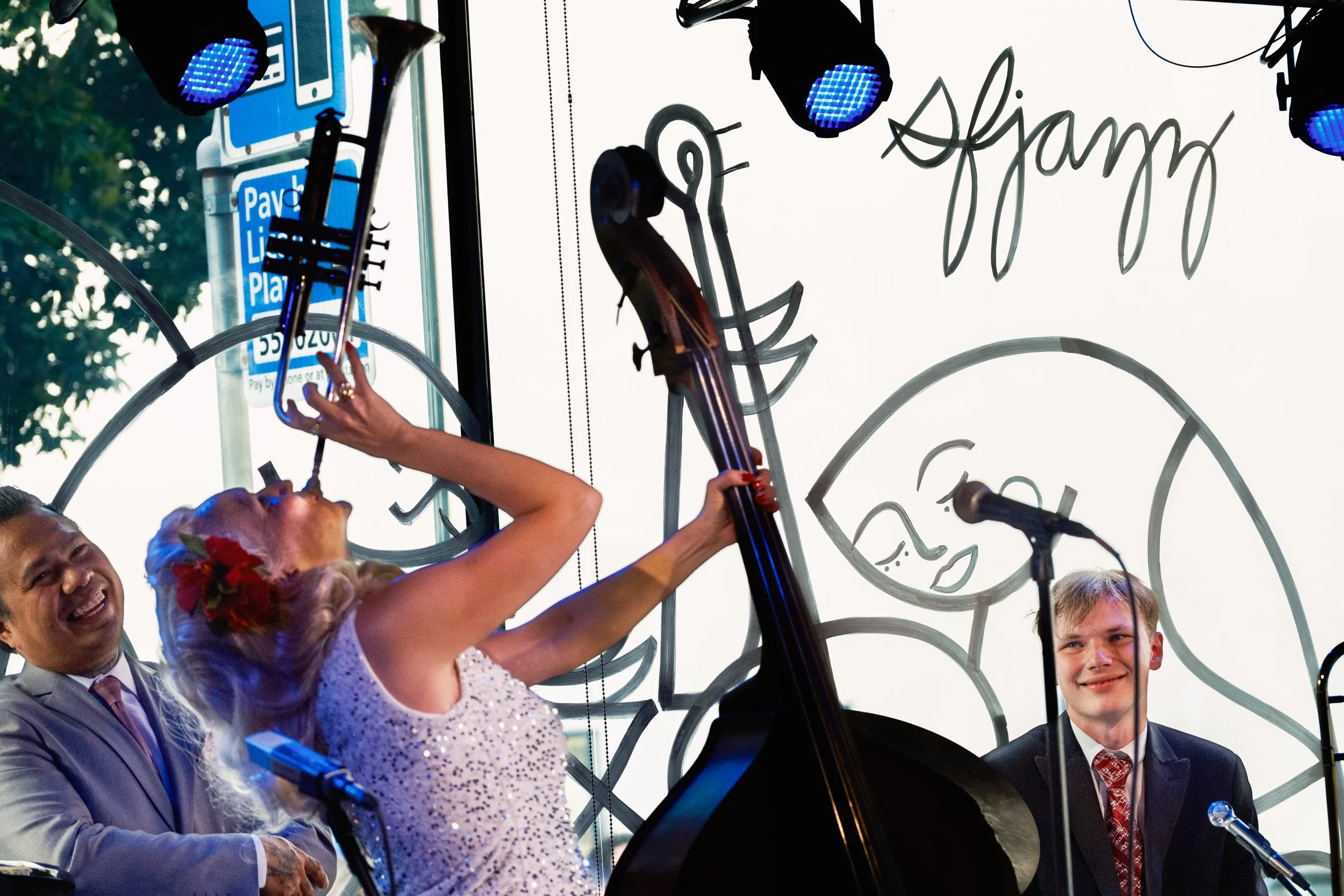
For the “SFJAZZ Stomp”—a song she announced she was composing on the spot— head tilted back, she balanced a trumpet on her lips while playing bass with her hands. “The only thing you should think of now,” she told the audience, “is that you haven’t heard the song before, so sit there and look excited.” Then came tap dancing, which she executed with the same offhand confidence she brought to every other instrument of the night.
In a pre-show interview, Carling had explained her relationship to the instruments she collects. Though the trombone is her primary voice, she said, each instrument has its own soul. “When I play hard, it’s very beautiful and a little meditative, and choosing the right instrument is not easy,” she said. “The flute can create this magic, the trumpet gives the melody, and the trombone has a lot of ability.” Her inspiration, she offered, was Rahsaan Roland Kirk—the multi-instrumentalist titan who played several horns simultaneously and treated every performance as a one-man orchestra. Sunday night, that lineage was visible.
Carling closed the set with “Ice Cream,” the traditional New Orleans standard that gave every band member a solo turn and served as a final showcase for Carling’s playful vocals and tap dancing.
Rather than ending with a bow, she stepped off the stage entirely and led her horn section down the center aisle and into the lobby, all while playing “When the Saints Go Marching In” and recording a cell phone video of herself to capture the audience’s reactions. The ushers had seven minutes to turn the house for the second show.
Watching the Carling band work the Joe Henderson Lab, it was hard not to think of what San Francisco once had and largely lost—the Dixieland tradition that Turk Murphy sustained for decades at Earthquake McGoon’s and the New Orleans Room at the Fairmont. That music thrived on exactly this combination of technical command, theatrical personality, and collective joy.
Gunhild Carling, Swedish-born and now Northern California-based, has inherited it, expanded it, and made it hers. Sunday night, for one packed hour, she brought it back.
Program Notes
Artist: Gunhild Carling and her Jazz Band
Venue: Joe Henderson Lab, SFJAZZ, San Francisco, CA
Date: Sunday, May 24, 2026
Showtime: 6:00 p.m. set
Personnel: Gunhild Carling, vocals, trombone, trumpet, harmonica, recorder, bass; Idun Carling, trombone, trumpet, vocals; Chloe Feoranzo, clarinet, vocals; Lakshmi Ramirez, upright bass; Viggo Carling, drums; Johan Carling Bloome, banjo; Neal Fontano, piano.
Set List: “Way Down Yonder in New Orleans,” “Beale Street Blues,” “Cornet Chop Suey,” “Basin Street Blues,” “Just a Closer Walk with Thee,” “East of the Sun (West of the Moon),” “Samba De Orfeu,” “I Can’t Believe That You’re in Love with Me,” “Stompin’ at the Savoy,” “Blues for Harmonica,” “SFJAZZ Stomp,” “En Månskenspromenad,” “Ice Cream,” “When the Saints Go Marching In”
More on the artist: gunhildcarling.com
Listen to our podcast with Gunhild Carling here.