Miles Davis at 100: Beasley's All-Stars Go Deep at the Presidio
Spanning a 90-minute set from Birth of the Cool to Amandla, Beasley's sextet anchors the centennial with Miles's most influential band — the 1965–68 quintet featuring Wayne Shorter.

Trumpeter Sean Jones paying tribute to Miles Davis at the Presidio Theatre. Photo: Steve Roby
Last September at San Francisco’s Presidio Theatre, percussionist and former Miles Davis collaborator Mino Cinélu marked the trumpeter’s centennial by lighting 100 candles across the stage and performing four Davis compositions. On Thursday night, eight months later, pianist John Beasley returned to the same venue, with the same anniversary in mind, and pursued an entirely different aesthetic.
The performance also felt like a closing: it served as the final stop on Beasley’s Miles Davis tribute tour, bringing the project to a close in the Bay. “No candles. No chronology. No museum pieces,” Beasley wrote on social media ahead of the Presidio performance.
What followed was less a historical survey than an argument about lineage — about how Miles Davis’s music travels through generations of musicians, continually reshaping itself. Despite promotional language promising a performance spanning Birth of the Cool through Amandla, Beasley’s 90-minute set repeatedly gravitated toward one orbit: the 1965–68 quintet featuring Wayne Shorter, Herbie Hancock, Ron Carter, and Tony Williams.
That gravitational pull emerged almost immediately. Seated at the piano, Beasley mapped out the evening’s loose itinerary — Birth of the Cool, Bitches Brew, The Man with the Horn — before threading “Moon Dreams,” “Sanctuary,” and “Fat Time” into a compressed medley of three decades of Miles Davis into a single continuous gesture. The transitions arrived with dream logic rather than historical sequence. Themes dissolved into electric textures, then reassembled as groove.
The deeper story of the night was hidden in the repertoire choices themselves. Of the eight compositions performed, four came directly from the Second Great Quintet’s repertoire. Three were written by Wayne Shorter. Even in a concert celebrating Miles Davis at 100, the evening repeatedly acknowledged the musicians who reshaped Davis’s language from within.
Beasley assembled a band capable of navigating every era of Davis’s catalog without reducing any of it to mere stylistic imitation. Trumpeter Sean Jones largely avoided direct Miles references, favoring a warm, centered tone that occasionally gave way to sharp-edged bursts in the more electric passages.

Drummer Terreon Gully. Photo: Steve Roby
Guitarist Kurt Rosenwinkel brought atmospheric shimmer and harmonic ambiguity to the ensemble, while saxophonist Mark Turner approached the material with the cool abstraction and elongated phrasing that Shorter’s compositions invite. Behind them, bassist Ben Williams and drummer Terreon Gully kept the music in constant motion, refusing to settle into static swing and favoring shifting rhythmic currents.
“Paraphernalia” captured the ensemble’s approach especially well. Rather than reproducing the taut momentum of the original Miles in the Sky-era recording, the sextet stretched the composition outward, allowing Rosenwinkel’s guitar textures and Turner’s tenor lines to blur the boundaries between post-bop structure and electric atmosphere. Gully’s drumming supplied the connective tissue, moving fluidly between cymbal-driven swing and denser polyrhythmic figures.

Pianist John Beasley sharing a Miles Davis story with the crowd. Photo: Steve Roby
At the piano, Beasley worked from a laptop labeled UM Miles, his roadmap for the show’s electronic layer. Its patches were named for the musical worlds the program would traverse: “Sketches” for Sketches of Spain, “Moon Dreams” for the Birth of the Cool medley opener, “Zawinul Organ” for the In a Silent Way textures Joe Zawinul brought to Miles Davis in the late ’60s, and, pointedly, “Hassel,” nodding to Jon Hassell, whose Fourth World sound shaped Davis’s late-career recordings Tutu and Aura. The naming was both practical and suggestive, framing Beasley’s approach not as imitation of Miles but as a way into the network of collaborators and aesthetic influences that formed Davis’s sound world.
The evening’s most revealing moments came between songs. After “Paraphernalia,” Gully stepped to the microphone and traced his personal connection to Miles back to East St. Louis, where he grew up a block from the Davis family home and attended the same high school. His music teacher — a local educator named Ron Carter, no relation to the bassist — encouraged students to move beyond the surrounding housing projects and toward jazz.
Jones followed up with his story about discovering Miles through two albums given to him by a sixth-grade band teacher: Kind of Blue and Amandla. He chose Amandla first because its cover intrigued him. Years later, after joining Marcus Miller’s band, Jones called the same teacher and put Miller on the phone with her.
The anecdote emerged as evidence of Miles Davis’s unusually durable chain reaction across generations of musicians, carrying the warmth of a sentimental tribute.
Those stories ultimately clarified the concert’s central thesis. The music onstage was not organized around forming a canon or preserving history. It explored the deeply personal pathways by which artists first encounter Miles Davis — through teachers, neighborhoods, records, mentors, accidents, and obsession.
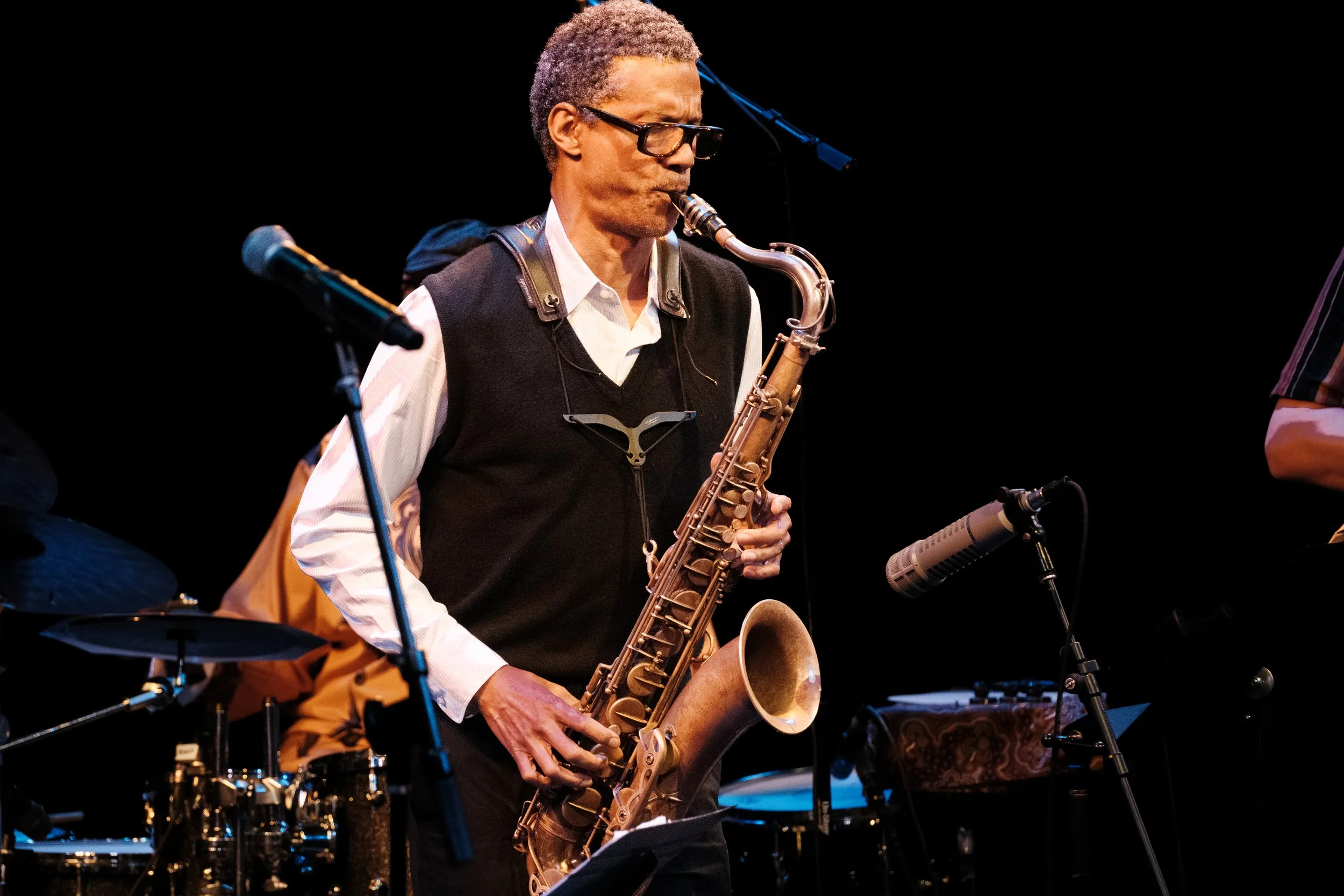
Saxophonist Mark Turner. Photo: Steve Roby
Beasley reinforced that idea with his own story about initially dismissing a 1989 phone call from Davis as a prank while working on a studio session with Rickie Lee Jones, Walter Becker, Chuck Rainey, and Jim Keltner. Becker physically pushed him toward the door and told him to take the call. He did. The rest became part of the same lineage traced by the concert that evening.
The concert’s closing stretch pushed further into Davis’s electric years, when Williams’ bass grooves and Gully’s elastic drumming created more room for collective improvisation. Even then, Beasley avoided nostalgia. The music retained the restless forward motion that defined Davis’s bands across every era: a sense that stylistic boundaries existed mainly to be crossed.
That instinct gave the evening its emotional center. Rather than presenting Miles Davis as a finished monument, Beasley and his ensemble treated the music as a conversation still unfolding among the musicians onstage and among the audience in the Presidio Theatre, a century after Davis’s birth.
Program Notes
Artist: John Beasley Sextet
Venue: Presidio Theatre Performing Arts
Location: San Francisco
Date: Thursday, May 14, 2026
Showtime: 7:30 p.m.
Personnel
John Beasley: piano, keyboards, synth, melodica
Sean Jones: trumpet
Mark Turner: tenor sax
Kurt Rosenwinkel: electric guitar
Ben Williams: electric and acoustic bass
Terreon Gully: drums
Setlist: “Seven Steps to Heaven,” “Teo,” “Madness,” Medley: “Moon Dreams”/“Sanctuary”/“Fat Time,” “Iris,” “Catémbe,” “Paraphernalia,” “Pinocchio”
Listen to our exclusive interview with John Beasley here.