Gunhild Carling at SFJAZZ’s Joe Henderson Lab
The multi-instrumentalist returns with her New Orleans ensemble for four intimate performances, presenting new music shaped by audience connection and real-time interaction.
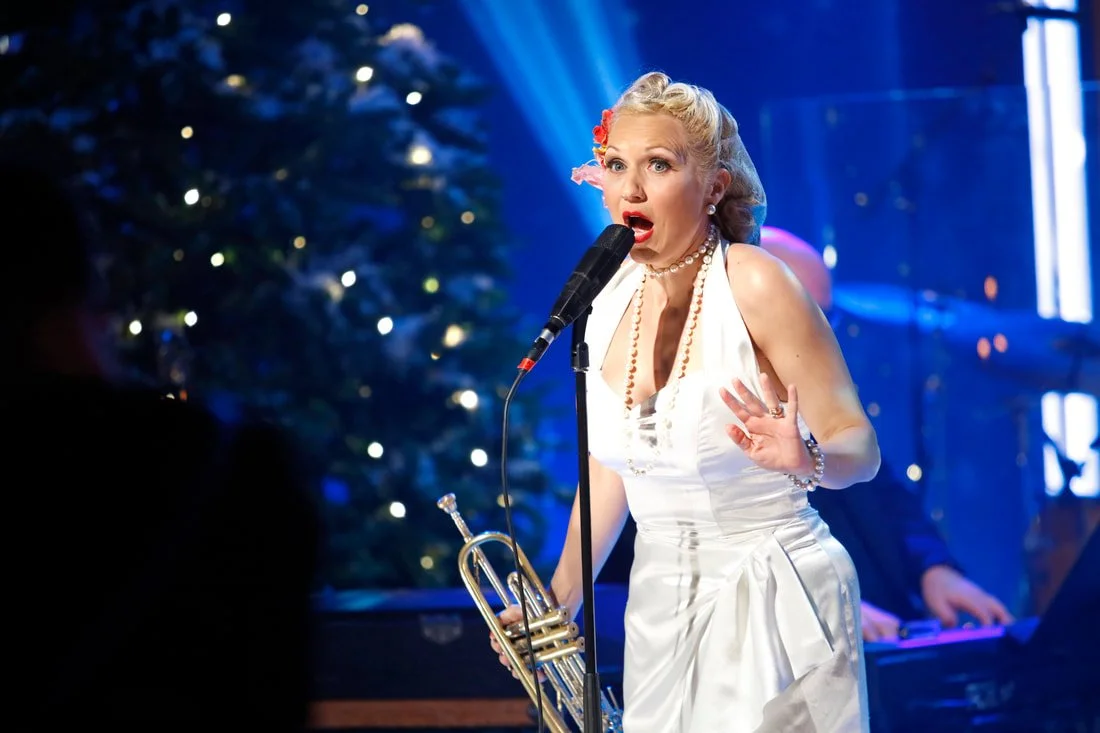
Gunhild Carling brings her New Orleans jazz ensemble to the Joe Henderson Lab at SFJAZZ on May 23 and 24. Courtesy photo.
Listen to the full conversation with Gunhild Carling below.
On May 23 and 24, Gunhild Carling returns to the Joe Henderson Lab for four performances with her New Orleans jazz ensemble, arriving with new music shaped by the environments she plays in—and the audiences who meet her there.
Carling’s career has often been framed by range: trombone, trumpet, harp, flute, bagpipes, and more, sometimes within a single piece. That inventory tells only part of the story. What drives her work is a principle she arrived at as a teenager—that music must register physically as well as sonically. “I can include the whole audience in my inspiration,” she said recently from New Orleans, where she was in residence during Jazz Fest. “Here and now—we are having a wonderful time.”
She grew up in Gothenburg, Sweden, in a deeply musical family, and began performing almost as soon as she could hold an instrument, making her recording debut on trombone at nine. The more decisive shift came later, when she began to treat music less as execution and more as transmission. “When I really understood that music is not only playing the part that was given to you,” she said, “you can power the music with feeling.” That idea remains central to how she builds a set, chooses an instrument, and reads a room.
Her multi-instrumental approach often draws comparisons to Rahsaan Roland Kirk, though Carling frames it less as virtuosity than as vocabulary. Each instrument serves a different expressive function. The harp opens a quieter, reflective space. The flute shifts the atmosphere. The trombone—her primary voice—anchors the melodic line with clarity and weight. Even her more theatrical signatures, like playing multiple trumpets at once, are integrated into the broader arc of a performance.
That arc is shaped in real time. Carling treats the audience as participants, approaching familiar material as if it were unfolding for the first time. A century-old New Orleans standard is delivered with present-tense urgency. Originals lean toward direct emotional language, often centered on love and connection. “I see every person who came to my show like my best friend,” she said. “I’m gonna give everything.”
Her album Jazz Is My Lifestyle consolidates that approach across eleven original compositions rooted in New Orleans traditions. One track, “I’ll Wait for You in San Francisco,” carries a local backstory. During the pandemic, Carling found herself in the Bay Area while much of the city was closed. She assembled an informal band from her neighbors—musicians from varied backgrounds, many new to jazz—and spent days working through the New Orleans repertoire. The song’s title grew out of those conversations. “I used to say, ‘Where can I see you?’” she recalled. “I said all the time, ‘I’ll wait for you in San Francisco,’ because I couldn’t go anywhere.”
The SFJAZZ setting at the Joe Henderson Lab’s scale allows for close-range interaction, where subtle shifts in tone, phrasing, and dynamics carry without mediation. Carling performed there previously and points to the room’s atmosphere as part of the appeal. The proximity between band and audience sharpens the feedback loop she relies on.
Her ensemble for these dates reflects a balance of familiarity and flexibility. Trombonist Idun Carling, her daughter, joins the front line, while her son Viggo Carling covers drums and banjo. Clarinetist Chloe Feoranzo adds a New Orleans timbral thread, and bassist LaMi Ram provides a grounded, rhythmic foundation shaped by a background that extends beyond jazz. Pianist Neil Fontano, based in the Bay Area, completes the group. The configuration supports quick shifts in texture and feel without losing cohesion.
New material will be introduced across the four shows, alongside long-standing repertoire and elements that have become part of her live language, including a tap-dance finale and appearances from less conventional instruments. The sequencing is less about setlist design than about pacing the room—gauging when to expand, when to pull back, and how to keep the audience engaged across the full performance.
Carling evaluates each performance against a straightforward metric: whether it moves the room. In a space like the Joe Henderson Lab, that response is immediate and visible. Over four sets, the goal remains consistent—establish a shared experience that feels active, not observed.
Show Details
Artist: Gunhild Carling
Venue: Joe Henderson Lab, SFJAZZ Center, San Francisco
Dates: May 23–24, 2026
Showtimes: Saturday 7:00 PM & 8:30 PM; Sunday 6:00 PM & 7:30 PM
Tickets:sfjazz.org
More info:gunhildcarling.net