Honoring Miles and Coltrane on Their Own Terms
At SFJAZZ’s Miner Auditorium, Terrence Blanchard and Ravi Coltrane treated a half-century-old repertoire as an ongoing conversation—not a monument.

Terrence Blanchard and Ravi Coltrane close out SFJAZZ’s 26-26 season. Photo: Steve Roby
When Ravi Coltrane walked onstage at Miner Auditorium last Sunday evening, he did something instinctive: he looked up. To his left, projected above the stage, was a black-and-white portrait of his father—an image from 1960, overlaid with swirling abstract shapes that dissolved in and out of live footage from the stage below. Ravi glanced at it briefly, bumped shoulders with Terence Blanchard, raised his saxophone, and began to play.
That small gesture—the glance upward, the shoulder touch, the saxophone rising—quietly framed what followed.
Sunday night’s show closed a four-night residency and SFJAZZ’s 2025–26 season with a program billed as a Miles Davis & John Coltrane Centennial. The occasion brought Blanchard, SFJAZZ’s executive artistic director, together with Ravi Coltrane for a show on a limited global tour, with upcoming stops in Germany and France before it concludes in Washington, D.C., this November.
It arrived at the tail end of a season saturated with centennial tributes: the Miles Electric Band with Vince Wilburn Jr. and Keyon Harrold; Marcus Shelby’s orchestral Miles tribute; Emmet Cohen’s Coltrane night; and Mino Cinélu and John Beasley across town at the Presidio Theatre. Bay Area jazz audiences have been immersed in this repertoire for months. The question wasn’t whether this show would honor its subjects. It was how.
A Different Opening Statement
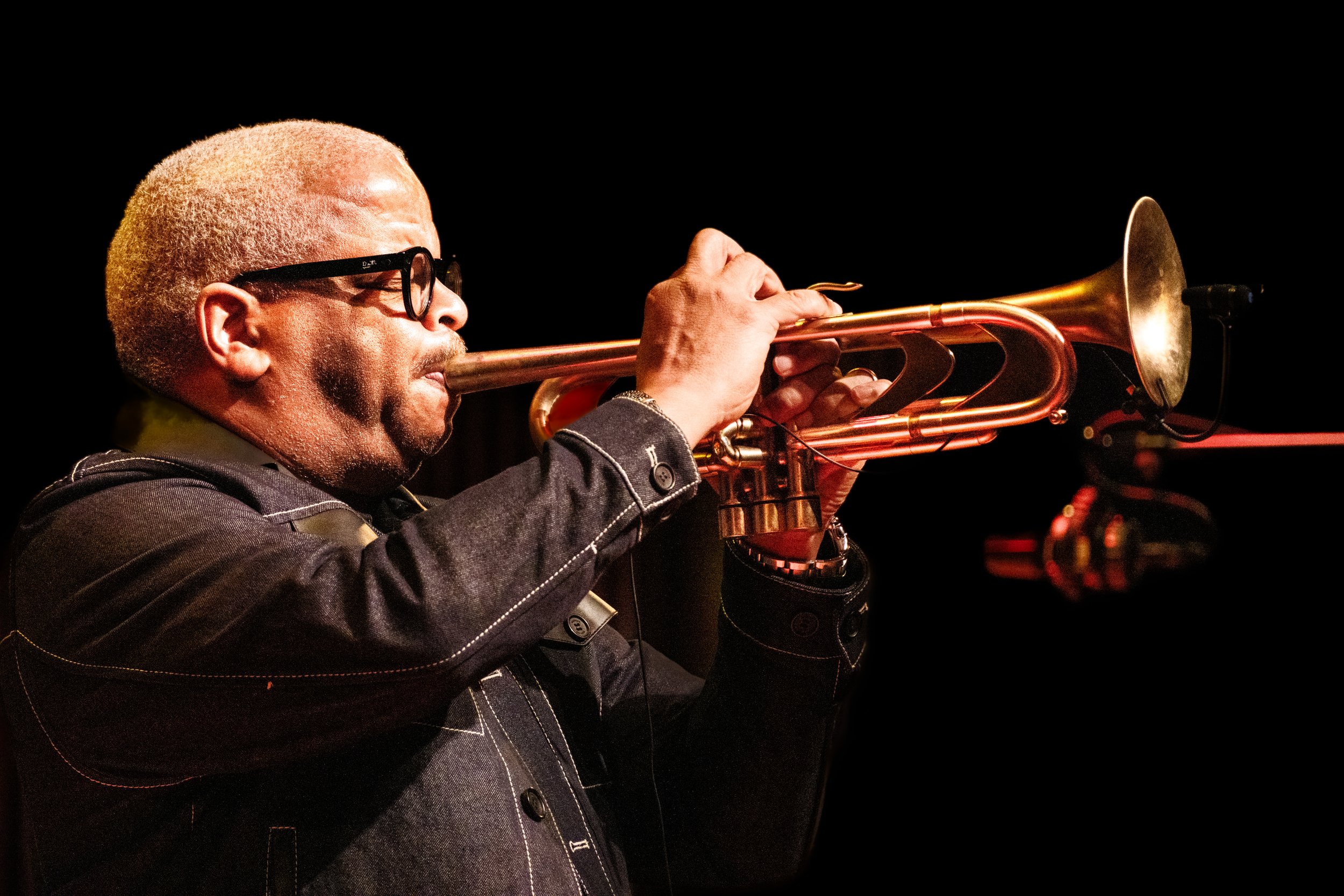
Terrence Blanchard. Photo: Steve Roby
Blanchard’s answer arrived before a single shared standard was played.
Behind and above the stage, the opening visuals cast Miner Auditorium in a dark, surreal light—overlapping abstractions of statues, cityscapes, and masks that made the room feel less like a concert hall and more like a dream.
When Blanchard walked out, trumpet in hand, the E Collective was already in full motion: Charles Altura rocking gently at the guitar, his expression barely changing; Tom Oren splitting his attention between a piano on his left and synthesizers on his right.
Blanchard sat, letting the band carry the weight for a few bars, then raised his horn. What came out was “Flow”—not a Miles Davis standard or a Coltrane composition, but a piece from Blanchard’s own 2005 album of the same name. His trumpet was run through an effects pedal, the sound hovering between a Harmon-muted horn and an overdriven guitar. At the tune’s peak, he bent forward and drove the final note toward the floor with his whole body, as if force of will could push the sound through the stage and into the ground.
Before a single note of the shared repertoire was played, the evening’s aesthetic was already on record.
“One of the things we’re not doing tonight—we’re not doing the original arrangements,” Blanchard told the room. “If you came here to hear what was on the records, I feel sorry for you.” The audience laughed. It was a gentle provocation, but it carried weight. He was asking the room to trade a certain kind of reverence for something more demanding: to hear what these musicians do when freed from the obligation to be faithful to a recording.
Inheritance Over Recreation
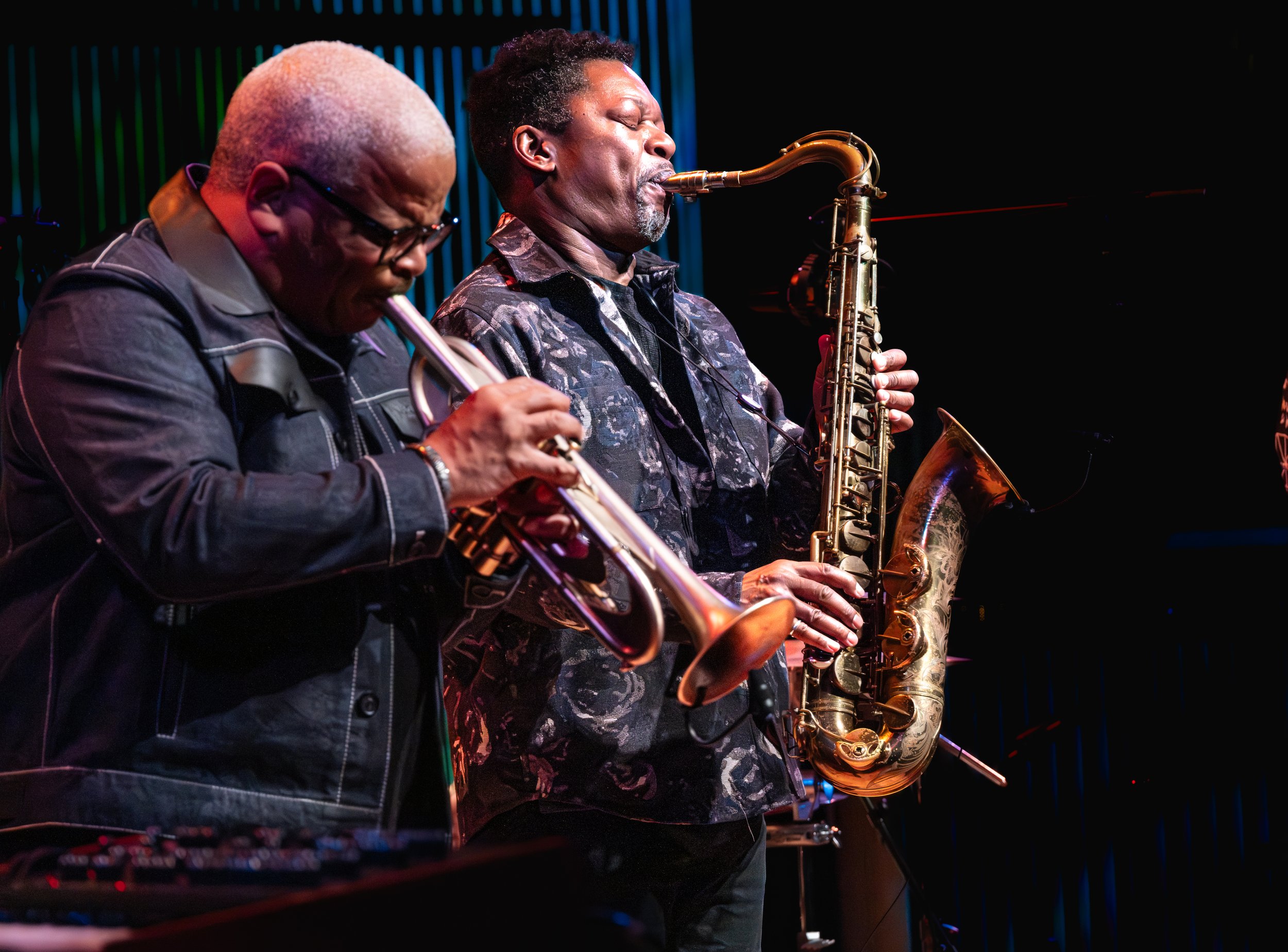
Blanchard and Coltrane. Photo: Steve Roby
The repertoire was drawn entirely from 1958–1961, when Davis and Coltrane played and recorded together. “Flamenco Sketches” arrived early, its open modal structure doing what it has always done: offering a frame and then stepping back. The arrangement didn’t try to reproduce the Kind of Blue atmosphere. It used the form as a frame, letting the musicians bring their own present tense to it.
As the projections shifted to feature album-cover graphics bearing the word COLTRANE, Ravi entered, and the real conversation began. New images emerged alongside him—artistic portraits overlaid with archival black-and-white photographs, and a 1960 Coltrane quintet poster dissolving in and out of live stage footage. The visuals reminded the room what a legacy looked like; the music Ravi was making reminded it of something else.
On “On Green Dolphin Street,” he and Blanchard delivered a blazing two-horn encounter—both standing, left legs angled forward, working through the changes with a looseness that felt earned, not casual. The rhythm section held the ground as the two horns traded ideas above it. Their conversation was elastic and unscripted. Neither musician played toward the other’s legacy. Both played toward the music.
The Weight of a Name
The most quietly remarkable thing about Ravi Coltrane’s playing is its restraint. The pressure the Coltrane surname places on any saxophonist who bears it is obvious, and the temptation to lean into it—to deploy a few strategic phrases that nod to the father—must be constant. Ravi doesn’t do that.
His playing is linear and controlled, finding tension in space and pacing rather than density. At one point during a soulful, samba-inflected number, he stooped, lowering his saxophone toward the floor as dramatic paintings of his father rotated slowly above and behind him—monumental, archival, insistent. Ravi played something quietly, unmistakably his own.
During an earlier soundcheck, Blanchard had described Ravi as “an amazing individual to have his own voice on that instrument in this day and age,” and the performance made clear why that achievement mattered. The most visible tribute to John Coltrane in Ravi’s playing Sunday night was his refusal to impersonate him.
On “All of You,” Blanchard sat on his stool and followed every chord change, tapping the rhythm out on his thigh while Ravi carried the melody forward. Then he rose, the horns overlapping, as a photograph of Miles Davis in dark sunglasses materialized on the screen behind them. Again, Blanchard drove his final notes toward the floorboards, summoning that same gesture—the horn angled down, the body leaning in, as if still trying to finish what “Flow” had started.
The Medley and the Collective
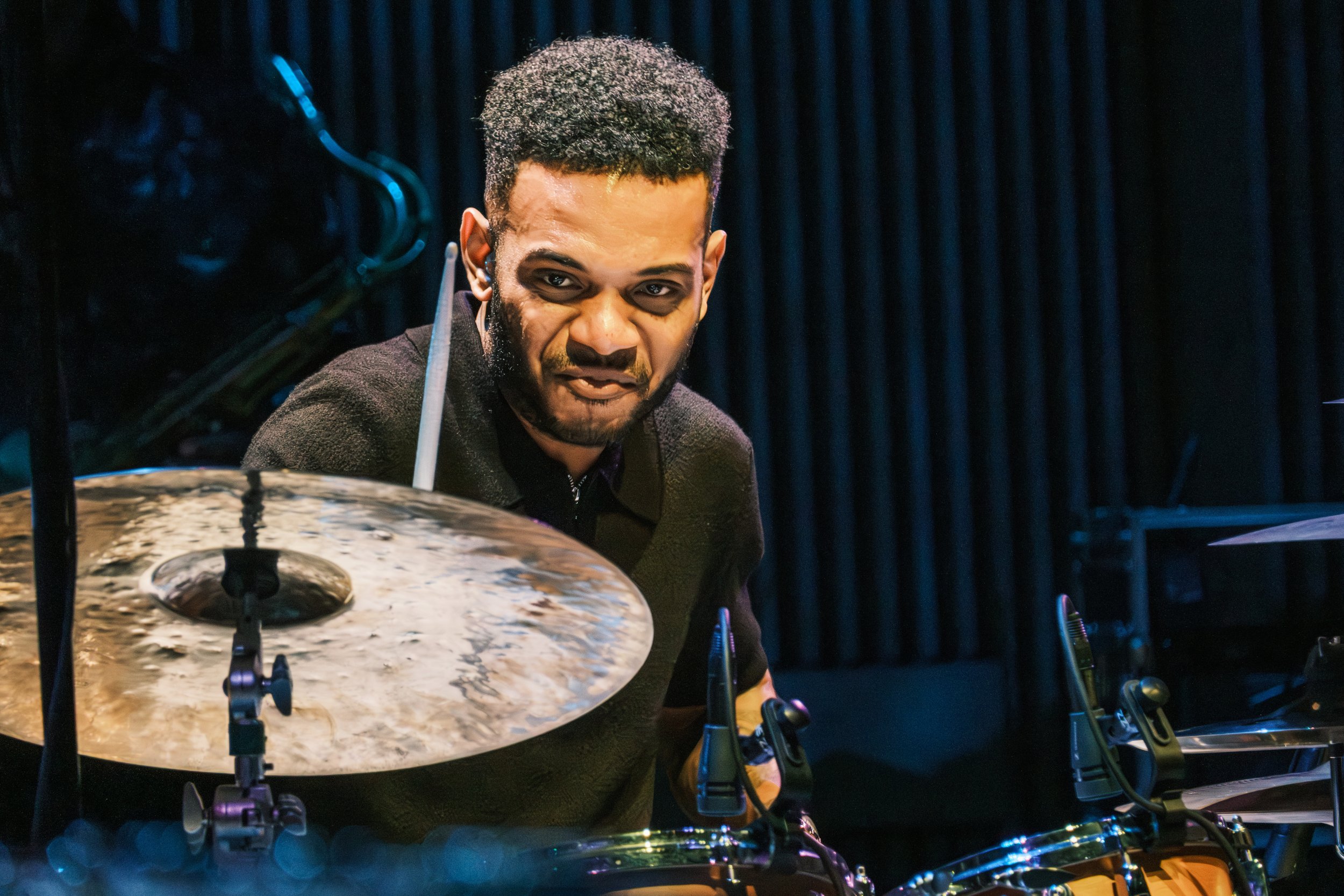
Mark Whitfield Jr. Photo: Steve Roby
The set’s most striking passage was the mash-up. “Someday My Prince Will Come” folded into “All Blues” and then into “Teo,” the transitions so smooth the seams disappeared—each piece surfacing from within the previous one rather than following it. Altura moved through arpeggios with an ease that made the harmonic complexity feel inevitable. When the audience caught the opening of “Someday,” there was an audible stir of recognition across the hall.
Then came the drum solo. Close-up footage of Mark Whitfield Jr. appeared on the back screen: lips pursed tight, drumsticks a blur in front of his face, concentration so complete the camera could barely hold it. Oren shook his head. When the solo dissolved into lighter cymbals, piano and bass and guitar followed the temperature down, and the medley found its way home.
“Two Bass Hit” closed the main set at its most insistent. Ravi crouched and rocked back and forth as the drums crashed without pause, then retreated toward the stage door as Blanchard crept forward to take his place. Blanchard pressed the effects pedal for a two-horn effect—a simulated conversation with himself—then took a small, involuntary hop after landing a particularly high note, as if surprised by where the music had taken him. The audience rose.
A Show That Owed More Than It Paid
For the encore, the visuals shifted into something stranger: swirling spacecraft, a vast control room full of upward-facing figures, buildings with “Liberation” inscribed across their entryways, figures in metallic space suits crossing otherworldly terrain. Whatever the centennial imagery had been—dignified archival portraits, the vintage album covers, those historical posters—was gone.
The encore was “Benny’s Tune,” written by guitarist Lionel Loueke and drawn again from Blanchard’s Flow album. The horns joined, intensity rising, as Blanchard pushed his trumpet toward the ground one last time while Ravi crouched beside him. Then all six musicians found a landing together—clean, deliberate, unhurried. The crowd roared.
It was a beautiful ending. It was also, given the billing, a slightly strange one.
Before the encore, Blanchard had told the crowd: “We have this project we’re going to do, Flow Revisited, and one of the tunes we want to play for you right now is from that album. It’s become a bit of a classic amongst the younger musicians. They all love playing this tune, and we never get a chance to play it, so we’re going to play it for you right now.” The sci-fi visuals weren’t for Miles or Coltrane. They were for whatever comes next for Terence Blanchard.
This matters because during the sold-out two-hour show, neither Miles Davis nor John Coltrane was mentioned. They were called “they.” Blanchard handled all the between-song commentary; Ravi, who sat on a stool while Blanchard spoke, never took the microphone. A few words from the man who actually carries the Coltrane name—who bears the weight of it every night he plays—would have added something the evening badly needed.
Opening and closing with his own compositions was an odd choice for a show billed as a centennial celebration of someone else’s legacy. The performances within the frame were often excellent. The music was largely honest and alive. But the evening’s architecture belonged to Blanchard in ways the billing didn’t fully prepare audiences for. The centennial was the occasion. It might have been given a little more of the stage.
Program Notes
May 31, 2026 · Robert N. Miner Auditorium · 7:00 p.m.
Personnel: Terence Blanchard, trumpet; Ravi Coltrane, saxophone; Charles Altura, guitar; Tom Oren, piano/keyboards/synth; Alex Smith, bass; Mark Whitfield Jr., drums
Setlist: “Flow” · “Flamenco Sketches” · “On Green Dolphin Street” · “All of You” · Medley: “Someday My Prince Will Come” / “All Blues” / “Teo” · “Two Bass Hit”
Encore: “Benny’s Tune”