At SFJAZZ, Miles Stayed in Motion
The final night of SFJAZZ’s Miles Davis centennial celebration featured the Miles Electric Band at Miner Auditorium, but the concert also conveyed a deeper message. Over four nights curated by Vince Wilburn Jr. and focused by Keyon Harrold’s musician’s-eye view, the series showcased Miles Davis as an artist continually evolving toward new sounds. (Listen to an interview with Vince Wilburn Jr. at the end of this article.)

Keyon Harrold. Photo: Steve Roby
By the time the Miles Electric Band took the stage on Sunday night, SFJAZZ’s Miles Davis centennial celebration had already covered quite a bit of ground. Thursday reopened Doo-Bop with a panel discussion about Miles’s late interest in hip-hop. Friday focused on the Miles Davis–Gil Evans partnership through chamber-sized arrangements. Saturday highlighted Kind of Blue and the acoustic language that revolutionized modern jazz. Sunday increased the energy. The stage filled with keyboards, percussion, electric bass, guitar, reeds, turntables, trumpet, and drums. Miner Auditorium felt less like a memorial hall and more like a busy workshop.
That feeling of movement proved to be the key throughout the whole week.
The four programs came from different eras, with distinct ensembles and sonic priorities, but they shared the same drive. Miles Davis kept listening to where music was headed. Vince Wilburn Jr., Miles’s nephew, former bandmate, and the mastermind behind the four-night series, discussed that instinct with the ease of someone who had seen it firsthand. “He never looked back,” Wilburn said in our recent interview. “He was always looking forward, looking towards what the next project would be.”
That line gave the series its shape. It also explained why the final concert mattered so much.
A week built to widen the picture

Antoine Roney. Photo: Steve Roby
Wilburn said the SFJAZZ centennial series was planned over the course of a year. He aimed for the week to do more than just revisit the most famous parts of Miles’s career. While he had organized related multi-night Miles programs before, this centennial edition allowed him to draw a clearer line, from Doo-Bop to Gil Evans, from Kind of Blue to the electric years. Choosing to open with Doo-Bop was especially significant. Wilburn has long believed that listeners underestimate how closely Miles was following hip-hop in his final years, and he wanted the series to start with that progressive perspective.
The sequence also reflected something Miles himself valued: range. Wilburn described his uncle as someone who brought together musicians, artists, and ideas from different worlds, then let them add their own touch to the room. That habit appeared in the series design. Each night focused on a different chapter, and each chapter attracted a slightly different audience. The week never settled into one idea of what “Miles Davis music” was supposed to be.
“I hope they hear the progression of where Uncle Miles was going,” Wilburn said. “The common denominator was Uncle Miles.”
That became the most useful way to hear the final concert. The Miles Electric Band did not appear as a break from the rest of the week. It appeared as the closing proof that Miles’s music had always depended on movement.
Sunday night turned the current on

Rasaki Aladokun. Photo: Steve Roby
Night 4 featured a multi-generational group at Miner Auditorium: Wilburn on drums, Robert Irving III on piano and keyboards, Keyon Harrold on trumpet, Darryl Jones on bass, Jean-Paul Bourelly on guitar, Antoine Roney on reeds, Greg Spero on keyboards, DJ Logic at the turntables, and percussionists Munyungo Jackson and Rasaki Aladokun. Several of these musicians had direct ties to Miles’s later bands, while others came from worlds that Miles would have understood immediately. The lineup itself told the story.
The concert's physical experience stemmed from that setup. The electric Miles repertoire demanded density, pressure, groove, and the ability to keep multiple rhythmic and harmonic streams flowing simultaneously. The band responded with a sound that remained energized throughout the set. Wilburn and the percussionists kept the dance floor lively. Jones provided a grounded center to the music. Irving served as a connective force, shaping the band from within the keyboards. DJ Logic added another layer of attack and texture without turning the concert into a gimmick. Bourelly brought bite to the guitar role. Harrold led from the front, carrying the trumpet role with a strong sense of line and placement.
That role required unusual discipline. Harrold had already spent the week switching between very different Miles’s vocabularies. In an email interview, he described the Gil Evans material as “a lyrical expression,” music that demands melodic control over broad harmonic landscapes. The electric repertoire calls for a different skill set. “It is not acoustic, so you have to be able to stand against the other instruments, as there are so many things happening,” he said. “Your chops have to hold up over the length of a set.”
That description made Sunday’s concert easier to understand. The challenge wasn’t just volume. It was about finding clarity within a crowded space. Miles’s electric bands always needed that balance. A trumpeter had to project through the band while sounding intentional, clear, and personal. Harrold achieved this by not crowding his phrases. He kept his sound pointed and human, even as the ensemble around him was dense with keyboards, percussion, and rhythm.
Keyon Harrold as a bridge figure
Keyon Harrold. Photo: Steve Roby
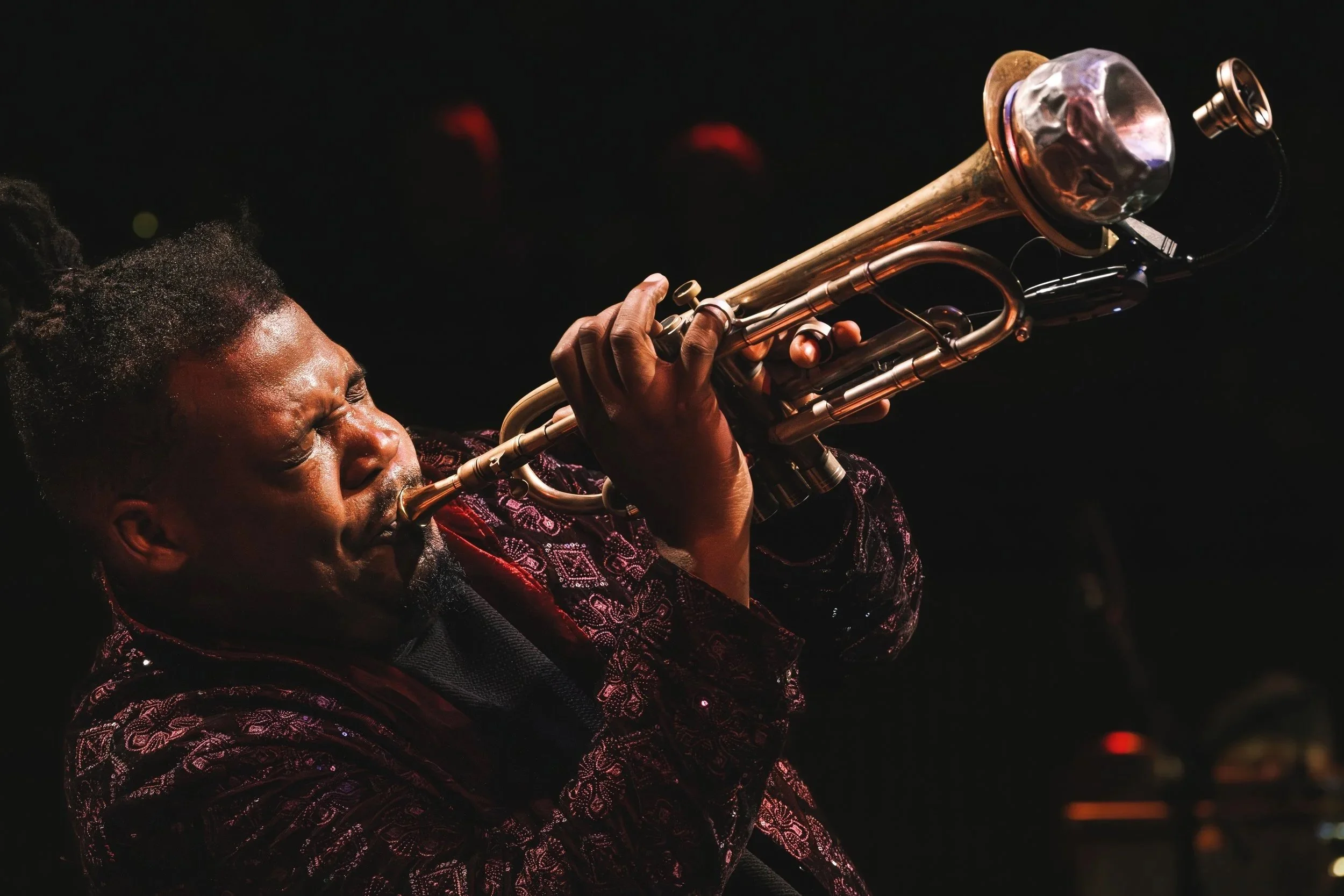
Harrold proved especially valuable to the series because he could bridge the week’s internal contrasts. He had one foot in the orchestral world of the Gil Evans material and the other in the electric world that concluded the series. His comments made clear that he did not see those programs as opposing camps. He perceived them as distinct terrains that required the same level of artistic focus.
“What I’m most responsible for honoring is his energy—his spirit, his soul, his melodicism, his note inflections,” Harrold said. That answer cut through a familiar trap in Miles tributes. The work did not depend on copying the surface of Miles’s phrasing. It depended on understanding the emotional and rhythmic intelligence inside it.
Harrold also spoke with unusual clarity about why Miles continues to connect with younger players and listeners. He highlighted Miles’s talent for storytelling in a single phrase: the way a note could land with emotional impact, depending on its place in the harmony and how it was played. He also challenged the idea that Miles’s economy was a form of simplicity. The sparseness was a deliberate design. The note choices added drama.
Most of all, Harrold kept returning to Miles’s future tense. “Miles was always living in the future,” he wrote.
That line sat beautifully alongside Wilburn’s memory of living with Miles in Malibu during the 1980s. Wilburn remembered MTV on with the sound muted, Miles turning up whatever caught his ear, the trumpet and piano nearby, records and tapes close at hand. He was always scanning. He was always testing.
More than a tribute format

Jean-Paul Bourell. Photo: Steve Roby
Wilburn was especially insightful when discussing audience reactions to Night 4. Older listeners told him they valued hearing the band interpret this iconic electric era while “putting your own spice to it.” That feedback mattered to him because it confirmed the band's main goal. “We are definitely not a tribute band,” he said profoundly.
That statement gave the final night its greatest energy. The Miles Electric Band was performing music connected to one of the most legendary figures in jazz. The musicians onstage knew that legacy well. They also knew that music quickly loses its life if it’s seen as a fixed thing. Wilburn wanted the band to guide the audience through their own path with the material.
He said the same ethic shaped Miles’s own bandleading. “When Uncle Miles calls any musician, you have to be ready,” Wilburn recalled. The point went beyond just technical readiness. Miles picked players who could respond to metaphor, to feeling, to movement, to an opening in the music that hadn't fully revealed itself yet. That lesson carried through the Sunday band as well. Each player had a specific role, but the bigger goal was collective: keep the music alive.
The final night was split into two levels. It delivered the intensity and vibrancy audiences expected from electric Miles. It also highlighted the entire week. Thursday showed Miles listening to hip-hop before many jazz institutions gave it serious consideration. Friday depicted him as a collaborator in color and form. Saturday revealed the acoustic grammar that influenced much of the music that followed. Sunday saw all that energy burst open publicly.
Wilburn’s closing insight may have said it best: “The music was first, and the evolution of the music was always his compass.”
That was the achievement of SFJAZZ’s centennial week. It showcased four very different Miles Davis worlds side by side and demonstrated how the same principle ran through them all. Miles stayed in motion.

Vince Wilburn Jr. with Keyon Harrold. Photo: Steve Roby
Listen to an interview with Vince Wilburn Jr. on the Miles Davis Concert Series at SFJAZZ.
Program Notes
Event: Miles Davis’s Bitches Brew To Tutu
Artist: Miles Electric Band (MEB)
Date: Sunday, March 22, 2026
Showtime: 7:00 p.m.
Venue: Miner Auditorium, SFJAZZ Center
Personnel
Keyon Harrold: trumpet
Darryl Jones: bass
Jason "DJ Logic" Kibler: DJ
Jean-Paul Bourelly: guitar and vocals
Greg Spero: keyboards
Robert Irving III: piano, keyboards, music director
Munyungo Jackson: percussion
Rasaki Aladokun: percussion
Antoine Roney: reeds
Vince Wilburn Jr.: drums, artistic director
Setlist: Medley: “Jack Johnson/Speak” (A Tribute to Jack Johnson/Star People); “It Gets Better” (Star People); Medley: “In A Silent Way/It’s About That Time” (In a Silent Way); “Selim” (Live-Evil); Piano Medley: “Seven Steps To Heaven/Blue In Green” (Seven Steps to Heaven/Kind of Blue); “Nefertiti” (Nefertiti); “Decoy” (Decoy); Medley: “Time After Time/Human Nature” (You’re Under Arrest); “Footprints” (Miles Smiles); “Pharaoh’s Dance” (Bitches Brew)
Listen to our interviews with Javon Jackson, Eddie Henderson, and Lennny White here.