Inside Elipsis at Soundcheck: Rhythm, Trust, and Preparation
At a public SFJAZZ soundcheck, Michael League and Elipsis revealed how shared leadership, deep-rooted rhythm, and collective listening shaped the music audiences would hear that evening.

Pedrito Martínez. © Steve Roby
At 4:30 p.m., the doors to Miner Auditorium opened quietly. About fifty people entered the hall, and the room was already filled with dense, percussive, and alert sound. Elipsis was mid-soundcheck. Congas spoke in layered voices. The drum kit answered. Voices hovered, then settled into place. The audience stepped into a working moment rather than a presentation.
SFJAZZ’s unique Open Soundcheck series offers the public a view into preparation, and this afternoon made that purpose tangible. Onstage, Michael League, Pedrito Martínez, Antonio Sánchez, and Glenda del E used the time to refine structure, transitions, and cues. The emphasis stayed on how the music would move later that night, not on surface polish.
League addressed the room early, framing the session as a shared roadmap. Elipsis, he explained, operated without a single leader. “There isn’t one person in charge of this band,” he said. “Everybody has an equal say in the material and the arrangements.” The soundcheck aligned the group on how to begin and end pieces, when to look for visual cues, and how to navigate moments guided by feeling.
That collaborative ethic defined the music itself. Elipsis formed through improvisation before composition. Sánchez traced the project’s beginnings to New York, before the pandemic, when the musicians gathered without prepared material. “Nobody really brought anything,” he said. “We just started making stuff along in real time.” Those sessions led to an almost fully improvised performance at the North Sea Jazz Festival, followed by a gradual shift toward shaped pieces.
By the time the group entered Miner Auditorium, the music carried form and intention. The setlist drew from Elipsis, the six-song album released earlier this month on GroundUP Music. Each piece reflected how it came together: rhythm first, structure discovered, melody shaped through listening.
Martínez’s setup dominated the visual field. Five conga drums surrounded him, including the traditional trio of tumba, conga, and quinto. The tumba supplied the bass foundation. The conga carried the central pulse. The quinto traced higher, improvisational lines. Together, the drums produced a full spectrum of tones rooted in Afro-Cuban tradition.
Behind and slightly to the side, Sánchez’s drum kit offered contrast rather than competition. His playing emphasized articulation and clarity, supporting the rhythmic architecture. League shifted between guitar and bass, listening closely and watching for cues. Del E moved between keyboards, synthesizers, bass keyboard, and voice, occupying a flexible role that allowed the music to open and contract.
During the soundcheck, the band skipped solos and focused on form. Endings received careful attention. Eye contact replaced verbal direction. League described the process as preparation for collective navigation. “The soundcheck is basically a roadmap,” he said, “for how we’re going to present the music live.”
The formation of Elipsis reflected that approach. The project began as a trio, with League covering bass and harmony across instruments. Limitations emerged once recording began. The music required a musician who could sing, play, and navigate the Cuban musical language fluently. Del E entered the picture through that need. “We needed someone who could play the Cuban music and sing,” League said. “The list is pretty short.” Del E described the invitation simply. “When Mike asked me, Tony, and Pedrito, I said, ‘Okay, let’s do it,’” she said.

Glenda del E and Michael League. Photo: © Steve Roby
The album itself emerged through an unconventional process. Sánchez and Martínez recorded two days of free improvisation in a New York studio during the pandemic, exploring different tempos and keys. League, working from Spain, received the recordings and built compositions around them.
“It was really weird, but really fun,” League said. “Normally, you write first and then record. In this case, we recorded first and then wrote.” Martínez recalled seeing the finished material arrive. “When Mike sent everything back to us,” he said, “with bass, keyboard, everything—it was crazy.”
Audience questions guided the latter part of the session. When asked about solo length and structure, League emphasized instinct and shared listening. “We’re not counting bars,” he said. “We’re feeling where things want to go.”
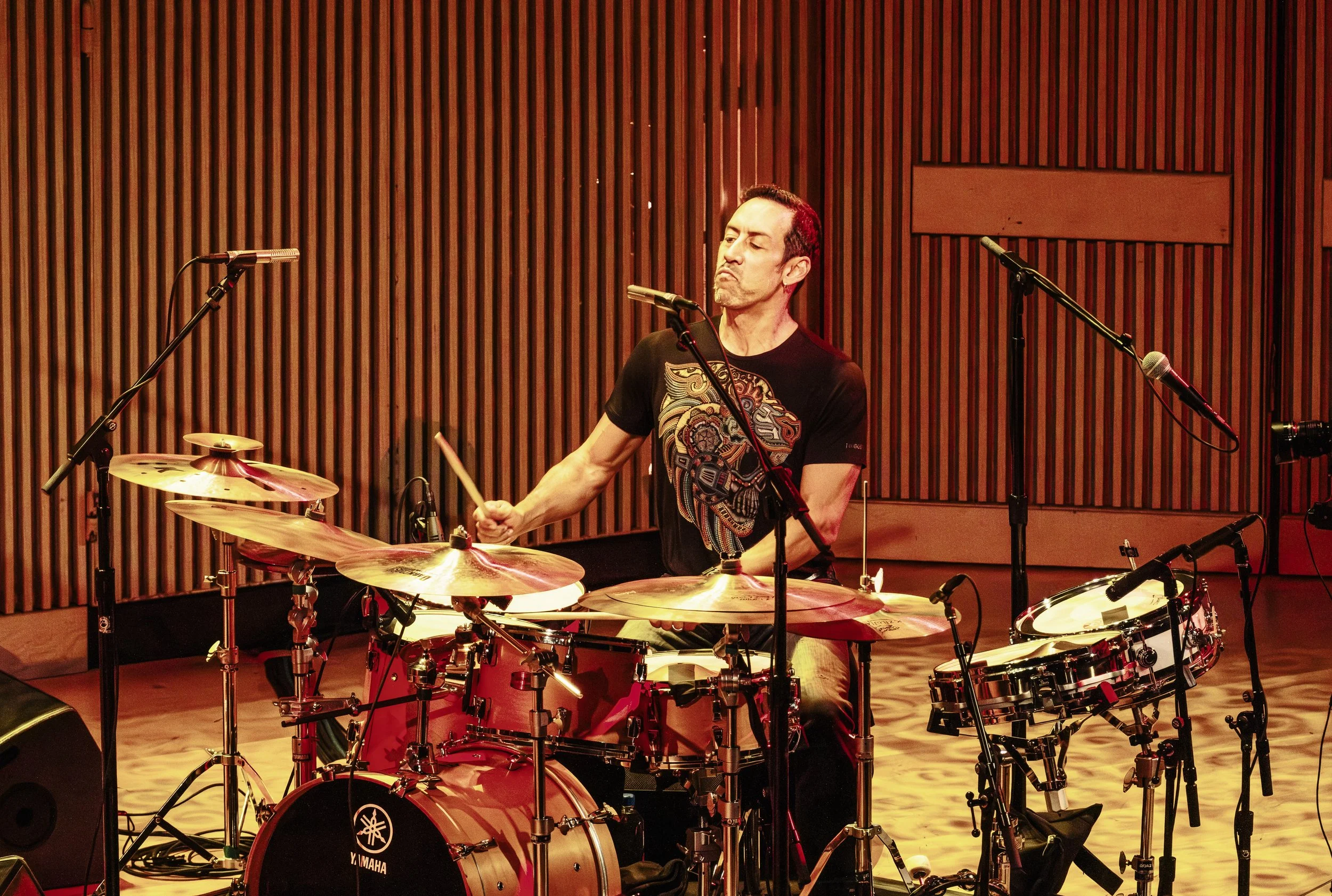
Antonio Sánchez. Photo: ©Steve Roby
As the soundcheck ended, the audience gained a clear sense of what the evening concert would reveal. Elipsis would present the album in condensed form, shaped for four musicians rather than layered studio overdubs. Songs would move through ritual rhythm, chant, improvisation, and collective release.
When the musicians stepped away from the stage, the room carried anticipation grounded in understanding. The evening performance at Miner Auditorium would arrive with context, intention, and shared awareness.