Elipsis Opens Michael League’s SFJAZZ Residency
Michael League launched his SFJAZZ residency with Elipsis, a project rooted in Afro-Cuban rhythms, collective authorship, and a forward-moving tradition.

Elipsis. ©Steve Roby
Michael League opened his four-night artistic residency at SFJAZZ by placing tradition at the center of forward motion. The debut San Francisco performance of Elipsis at Miner Auditorium was both a celebration and a declaration: a release-week concert for a new project and a statement about how deeply rooted music continues to evolve.
The band—League on guitar, bass, and background vocals; Pedrito Martínez on congas, bàtá drums, and lead vocals; Antonio Sánchez on drums; and Glenda del E on keyboards, synths, bass keyboard, and background vocals—presented material from their new self-titled album, Elipsis, with clarity and force. The title, a truncated form of “ellipsis,” made its meaning clear. Three dots signaled continuation. This music carried the lineage forward.
League framed the moment early. “It’s such an honor to be in one of the most iconic venues in San Francisco,” he told the audience, calling the night an unofficial album release party for a record that had arrived just a week earlier. He described Elipsis as a democratic band, then smiled and added context. This evening marked the first night of his SFJAZZ residency, and it felt right to begin by introducing a project built on collective authorship.
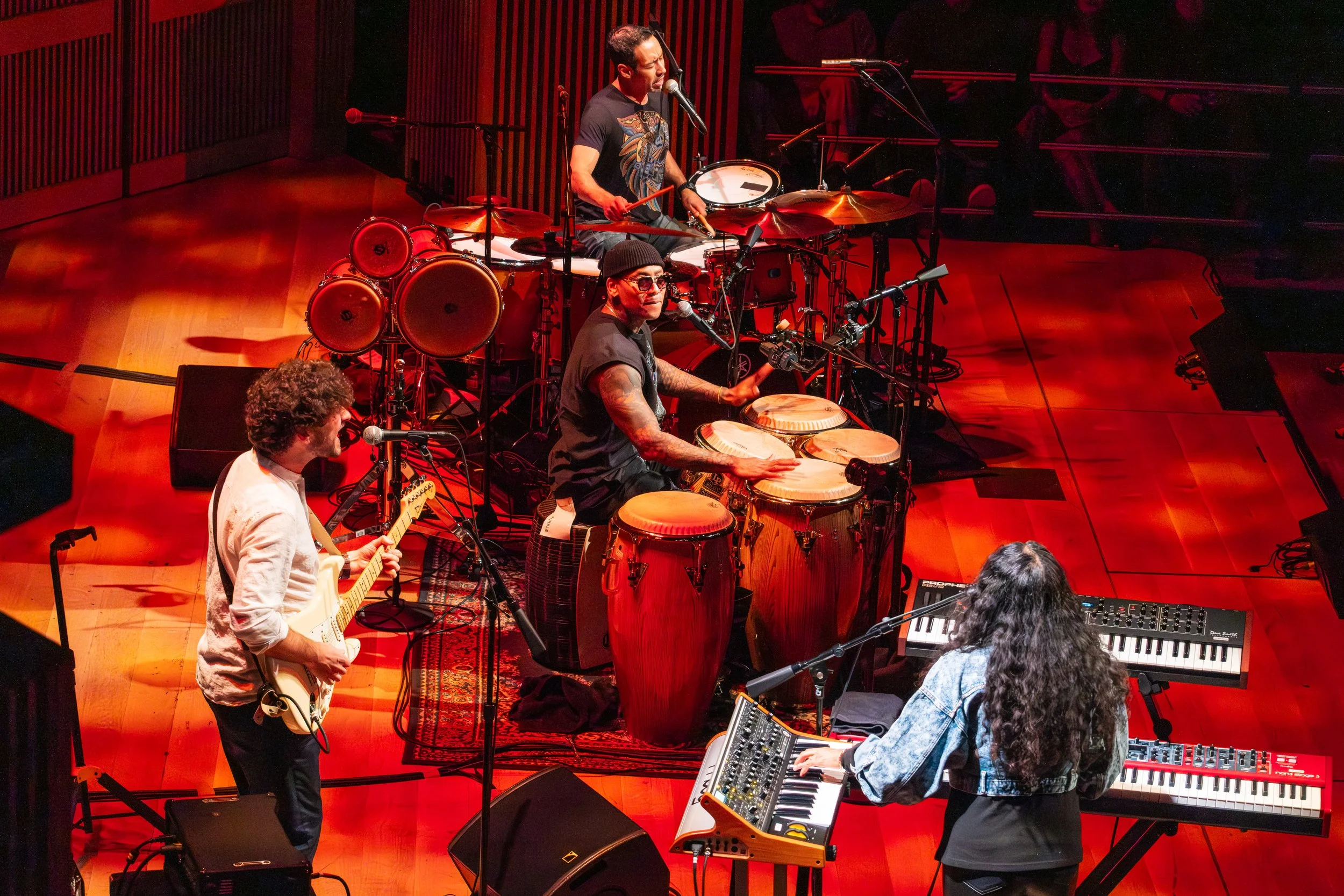
The stage layout embodied that ethos while telling its own story. Martínez stood at the center, surrounded by five congas and three bàtá drums, handling lead vocals and rhythmic direction. League remained partially obscured behind del E’s three-keyboard setup, stepping forward only for select guitar statements, contributing background vocals, and shifting to bass as needed. Sánchez anchored the backline with a kit augmented by additional snare drums, his presence felt as much through restraint as through fire.
The ninety-minute set opened with “Congo No Calla,” which established the ensemble’s rhythmic architecture. Martínez and Sánchez interlocked patterns that breathed and pivoted, creating motion without urgency. The groove carried weight while remaining agile, a hallmark of the band’s sound. From the outset, the music invited equal measures of movement and attention.

Antonio Sánchez. Photo: Steve Roby
“Caminando” expanded on that invitation. A chanting choir repeated a short phrase over a deep, driving bass line, while overlapping percussion patterns stacked and released. Del E’s keyboard work added a fusion-inflected sheen to the texture, coloring the music with harmonic brightness. In concert, the piece stretched far beyond its album length, evolving into a jam that blended Afro-funk, cha-cha, prog-rock contours, and Yoruba chant into a single, continuous arc.
Midway through the set, Sánchez delivered a six-minute drum solo that reset the room’s energy. Beginning with mallets on the floor toms, he shaped an eerie, melodic atmosphere before building density and velocity across the full kit. The solo unfolded as a composition rather than a display, moving through tension and release before resolving back into the ensemble space.
“Mi Tambor” leaned furthest into prog-rock territory, with del E prominent on synth. The tune underscored her central role in making the album playable onstage. League explained that Elipsis began as a trio project, built on improvisations recorded by Martínez and Sánchez during the pandemic. Those sessions, filled with stacked Yoruba vocal chants and free rhythmic exploration, arrived in League’s studio as two days of raw material.
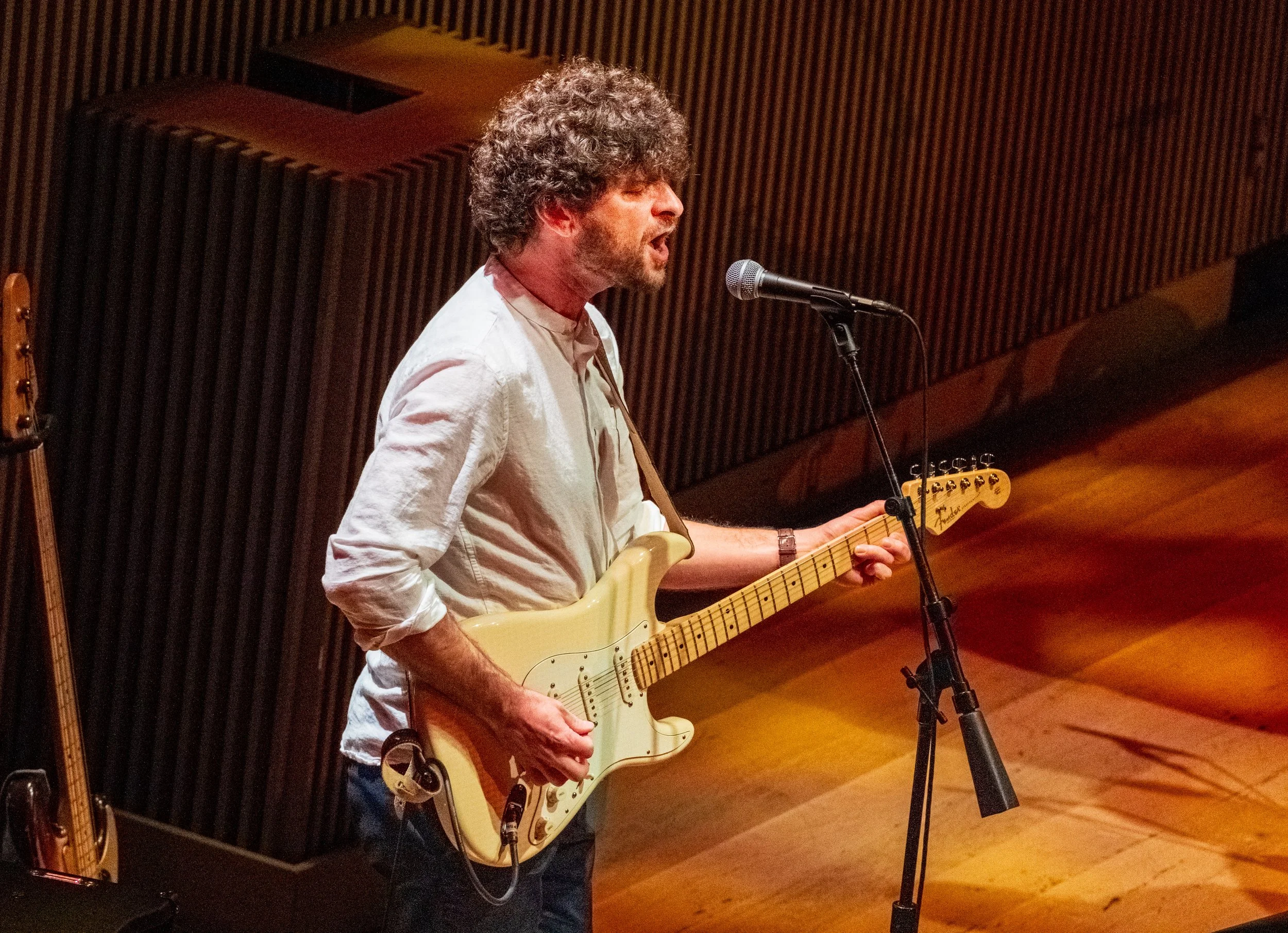
Michael League. Photo: © Steve Roby
“I kind of did my best to pretend I’m Cuban,” League joked, describing how he shaped the recordings into songs by cutting, repeating, harmonizing, and adding bass, guitar, and keyboards. When the question of live performance came up, the solution came quickly. “Who can sing Yoruba stuff, play Cuban music on keyboards, play bass and piano parts at the same time, and live in this modern, experimental sonic world?” he asked. “The list had one person on it.” He gestured toward del E, drawing laughter and applause as he praised her workload and musical command.
The project’s cultural roots surfaced most explicitly during “Suuru.” Before the song, Martínez explained the lineage of the bàtá drums, tracing their path from Yoruba culture in West Africa through the African diaspora to Cuba. He demonstrated how the tumba, conga, and quinto traditionally function as separate voices, then showed how he performed them together. “It’s hard,” he said with a grin, “but I’m doing my best to make it sound good.” The audience responded with warmth as the song’s meaning—“patient” in a Yoruba dialect—settled into the room.
Throughout the night, League returned to gratitude, both for the venue and the moment. He emphasized the importance of organizations like SFJAZZ in an era of rapid technological change, praising the institution for supporting live music and musicians. He also framed the Elipsis concert as the right way to begin the residency.
The set closed with “Variant,” a piece composed in seven that moved with ease and authority. Deep roots made the meter feel natural, even danceable. The encore carried the same spirit, and the band invited the audience to meet them afterward, transforming the performance into an exchange.
Elipsis succeeded by treating tradition as living material. The music honored Yoruba culture, Afro-Cuban rhythms, jazz improvisation, and modern composition, allowing each to breathe and transform. As the first chapter of Michael League’s SFJAZZ residency, the concert set a tone of command, curiosity, and forward motion.
Three dots followed by sound.
Program Notes
Elipsis
Date: January 29, 2026
Showtime: 7:30 p.m.
Venue: Miner Auditorium, San Francisco
Setlist: “Congo No Calla,” “Caminado,” “Suuru,” drum solo by Antonio Sánchez, “Obbakoso,” “Mi Tambor,” “Variant”
Photos: Steve Roby
Read our feature article about Michael League’s residency at SFJAZZ.