Michael League: A Prism of Sound at SFJAZZ
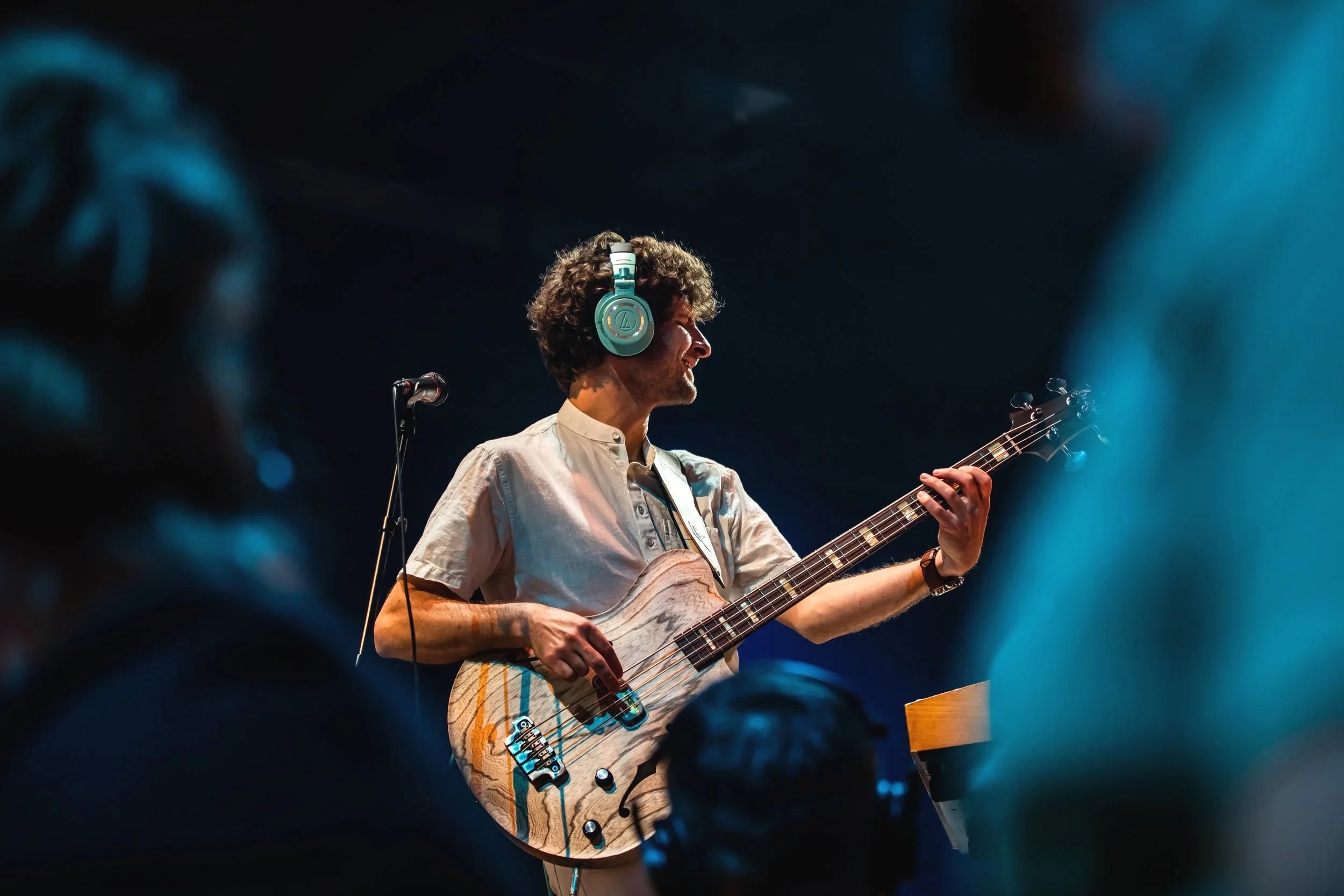
Michael League. Photo courtesy of SFJAZZ
The Snarky Puppy founder redefines the bandleader archetype during a residency defined by radical versatility, global collaboration, and a curator’s ear for contrast.
See the full show details and ticket information at the end of this feature. Listen to the full conversation with Michael League below.
Michael League occupies a distinctive place in the modern musical landscape, balancing the gravitational pull of a massive fanbase with the instincts of a sonic explorer. Best known as the bassist and architect of Snarky Puppy—the ensemble that redefined instrumental fusion for a YouTube generation—League has long worked through a wider aperture. Now based in Catalonia, Spain, the five-time Grammy winner increasingly frames his practice around facilitation: assembling contexts, collaborators, and conditions that allow music to unfold in unexpected ways.
That philosophy comes into focus next week, as League serves as Resident Artistic Director at the SFJAZZ Center, presenting a four-night run from January 29 through February 1 that functions as a refracted self-portrait. The residency presents his musical life in contrasting shards—intimate duos, rhythm-driven experiments, chamber ensembles, and groove-based trios—inviting listeners to trace the connective tissue for themselves.
Roots: The Myth of the Single Identity
The music industry slots artists into easily recognizable brands. League argues for a broader view of creative life, one that reflects the range most musicians develop over years of work. He sees artistic identity as layered and evolving rather than singular.
Even as Snarky Puppy’s profile expanded internationally, League maintained parallel paths: playing in Dallas jazz clubs, producing records for pop vocalists, performing as a sideman, and studying folkloric traditions. These pursuits rarely surfaced in the dominant narrative of his career. This residency gives them presence. For League, the curatorial frame offers a way to present music as an ecosystem—one that reveals how musicians grow through stylistic overlap, cultural exchange, and long-term curiosity.
Demolishing the Fourth Wall
“I really like the idea of challenging listeners to open themselves up to the fact that musicians do a lot more than the one thing they’re known for. And I think this residency format allows the opportunity to show the diversity of things I’m interested in”
The week opens with a listening party; a format League values for its immediacy. He often describes performance culture using the metaphor of a proscenium, with the stage elevated both physically and psychologically above the audience. Expectations of expertise and spectacle follow.
The listening party dissolves that architecture from the outset. League uses the setting to speak openly about process, influences, and missteps, placing composition and recording in a human context. He wants audiences to encounter the work as the result of decisions, accidents, and collaborations. That philosophy shapes the entire residency, positioning each performance as a shared investigation rather than a one-directional display.
A Record as Reverse Engineering
Wednesday night features Ellipsis, a project that reverses the standard songwriting architecture. The collaboration with drummer Antonio Sánchez and percussionist-vocalist Pedrito Martinez began during the pandemic, with League in Spain and his collaborators in New York. Instead of starting with compositions, Sánchez and Martinez engaged in days of free improvisation over tempos, without harmonic frameworks. Martinez layered spontaneous vocals over dense beds of percussion. League received sprawling, ritualistic sound files—rhythm in its rawest form.
From there, he shaped the structure. He cut, rearranged, and organized the material, then composed harmonic movement beneath what already existed. On tracks such as “Obbakoso,” the effect is immediate. Groove becomes the foundation, with melody and harmony emerging from within it. The music carries the feeling of excavation, closer to future folklore than to fusion as it is usually heard.
The method reverses conventional production logic. Instead of musicians responding to compositions, the compositions respond to musicians. Presented live, Ellipsis becomes a demonstration of trust—an argument for rhythm as narrative and for collaboration as a compositional force. That same openness to process shapes the broader architecture of the residency itself.
“We have musicians from Mexico, Cuba, Turkey, Macedonia, Brooklyn, North Carolina, and the UK. Just that alone is an important and powerful statement right now—showing how vital foreign musicians are to the health of the United States’ musical culture.”
Collaboration as Cultural Necessity
League’s curatorial vision comes fully into focus through the roster he has assembled for the week. The lineup reads like a geographic map as much as a musical one, bringing together artists from Mexico, Cuba, Turkey, Macedonia, the UK, and across the United States. For League, this internationalism reflects how American music actually functions. He views immigrant musicians and musicians of color as foundational to the country’s cultural infrastructure.
The residency underscores that reality. The contrasts onstage—from Balkan chamber textures to gospel-inflected groove—demonstrate how music evolves through movement, exchange, and the friction of difference. These collaborations register as evidence of a shared, living continuum.
Miner Auditorium as Tasting Menu
League has shaped the four nights with the mindset of a chef designing a tasting menu. Each evening reveals a different facet of the same sensibility, leaving audiences inspired and satisfied. Miner Auditorium’s acoustics support a wide expressive range, allowing League to pivot between delicate duo interplay and dense, rhythm-forward ensembles.
After Wednesday’s Ellipsis debut, Thursday features an intimate duo with longtime collaborator Bill Laurance, foregrounding texture, harmony, and conversational interplay. Friday expands outward with vocalist Becca Stevens and The Secret Trio, a Balkan chamber ensemble that fuses microtonal modes with dance-floor propulsion. Saturday closes the arc with a trio featuring Cory Henry and drummer Nathaniel Townsley, grounding the residency in groove, virtuosity, and open-ended exchange.
Surprise is the connective thread. League points to the distance between the hushed acoustic textures of the duo set and the psychedelic density of Ellipsis as emblematic of what excites him now. Looking ahead, he increasingly imagines himself as a musical facilitator—stepping in where needed and shaping environments where others can thrive.
At SFJAZZ, that vision arrives fully formed: four nights of music as conversation, identity as plural, and the stage as a place where boundaries keep blurring.
TICKET INFO
SFJAZZ Resident Artistic Director
Michael League of Snarky Puppy
WED-SUN, Jan. 28-Feb. 1
Miner Auditorium
Snarky Puppy Bandleader Presents Four Exciting Projects!
Michael League, a Grammy-winning bassist, bandleader, and producer best known for leading Snarky Puppy, masterfully blends jazz, funk, and global grooves. As an SFJAZZ Resident Artistic Director, his upcoming concert series begins with Elipsis, featuring drum virtuoso Antonio Sánchez, Cuban percussionist Pedrito Martinez, and pianist-vocalist Glenda del E (Jan. 29). The residency continues with pianist Bill Laurance (Jan. 30), followed by jazz-folk innovator Becca Stevens and The Secret Trio (Jan. 31), and concludes with pianist-organist Cory Henry and drummer Nathaniel Townsley (Feb. 1).
Jan 28 Listening Party w/ Michael League
Jan 29 Elipsis w/ Michael League, Antonio Sánchez, Pedrito Martinez, & Glenda del E
Jan 30 Michael League & Bill Laurance
Jan 31 Becca Stevens, Michael League & The Secret Trio
Feb 1 Michael League, Cory Henry, Nathaniel Townsley
— Sold Out!
Tickets and info can be found at:https://www.sfjazz.org