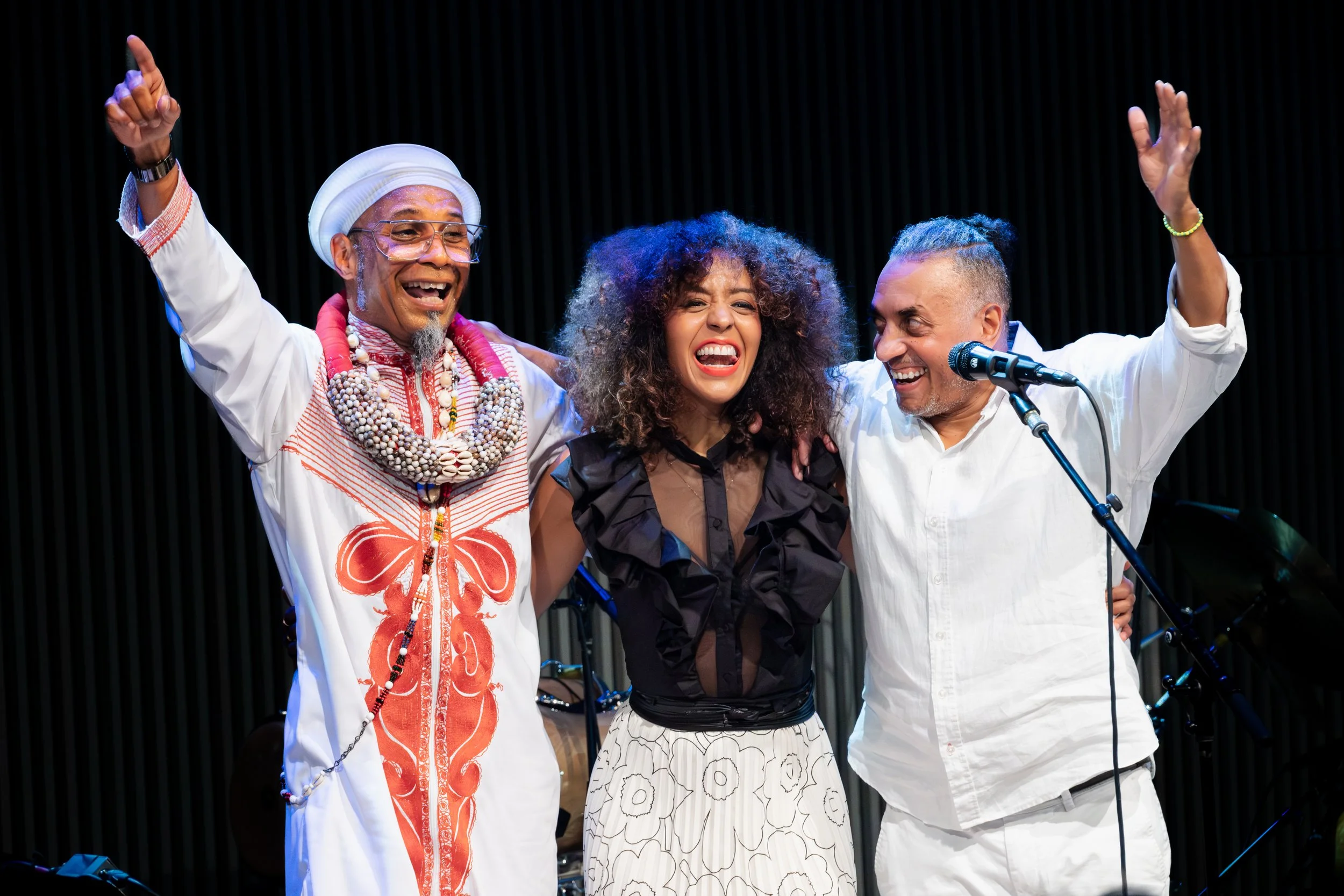
At the center of Omar Sosa’s four-night residency at SFJAZZ, the Aguas Trio transforms Miner Auditorium into a ceremonial space where water, rhythm, and improvisation converge in a shared spiritual experience.
Soundcheck: Preparing the Ritual
The hall is quiet during the afternoon soundcheck. Omar Sosa sits at the grand piano in Miner Auditorium; a synthesizer stacked above the instrument like a second voice waiting to join the conversation. He tests a tone, listens to how it travels through the room, then reaches inside the piano to touch the strings. The sound is gentle but deliberate. Each adjustment feels like preparation for something more than just rehearsal. A benediction.
During the hiatus, Sosa and Cañizares film a music video for "Mañana Libre en San Francisco" (“Free Morning in San Francisco”) in a single, unedited take. The performance serves as a specialized production for SFJAZZ’s digital platform, capturing the violin’s gentle texture against the piano’s rhythmic gravity.
Hours remain before the audience arrives, yet the atmosphere already feels ceremonial. The instruments are arranged thoughtfully. A violin rests near the microphone stand. Percussion instruments form a small cluster around Gustavo Ovalles. The room breathes slowly, as if expecting the ritual that will take place later that evening.
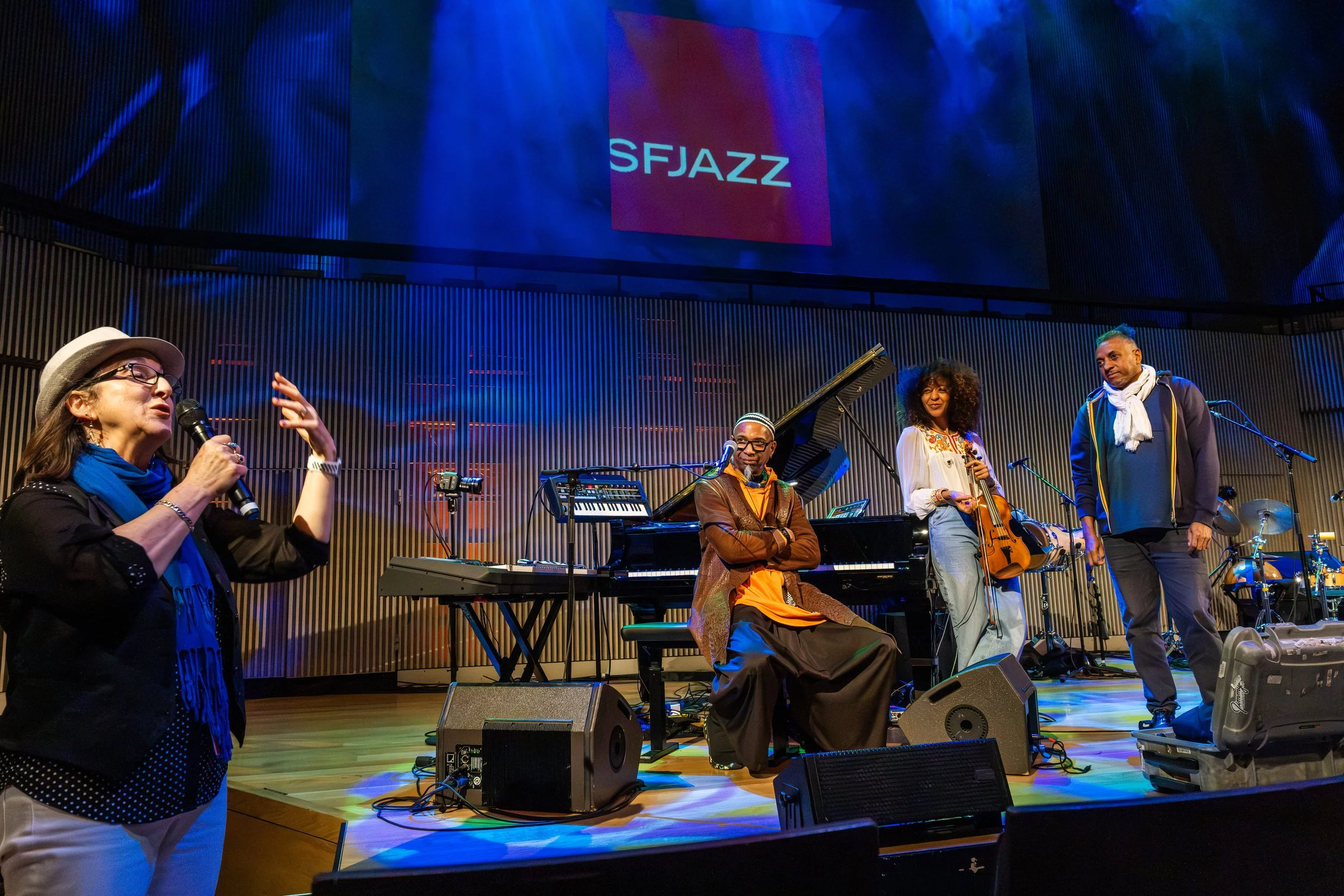
SFJAZZ’s Rebeca Mauleón fields questions from the audience. Photo: Steve Roby
Earlier in the afternoon, a small group gathers inside the auditorium for a soundcheck discussion moderated by SFJAZZ educator Rebeca Mauleón. The atmosphere feels informal—part rehearsal, part seminar. Musicians stand near their instruments while questions flow easily between the stage and the seats.
Sosa explains that the trio started years earlier after he saw violinist and vocalist Yilian Cañizares perform in France. The connection was instant. “We clicked first in a spiritual way,” he says. “Music is vibration. You can read notes on paper, but feeling the energy behind them is something different.”
The collaboration developed through visits and joint writing sessions, eventually becoming the Aguas project heard tonight.
Water as Philosophy
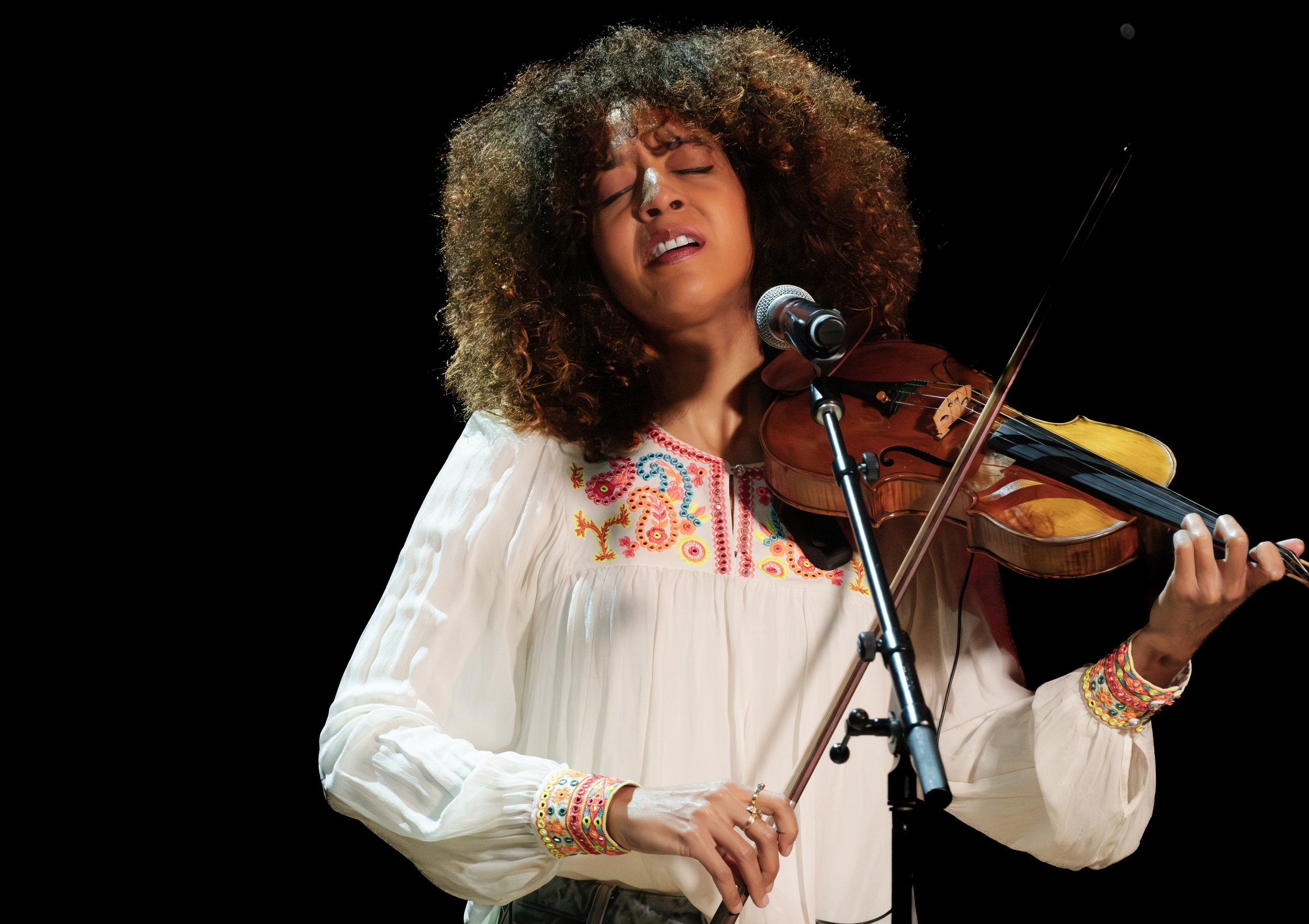
Yilian Cañizares during a musicada video shoot. Photo: Steve Roby
For the second night of his SFJAZZ residency, Sosa features the Aguas Trio, a collaboration with Cañizares and Venezuelan percussionist Gustavo Ovalles. The project explores Afro-diasporic spirituality through improvisation, drawing on musical traditions that use rhythm and melody as tools for reflection, invocation, and community connection.
The name itself hints at the group's central metaphor. “Aguas means water,” Sosa explains later in a backstage conversation. “Water is the fundamental element of life. Without water, none of us could be here. For me, spirituality is the core of everything I do.”
Cañizares approaches music from a complementary perspective. She moves smoothly between violin and voice, treating both as different expressions of the same musical instinct. “The voice is our first instrument,” she tells the afternoon audience. “It’s free and intuitive. The violin requires discipline and technique. I like the balance between those two energies.”
Their collaboration thrives on spontaneity. While preparing the repertoire, Cañizares once emailed Sosa with a detailed outline of song structures and solo sections. “He wrote back with just one sentence,” she says with a laugh. “He told me, ‘Go with the flow.’”
That phrase became the trio's guiding principle. Improvisation unfolds through attentive listening. Harmonies shift unexpectedly. Melodies appear and dissolve like currents in moving water. “We never tell each other where the improvisation will go,” Cañizares explains. “We follow whatever shape the moment needs to take.”
Even the instrumentation reflects this openness. The ensemble performs without a bassist. Instead, Sosa shapes the low register through the keyboard, layered to the left of the piano. “The keyboard started as a backup,” he says during the Q&A session. “Now it’s part of the sound. I can move anywhere harmonically without limits.”
The Ceremony Unfolds
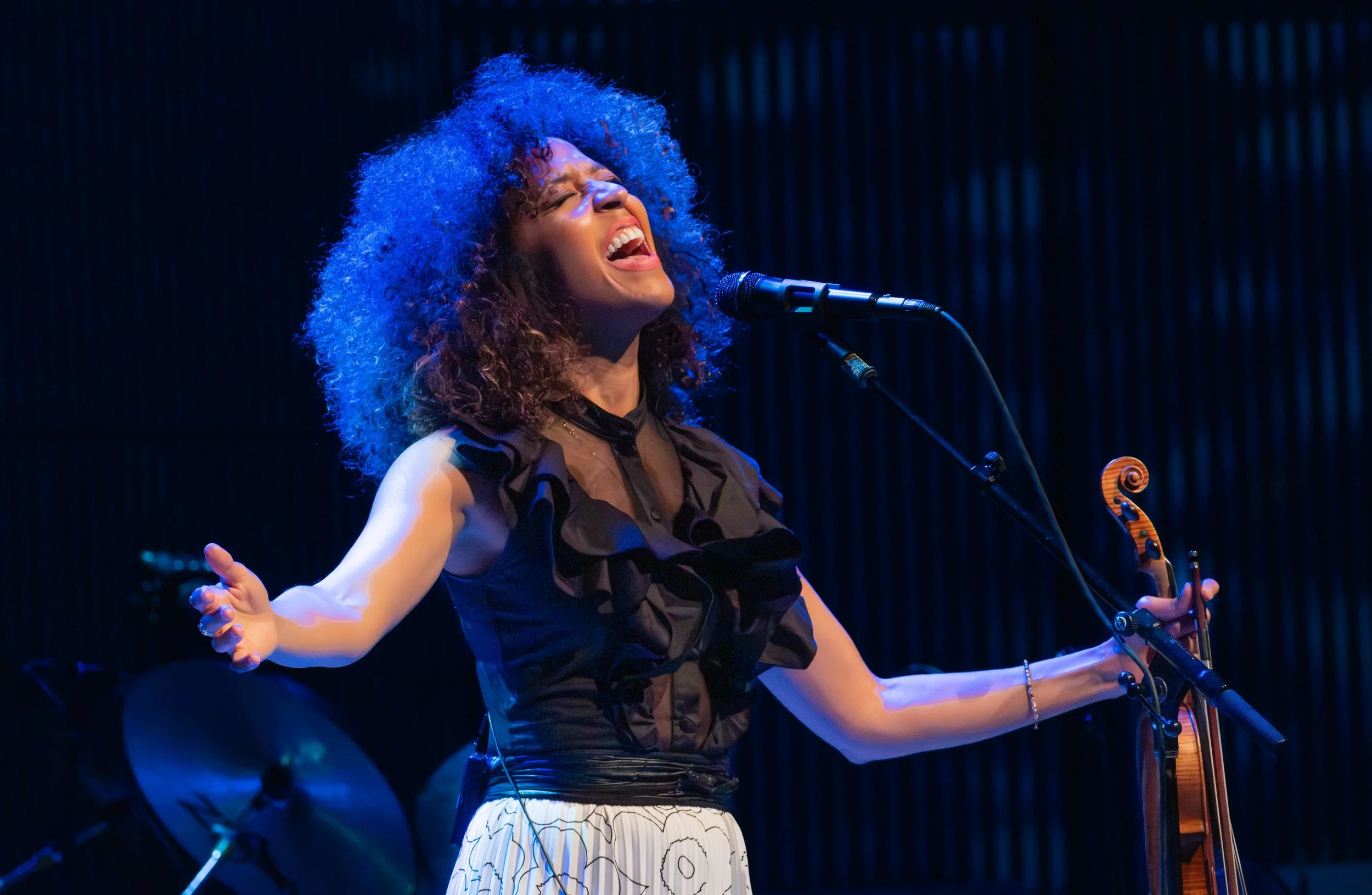
Yilian Cañizares. Photo: Steve Roby
The effect becomes clear once the evening performance begins.
Sosa begins the concert by creating a spacious sonic landscape for “Cuadro de Casa.” Moving between piano and synthesizer, he forms a gentle foundation that feels nearly architectural. Spoken Spanish phrases come from a recorded track as the trio settles into a slow, meditative rhythm. The music develops intentionally, with each gesture leaving room for the next.
Cañizares enters softly, her violin tone warm and vocal. The melody floats above Sosa’s harmonies before dissolving into improvisation. Ovalles responds with delicate percussion patterns that shimmer rather than dominate. The trio’s interaction feels conversational—three voices sharing a musical space built on patience and listening.
As the set develops, the music grows more dramatic.
“Duo de Aguas” introduces a rising rhythmic tension. Sosa and Ovalles construct a restless backdrop while Cañizares begins repeating a single phrase: “Water, agua.” Her voice becomes part chant, part invocation. The tempo intensifies gradually until the phrase dissolves into an extended violin solo.
At one point, Sosa stands from the bench and reaches into the piano again, striking the inner strings with red brush-like sticks. The gesture produces metallic overtones that ripple through the hall. Ovalles responds instantly, weaving new rhythmic patterns around the unexpected textures.
Sound as Invocation
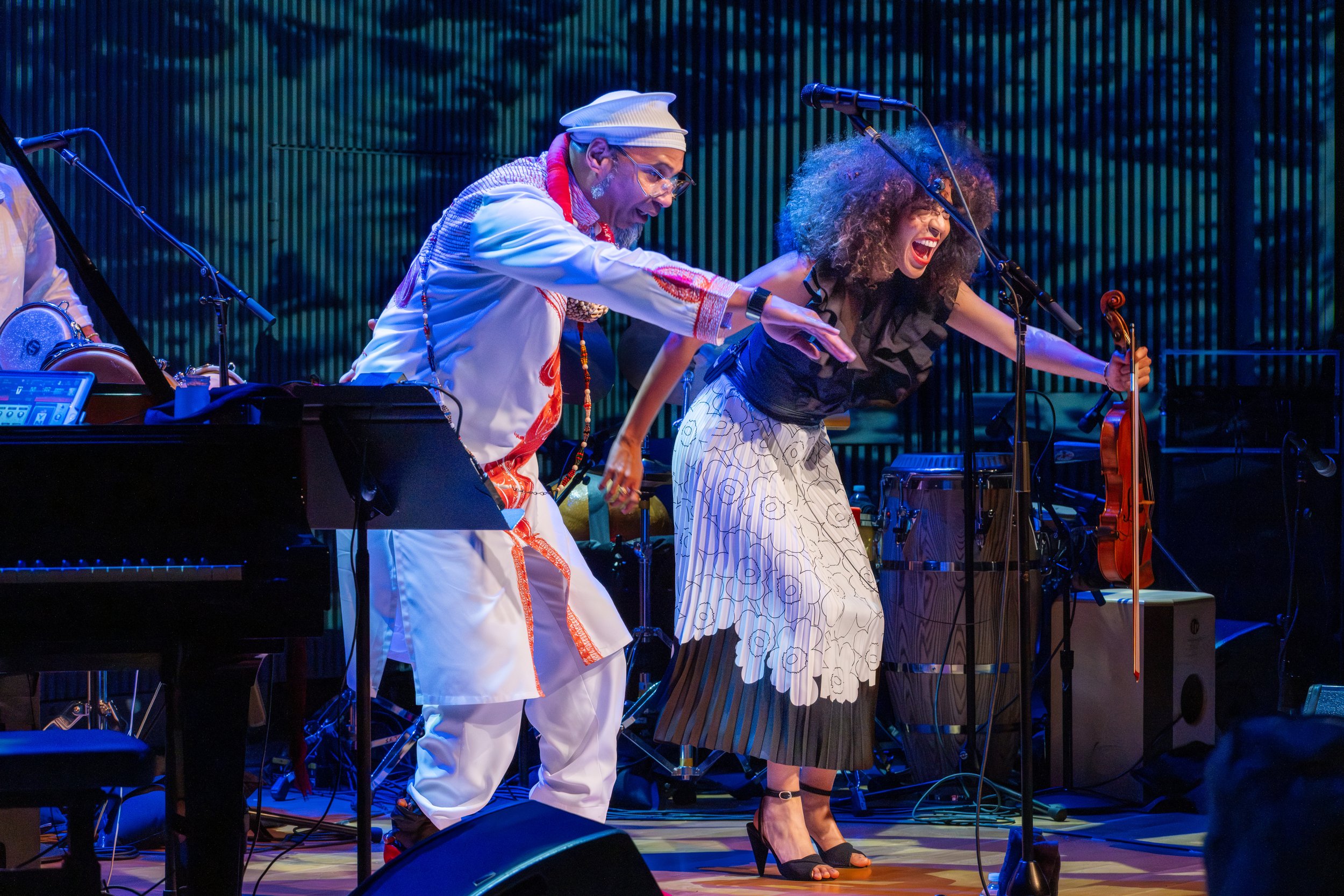
Omar Sosa and Yilian Cañizares at Miner Auditorium. Photo: Steve Roby
The performance continues for more than forty minutes before Cañizares pauses to address the audience. “This is my first time playing in this temple of jazz,” she says, glancing toward Sosa with a smile. “It is a sacred moment for me.”
Soon, the trio invites the audience to join the performance, encouraging listeners to sing and move with the rhythm. What began as contemplative improvisation gradually transforms into communal participation.
Ovalles then takes the stage alone. Kneeling beside an arrangement of instruments, he taps hollow bamboo sticks against a red stone slab, producing intricate patterns that echo the polyrhythmic traditions of the African diaspora. The rhythms expand and contract like breath, turning percussion into a form of meditation.
When Sosa and Cañizares return, the trio moves toward the evening’s most striking ritual.
During the encore, Ovalles leans over a black plastic basin filled with water. He scoops the liquid with both hands and pours it back slowly, allowing microphones to capture the delicate splash and resonance. Sosa accompanies the gesture with a gentle piano melody while Cañizares sings above the flowing rhythm.

Gustavo Ovalles. Photo: Steve Roby
The piece, “My Three Notes (Mis Tres Notas),” builds gradually until the audience rises once more, clapping and singing along.
For Sosa, moments like these reveal the deeper purpose of music.
“Every time we perform,” he said earlier that afternoon, “it’s like the first and the last concert. Music is vibration. It’s energy that you share with people.” Before each performance, the musicians gather backstage in a circle and hold hands for several minutes. “We channel our energy together,” he explains. “Jazz is about freedom, unity, and listening. The energy of the musicians, the audience, and the ancestors are all present in that moment.”
By the time the final refrain fades, the room feels transformed. The audience continues singing as the musicians leave the stage, the sound lingering long after the instruments fall silent.
The second night of Sosa’s residency reveals the spiritual center of his musical universe. Where the opening concert celebrated the vitality of young musicians with the Stanford Jazz Orchestra, the Aguas Trio turns inward, exploring rhythm and improvisation as pathways to reflection.
Two more evenings remain in the residency, each presenting a different ensemble and musical perspective. Yet the ceremony of the Aguas Trio stands at its heart—a reminder that, for Sosa, music remains a living current of shared energy, moving through time like water.
Program Notes
Omar Sosa, Yilian Cañizares, & Gustavo Ovalles: Aguas Trio
Date: Friday, March 6, 2026
Showtime: 7:30 p.m.
Venue: Miner Auditorium (SFJAZZ Center)
About This Show: For this performance, pianist Omar Sosa revisits the musical magic he created with Cuban violinist and singer Yilian Cañizares on their 2018 Otá Records album, Aguas. This enchanting release is inspired by jazz, Afro-Cuban rhythms, and modern classical music, and it is dedicated to water, the life-giving source of existence, and Oshun, the Goddess of Love and Mistress of Rivers in the Lucumí tradition of Yoruba. Joined on this night by a percussionist to form the Aguas Trio, Sosa and Cañizares produce a whole that is much greater than the sum of their parts.
Personnel
Omar Sosa: piano, keyboards, audio effects
Yilian Cañizares: violin, lead vocals
Gustavo Ovalles: percussion, vocals
Setlist: “Cuadro de Casa,” “Dos Bendiciones,” “Duo de Aguas,” “De la Habana y Otras Nostalgias,” “Oshun,” “D2 de Africa,” “My Three Notes (Mis Tres Notas)”
Tech Staff
Marco Melchior: Front of House (FoH) - Live Sound Mix Engineer and Production Manager for Omar Sosa
SFJAZZ Tech Crew
Alex Espolet: Front of House (FoH) Engineer
Martin Carmona: Monitor Engineer
Masanori Yura: Multitrack Recording and Mix Engineer
Emmett Reed: Audio Assistant
Dylan Lewis: Video Director and Camera Operator
Albert Wong: Video Mixer, Camera Operator
Jeremy Guy: Lighting Director
Matthew Moreau: Lighting Director
Chris Edwards: Production Manager for SFJAZZ
Taylor Rivers: Stage Manager