Night 1: Omar Sosa and the Vitality of the Next Generation
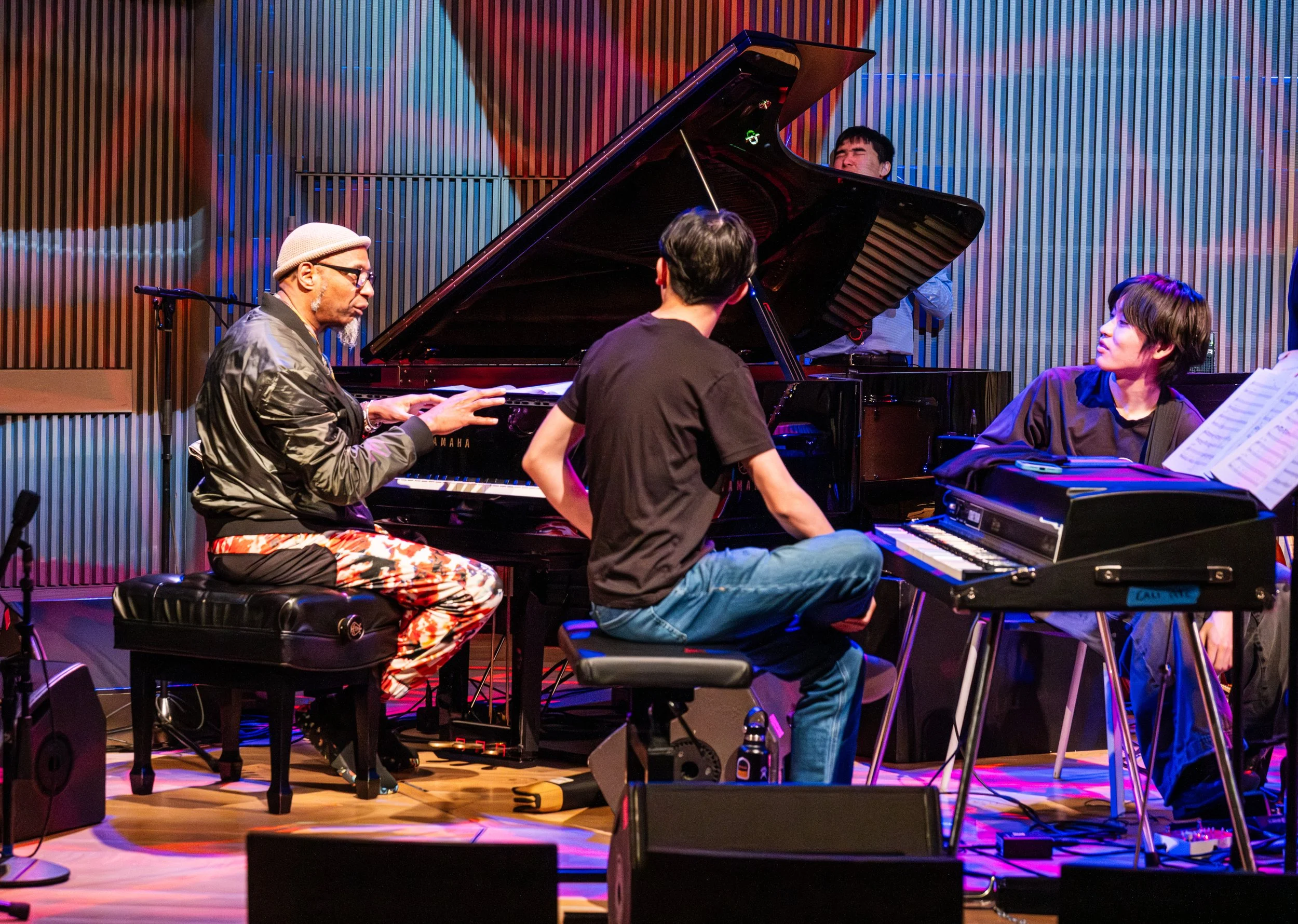
Opening his four-night SFJAZZ residency, Latin jazz pianist Omar Sosa draws on decades of experience to unleash a sweeping wall of sound with the fresh energy of 21 student musicians, filling Miner Auditorium.
3:30 p.m. The Stanford Jazz Orchestra’s (SJO) chartered bus pulls up to the SFJAZZ backstage entrance. Musicians step off clutching freshly pressed outfits and black instrument cases, bringing a raw, unrefined energy into their Miner Auditorium debut. SJO director Michael Galisatus divides the ensemble into two groups, a practical move for navigating the narrow backstage corridors of the “Jazz Temple.”
A student navigates through the dim maze, balancing a suit and a cardboard box of new shoes before stacking his gear against a growing wall of instrument cases upstairs. Four and a half hours remain until the show begins, and the halls are already filling with the quiet routines of preparation.
The Weight of Observation
The rhythm section arrives early and is already rehearsing with Omar Sosa and his percussionist, Tito Leliebre. Guitarist Ryota Sato and pianist Nathan Joseph stand closest to Sosa, close enough to observe every gesture and catch each instruction. The Cuban pianist leans over the charts, offering encouragement while shaping the arrangements' feel as the musicians follow his cues.
From the upper balcony, members of the orchestra’s horn section peer over the railing to watch the maestro at work, observing the interaction between the bandleader and the rhythm section.
At one point, Sosa suddenly halts the rehearsal. A soft hum drifts through the room.
“What’s that noise I hear?” he calls toward the sound booth.
Moments later, the sound fades away, and the source is revealed to be a fan quietly humming in the room.
Galisatus quickly gathers the students onstage and outlines a plan to bring them on stage section by section, hoping to avoid colliding with music stands, chairs, and microphones during the entrance. Trumpets take the upper riser, followed by the trombones, while the seven-player saxophone section fills the bottom row. Even with careful staging, there is barely an inch left onstage—tight quarters for a band this size.
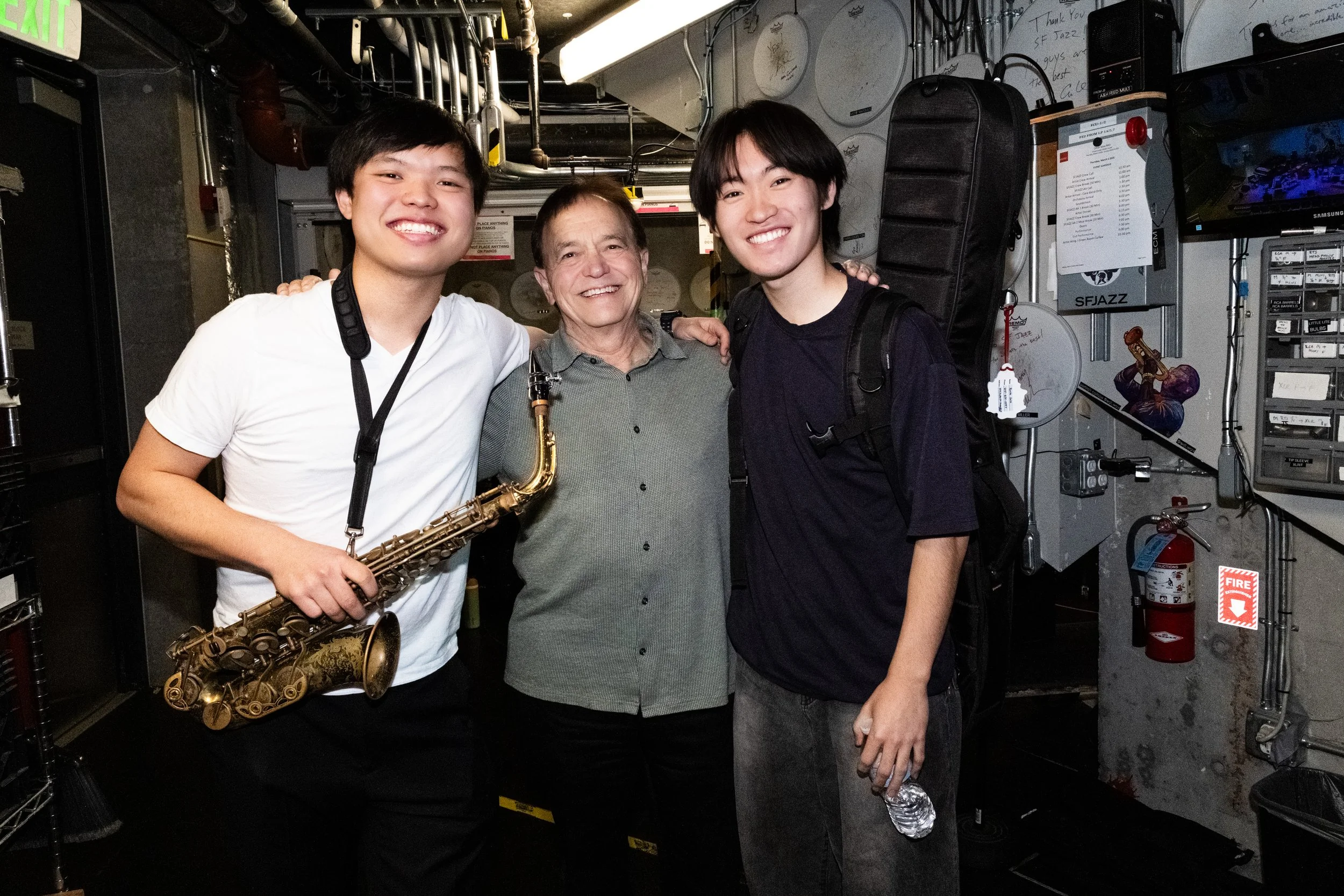
Ethan Htun, Michael Galisatus, and Ryota Sato at SFJAZZ. Photo: Steve Roby
Taming the Wild Horse
5:22 p.m. Rehearsal and soundcheck conclude. Before the students leave the stage, Sosa gives three instructions for the evening’s performance: bring soul, bring energy, and bring freshness.
“The music isn't hard,” he tells them with a smile. “You just have to catch the groove.”
Moments later, a staff member announces that food is waiting upstairs, and the students quickly head upstairs. Before they leave, Galisatus pauses to reflect on the effort that went into the collaboration.
Working with a student orchestra, he explains, requires transforming enthusiasm into discipline. Young musicians often arrive eager to play, which means the rehearsal process starts with shaping that excitement into focused listening.
“The hard part is they’re young and eager—they want to play,” he says. “It’s like taming a wild horse.”
Much of the ensemble’s rehearsal routine focuses on exercises designed to strengthen awareness across the band. The goal is to ensure that every player listens closely—not only to their section but to the entire room.
“We spend a lot of warm-up time helping everyone hear each other,” Galisatus says. “Everyone on stage, everyone in the room.”
That awareness helps the band develop a dynamic sense of balance: knowing when to push forward and when to pull back. According to Galisatus, the students have developed strong instincts in that regard.
“They’re fantastic listeners,” he says. “They know when to step back and when to step up. They’re watching for cues.”
The acoustics of Miner Auditorium also influence the ensemble’s approach. In many venues, young musicians tend to increase their volume to compensate for unclear stage sound. At SFJAZZ, that tendency fades because the room’s clarity lets every nuance be heard.
“The beautiful thing about here is the sound onstage is so clear,” Galisatus says. “You can hear every little detail.”
That clarity becomes crucial when working with Sosa, whose performances require both precision and intensity.
“Omar loves the energy level,” Galisatus adds. “When he plays, he plays hard. And it’s up to us to rise to his level.”
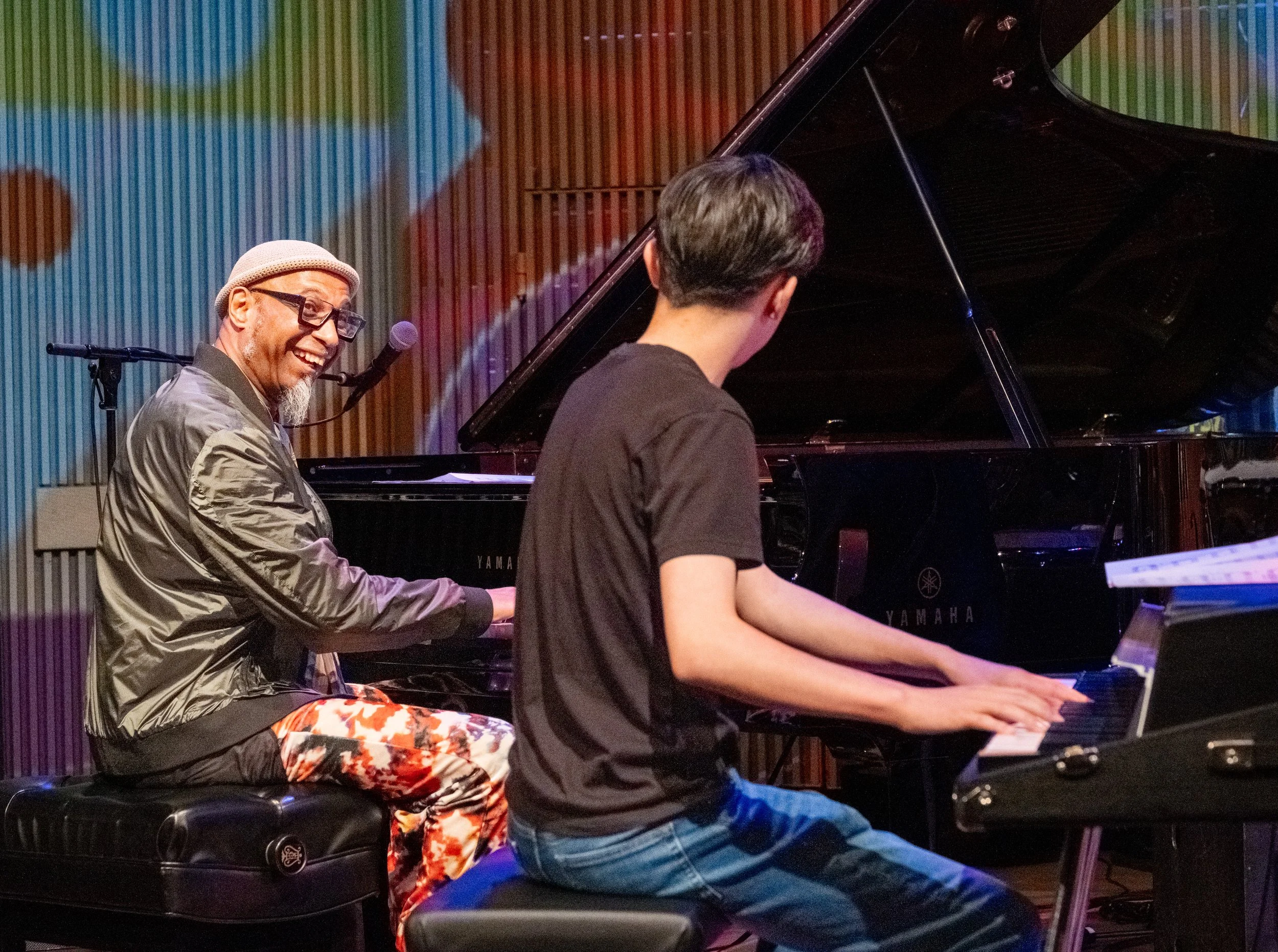
Omar Sosa and Nathan Joseph during soundcheck. Photo: Steve Roby
Learning to Fly
As Galisatus checks on the band, two student musicians reflect on what the afternoon rehearsal has meant to them.
For lead alto saxophonist Ethan Htun, Sosa’s approach emphasizes freedom. Instead of focusing strictly on technical perfection, the pianist encourages the students to explore the music with openness and imagination.
The shift is freeing. Playing in Miner Auditorium—a venue of many young musicians’ dreams—suddenly feels less like a pressure-filled debut and more like a shared musical conversation.
For guitarist Ryota Sato, the challenge is the lack of a traditional guitar score. Instead of a written part, he relies on the piano and bass charts and trusts Sosa’s instruction to follow the spirit of the music.
The experience shifts him away from strict notation and toward instinct. Even with the performance only hours away, the atmosphere stays surprisingly relaxed. Sato explains that Sosa’s energy creates an environment where exploration feels natural instead of risky.

Omar Sosa enters the stage. Photo: Steve Roby
Showtime at the Temple of Jazz
7:31 p.m. The house lights dim, and Scott Price steps onto the stage to welcome the audience. A longstanding member of Sosa’s management team, he recalls the pianist’s earlier collaborations with the NDR Big Band in Hamburg, including the award-winning album Ceremony. He also thanks Galisatus for integrating the Stanford ensemble into the project.
Then the introductions begin.
Row by row, the Stanford Jazz Orchestra steps onto the stage as applause builds throughout the hall. Parents and fellow students shout words of encouragement from the audience while the band members take their seats. “Good luck, Peter!” yells one excited concertgoer. When Sosa finally walks onto the stage, the cheers become even louder.

Andrew Zhang. Photo: Steve Roby
Ritual and Rhythm
Sosa appears smiling, dressed in his signature white outfit: a flowing tunic embroidered with red patterns, loose-fitting pants, and a white turban cap. Hanging around his neck is a large African necklace made of various shells, while similar shells wrapped around his ankles serve as percussion when he moves.
In his hands, he carries a flask of sacred water, a small statue, and a long red suede strap.
Before sitting at the piano, he performs a quick cleansing ritual, snapping the strap sharply on each side of the instrument. The crack echoes through the hall, signaling the start of the performance.
A single piano note sounds, quiet but commanding. As Sosa builds momentum, the shells around his ankles add a subtle rhythmic shake, while percussionist Tito Leliebre joins on congas and bongos to deepen the groove.
The opening piece, “Glu Glu,” bursts into a lively big-band arrangement featuring trombone, trumpet, and saxophone solos. The students rise to the challenge with confidence, and when the piece concludes, Galisatus announces the names of the soloists, prompting cheers from friends and family across the audience.

Ryota Sato. Photo: Steve Roby
Musical Conversation
The orchestra soon shows its wide emotional range with the moody ballad “Sad Meeting.” Alto saxophonist Ethan Htun and euphonium player Julius Schmidt give particularly moving solos, drawing sustained applause from the audience.
Throughout the performance, Leliebre drives the ensemble's rhythmic momentum, switching fluidly between congas and bongos while exchanging cues with the SJO drummer.
Midway through the show, Sosa takes a moment to reflect on the collaboration.
“It’s beautiful to be surrounded by this new generation,” he tells the audience. “They take this role very seriously—to serve in a big band.”
He then gestures toward Galisatus and invites the crowd to applaud the orchestra’s director.
Galisatus responds with gratitude, emphasizing the experience’s meaning for the students.
“Music builds community,” he says. “It builds lifelong friendships. This is something we’ll remember for the rest of our lives.”

Tito Leliebre. Photo: Steve Roby
After the Music
When the concert ends, Sosa greets fans in the lobby, signing albums and posing for photos as audience members linger to discuss the performance.
“It was incredible watching the students interact with Omar,” says Gabe, a visiting student from San Diego. “That kind of opportunity doesn’t happen often.”
Sonia, a San Francisco resident with Cuban roots, says the performance carried personal resonance.
“I’ve been a fan of Omar Sosa for a long time,” she explains. “Tonight felt nostalgic. It felt like he was sharing something deeply personal with the audience.”
Another Stanford student, Nina, leaves the hall with a different perspective.
“I had never heard of Omar Sosa before tonight,” she says with a smile. “Now I’m definitely a fan.”
For one evening, Miner Auditorium becomes a gathering spot where generations meet—a seasoned master mentoring young musicians toward their futures. Judging by the energy in the room, that future already sounds promising.
The collaboration with the Stanford Jazz Orchestra is just the first chapter of Sosa’s four-night residency at SFJAZZ. Over the following three nights, the pianist explores entirely different musical styles, each showcasing another side of his broad artistic vision. If the first night honors the energy of the next generation, the upcoming performances also promise their own unique worlds of rhythm, improvisation, and cultural exchange.
Bonus Audio Interviews
The audio clips were recorded during soundcheck and post-concert.
Program Notes
About: Omar Sosa’s San Francisco residency began on March 5, when he performed with the Stanford Jazz Orchestra — his first-ever big band show in the Bay Area. They offered selections from his 2018 album Es:sensual, recorded with Germany’s NDR Bigband and featuring arrangements by Brazil’s Jaques Morelenbaum.
Artist: Omar Sosa & Stanford Jazz Orchestra
Event: Music From The Album Es:sensual, Arranged By Jaques Morelenbaum
Date: Thursday, March 5, 2026
Showtime: 7:30 p.m.
Venue: Miner Auditorium (SFJAZZ Center)
Personnel
Omar Sosa: piano
Tito Leliebre: percussion
Stanford Jazz Orchestra
Michael Galisatus: director
Saxophones
Ethan Htun: alto
Hugh Cheng: alto
Anish Alur: alto
Quinn Simmons: tenor
Nima Rejai: tenor
Zachary Broveak: baritone
Caleb Benz: baritone
Trumpets
Alex Hong
Emily Mannion
Kazuya Bojarski
Silas Moody
Jordan DePue
Matthew Onadeko
Trombones
Andrew Zhang
Peter Eaton
Hunter Kim-Turnoff
Julius Schmidt
Brandon Kenery: bass trombone
Rhythm Section
Nathan Joseph: piano
Nicholas Oey: bass
Ryota Sato: guitar
Austin Konig: drums
Johnny Martinez: drums
Setlist: “Glu Glu,” “Sad Meeting,” “Reposo,” “L3 Zero,” “Mis Tres Notas,” “Angustiado” “Yiade”
Stanford Jazz Orchestra Soloists
“Glu Glu”
Andrew Zhang-Trombone
Caleb Benz-Baritone Sax
Jordan De Pue-Trumpet
Nima Rejai-Tenor Sax
“Sad Meeting”
Ethan Htun-Alto Sax
Julius Schmidt-Euphonium
Nima Rejai-Tenor Sax
Silas Moody-Trumpet
Kaz Bojarski-Trumpet
Nathan Joseph-Fender Rhodes
“Reposo”
Hugh Chen Alto Sax
Nicholas Oey-Bass
Ryota Sato-Guitar
“Cha Cha”
Peter Eaton-Trombone
Quinn Simmons-Tenor Sax
Ryota Sato-Guitar
“L 3 Zero”
Emily Mannion-Trumpet
“Mis Tres Notas”
Nima Rejai-Tenor Sax
Ryota Sato-Guitar
“Angustiado”
Quinn Simmons-Tenor Sax
Hugh Chen Alto Sax
Ethan Htun Soprano Sax
Ryota Sato-Guitar
Austin Konig-Drums
“Yiade”
Nicholas Oey-Bass
Ethan Htun-Alto Sax
Kaz Bojarski-Trumpet
Ryota Sato-Guitar
Omar Sosa Tech
Marco Melchior: Front of House (FoH) - Live Sound Mix Engineer and Production Manager for Omar Sosa
SFJAZZ Tech Crew
Alex Espolet: Front of House (FoH) Engineer
Martin Carmona: Monitor Engineer
Masanori Yura: Multitrack Recording and Mix Engineer
Emmett Reed: Audio Assistant
Dylan Lewis: Video Director and Camera Operator
Albert Wong: Video Mixer, Camera Operator
Jeremy Guy: Lighting Director
Matthew Moreau: Lighting Director
Chris Edwards: Production Manager for SFJAZZ
Taylor Rivers: Stage Manager
Steam Tech: Frank Lee
Div Lukic: Artist Liaison
Luna Celi: Artist Liaison
Brian Lee: Piano Technician