The Klezmatics at SFJAZZ: Improvisation, Memory, and the Politics of Joy
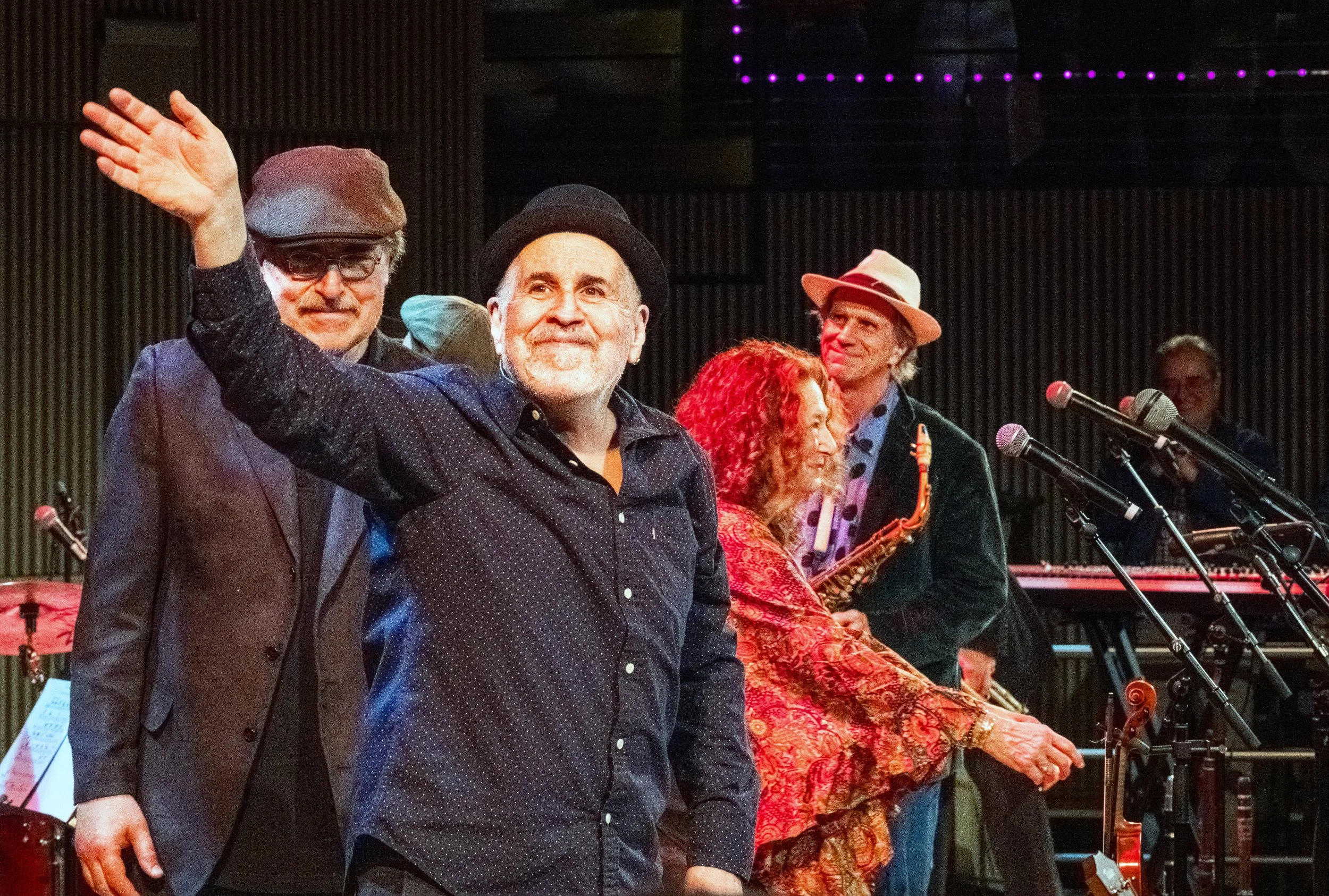
As they near their 40th anniversary in 2026, the Grammy-winning sextet delivered a jazz-infused Hanukkah program to SFJAZZ that balanced groove, grief, and collective resilience—while keeping the dance floor in mind.
At SFJAZZ’s Miner Auditorium on Monday night, The Klezmatics offered a holiday performance shaped by intention and scope. Drawing on material from Happier Joyous Hanukkah, recently reissued on vinyl, the band framed the evening around a central idea: joy gains force when it is shared, sustained, and responsive to the moment at hand. For an ensemble nearing four decades together, forged in the East Village ecosystem that blurred punk, folk, and the avant-garde, that idea felt deeply integrated into the music itself.
“When we play SFJAZZ, we intentionally... really give ourselves permission to go full throttle into the jazz and improvised aspects of our music. That’s part of the experience... So we always go a little into overdrive.”
The opening moments set the tone. “Honeyky Hanukkah,” Woody Guthrie’s witty addition to the Jewish songbook, arrived with a rhythmic push and forward drive. Its groove pushed against the formality of the seated hall and quickly changed the room’s energy. Within minutes, an audience member near the entrance stood up and began tracing traditional dance steps in the aisle. Ushers moved back as others followed her lead. The response unfolded naturally, highlighting the music’s physical pull and community spirit.
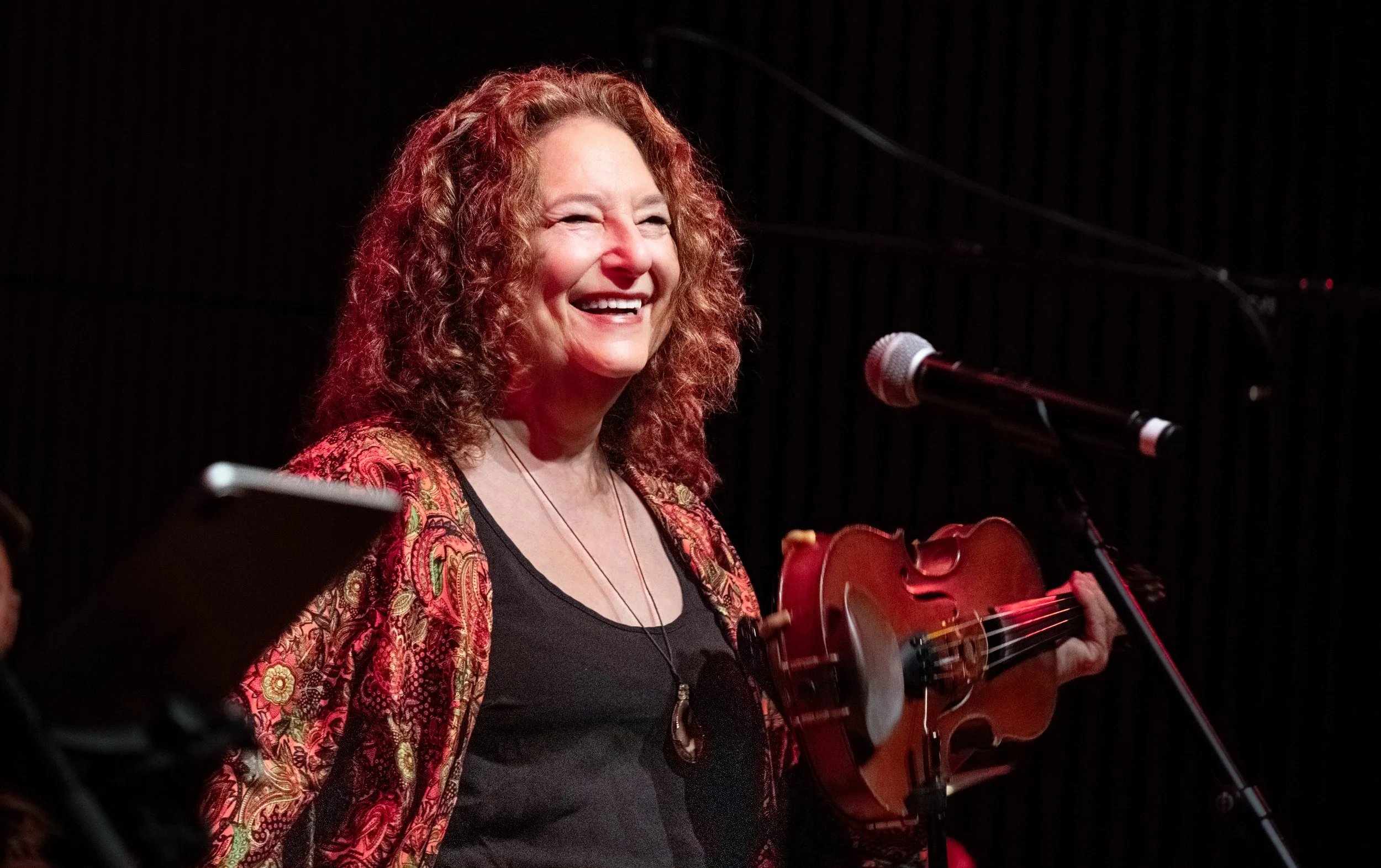
Lisa Gutkin: Photo: Steve Roby
That sense of movement carried right into the band’s jazz vocabulary. Miner Auditorium’s warm acoustics encouraged flexibility and interaction, emphasizing improvisation as a shared process. Trumpeter Frank London, a long-time catalytic presence in the group, has described SFJAZZ appearances as chances to expand the music’s improvisational scope. On “Vitsn,” from the upcoming We Were Made For These Times, he fully embraced that approach. Playing through a plunger mute, London crafted phrases that laughed, growled, and bent pitch, creating distinct connections between early jazz phrasing and the expressive shapes of Eastern European folk traditions. The solo played out as a conversation—between eras, styles, and emotional tones.
Across the set, the ensemble played with the cohesion of a seasoned small group. Drummer Richie Barshay and bassist Paul Morrissett moved through changing meters with buoyancy, forming a flexible foundation for violinist Lisa Gutkin and clarinetist Matt Darriau. Their exchanges felt like dialogue, driven by listening rather than showing off. Before “Kegn Gold Fun Zun” (“Towards the Golden Sun”), London offered a brief aside on rhythmic connections between Yiddish music and Crimean Tatar traditions. The context sharpened the performance, which settled its complexity through groove and momentum.
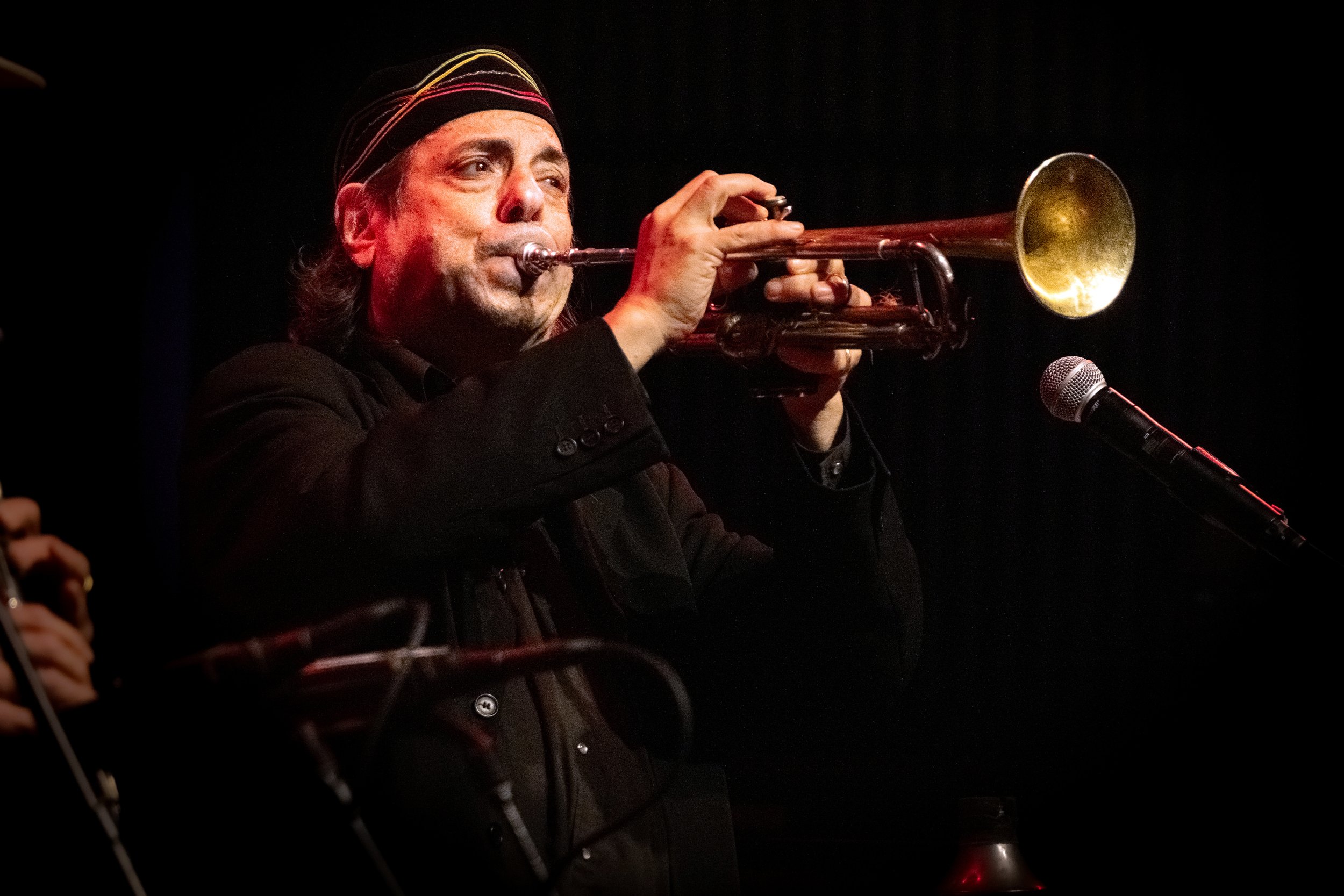
Frank London. Photo: Steve Roby
Midway through the program, the emotional focus narrowed. London spoke briefly about “innocent people who seem to be just being slaughtered at this time,” adding that “sometimes there are no words.” The band responded with “Elegy,” a sparse, wordless instrumental that drew the audience into collective stillness. Its placement in the set highlighted contrast as a musical tool, allowing reflection to coexist with motion rather than disrupt it.
From that quiet center, the band expanded outward again. Vocalist and accordionist Lorin Sklamberg—whose steady bellows work anchored the harmonic language throughout the night—introduced “Der Yokh,” the Yiddish adaptation of the Catalan protest anthem “L’estaca.” Sung with focus and restraint, the song’s metaphor of many hands pulling together carried particular weight. The performance relied on collective voices and a steady pulse, allowing the song’s message to emerge through repetition and unity.
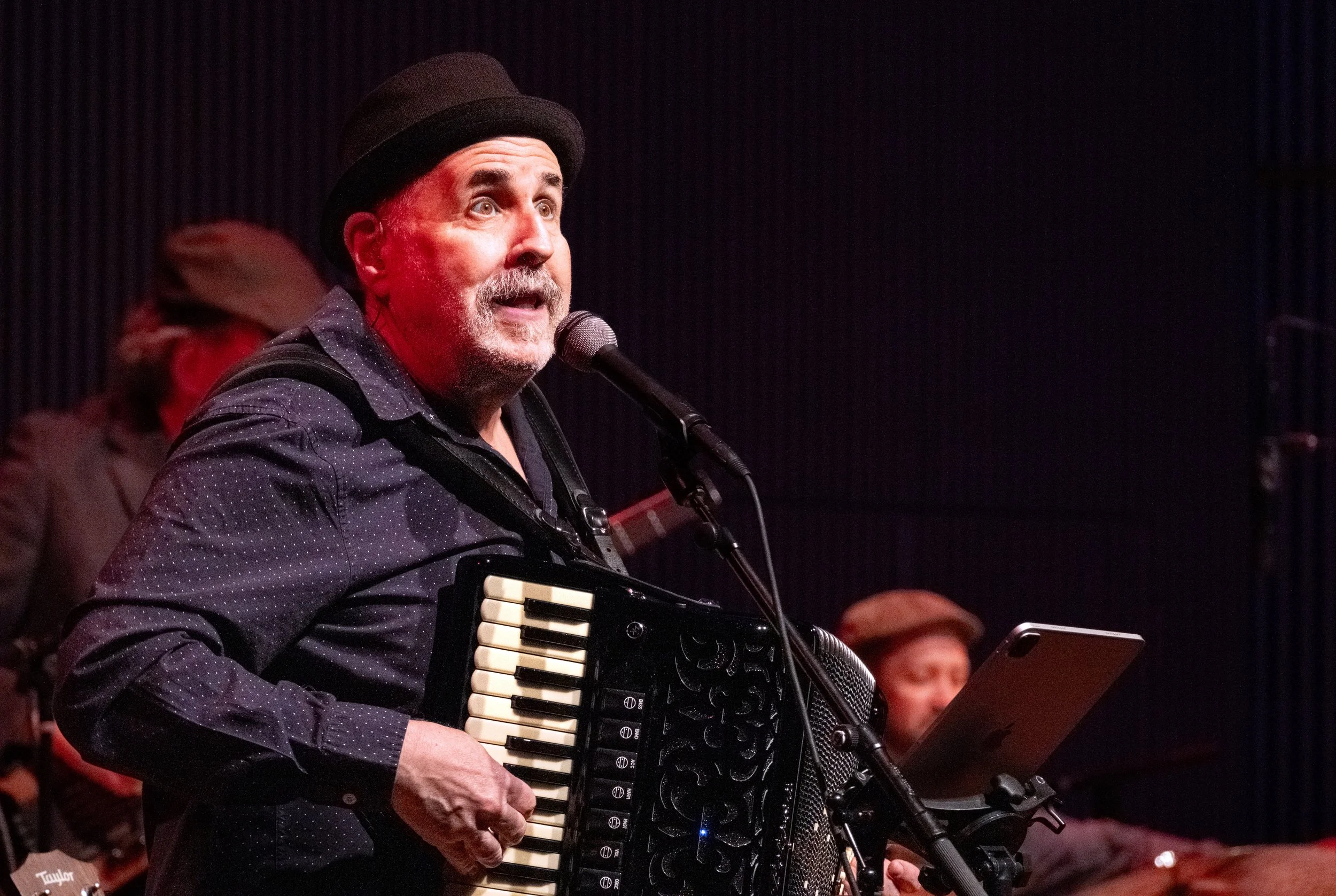
Lorin Sklamberg. Photo: Steve Roby
The group’s long-standing connection to Woody Guthrie resurfaced during “Deportee.” Before performing, Sklamberg recalled the 1948 plane crash that killed Mexican field workers whose names were left out of news reports, reduced to the label “deportees.” The performance was clear and straightforward, anchoring the evening’s bigger themes in a particular human story and reinforcing the band’s dedication to preserving history.
As the set approached its end, the music shifted back to dance-driven material with renewed energy. Years of shared language enabled the band to move smoothly between tight unison sections and open improvisation. The program’s richness—combining historical context, political reflection, and celebratory energy—sometimes required careful listening, but the group’s punk-klezmer roots kept the music lively and straightforward.
By the encore, “Ale brider,” the sense of separation between stage and audience had faded. Earlier, London described the band’s recent work as a way to help people “stay strong and avoid getting depressed.” The sentiment resonated clearly in the room. As The Klezmatics approach their 40th anniversary, they continue to treat tradition as a living practice—one shaped by listening, improvisation, and the belief that shared joy remains a powerful source of endurance.
Program Notes
Date/Showtime: December 15, 2025. 7:30 p.m.
Venue: Miner Auditorium, San Francisco, California
Event: Happier Joyous Hanukkah
Personnel
Lorin Sklamberg: lead vocals, accordion, acoustic guitar, piano; Matt Derriau: kaval, clarinet, saxophone; Lisa Gutkin: violin, vocals; Frank London: trumpet, keyboards, piano; Paul Morrissett: bass, tsimbl; Richie Barshay: drums.
Setlist: “Honeyky Hanukkah,” “Man In A Hat,” “Vitsn,” “Kegn Gold Fun Zun,” “Hanukkah Gelt,” “40 Years,” “Der Yokh,” “Happy Joyous Hanuka,” “Un Du Akerst,” “Elegy,” “I Am Willing,” “Lashinke,” “Deportee,” “Payklers Tants,” “Hanukkah's Flame,” “Hanukkah Tree.” Encore: “Ale brider.”
Listen to our interview with Frank London here.
Photos: Steve Roby