On the final night of their SFJAZZ engagement, two bassists found room for expansive solos and the pleasures of accompaniment.
Miner Auditorium, SFJAZZ Center, San Francisco — Sunday, November 15, 2026
Stanley Clarke spent much of Sunday evening praising Ron Carter, then offered the most persuasive tribute available to a fellow bassist: he listened. Their exchanges at Miner Auditorium turned the practical challenge of a two-bass duo—how to share its crowded lower register—into an exercise in mutual attention.
A steady drizzle had pushed concertgoers into the SFJAZZ Center lobby early. Fans cradled boxed sets they hoped to have signed later. Inside the auditorium, the stage held a rug, two stools, and two upright basses resting on their sides.
Clarke walked out alone, shook a few hands in the front row, and admitted that the rain had surprised him. The evening closed a four-night run and, he said, offered a chance to work with “probably my biggest hero growing up.” He took his seat, accepted a bass from a stage tech, adjusted the tuning, and began.
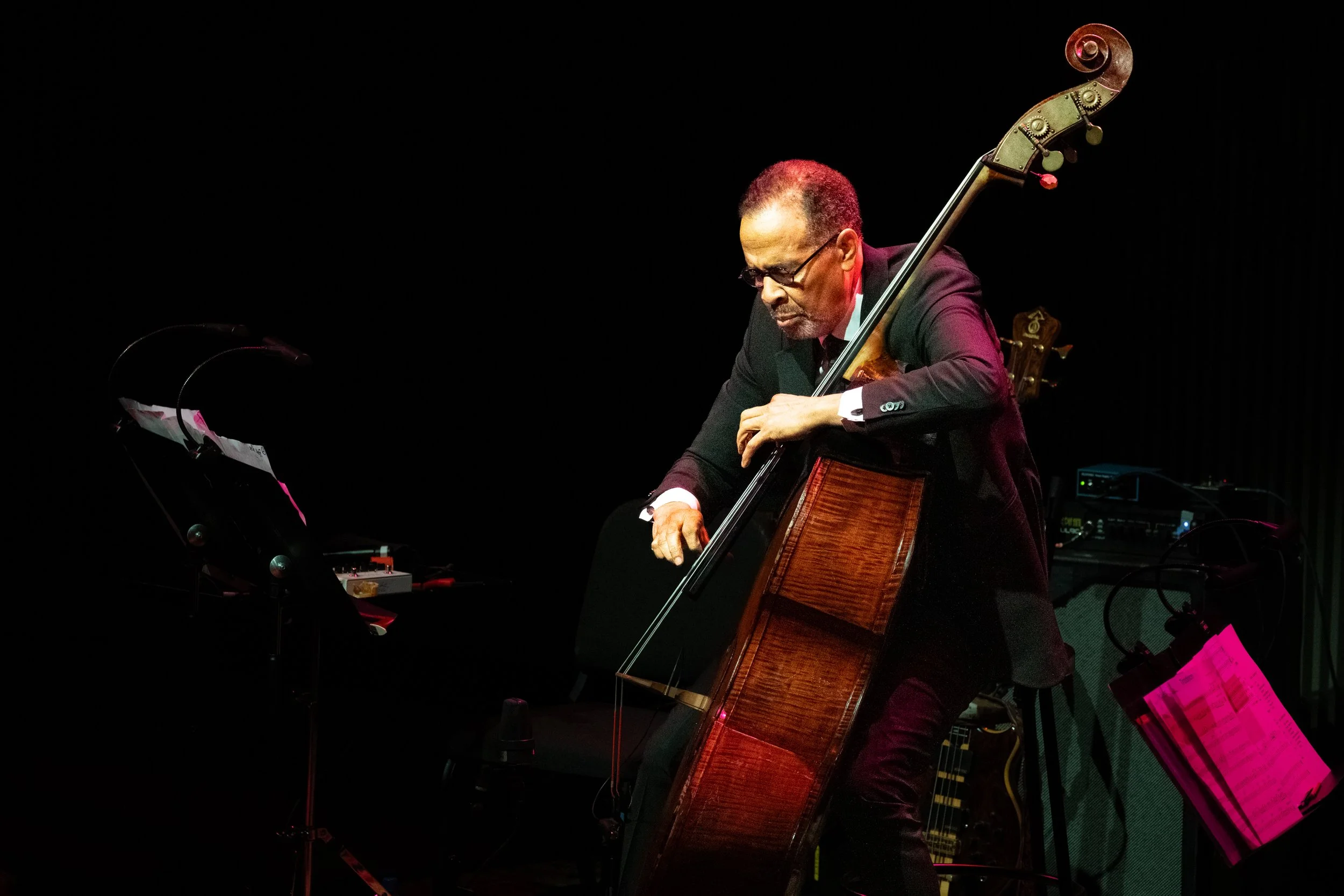
Stanley Clarke. Photo: Steve Roby
His opening solo tested the upright’s resources through sharply articulated plucks and long slides up the neck. Thumb strums and percussive taps changed its character; a flamenco-like flourish briefly suggested a guitar. Behind him, projected images of blurred trumpets dissolved into vibrant stained-glass images.
Clarke ended the segment with one of his “bass folk songs,” adapted, he explained, from an old Irish tune he had heard a young woman sing in a club. He said he had written 21 of these pieces and recorded perhaps four. His governing rule was that the music sounded its best on bass alone. The bassists in the house laughed in recognition.
Before Carter appeared, Clarke introduced the short film Why We Call Him Maestro. In it, he recalled being a cash-strapped Philadelphia college student in 1969 when his friend, bassist Charles Fambrough, brought over Miles Davis’s E.S.P. Clarke had fastened on Carter’s playing: its pitch, precision, and swing. The two friends subsequently spent years debating what Carter had played on particular records. Clarke closed by likening Carter’s lines to the bass parts underneath Johann Sebastian Bach: every note placed exactly right, “just absolutely perfect to me.”
Carter entered from stage left to a standing ovation, wearing a black suit with a colorful silk scarf draped around his neck. At 89, he settled onto his stool and drew the bass close, keeping his head level through much of the performance. Clarke, 75, often bent over the neck until his cheek nearly touched the wood. Their postures suggested different relationships with the instrument before they played a note together.
In Richard Scheinin’s preconcert interview for SFJAZZ, Carter had joked that he would bring a bass the same size as Clarke’s so they would be “even.” On Sunday, Clarke’s move to electric bass gave the partnership a clear division of sound. His upper-register melody floated above Carter’s darker acoustic lines, which supplied the harmonic footing and kept the form in view.
During a slow passage, animated raindrops were projected behind them. Clarke grinned and gestured toward Carter, at one point playfully urging him toward an ever-fainter tone. The pleasure lay in hearing how little sound it took to carry between them.
A blues number loosened the conversation. Clarke hummed along with his notes as the two traded phrases and rhythmic figures. The accompanying role passed back and forth, each player responding to the other’s pauses as closely as to the other’s lines.
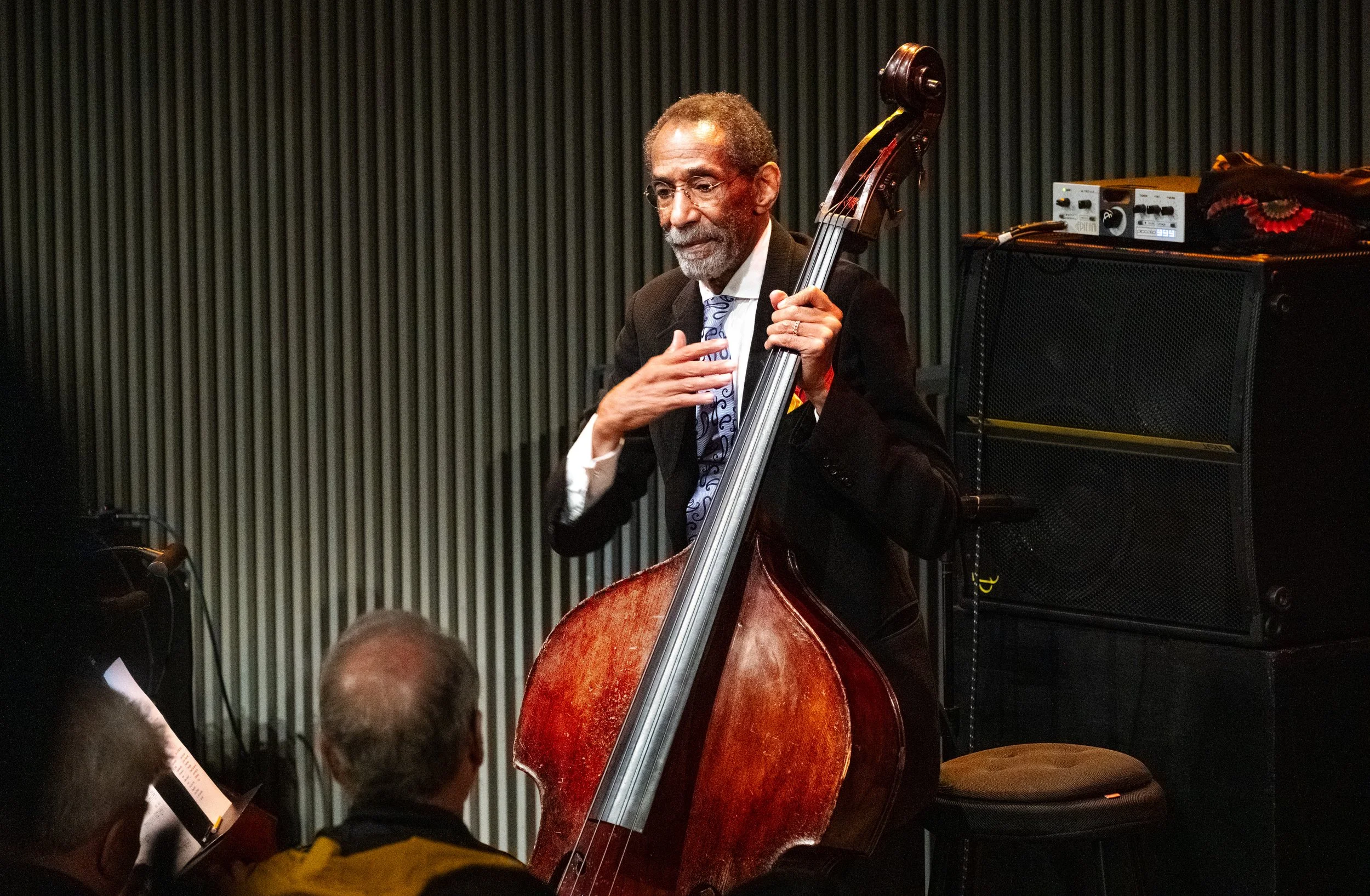
Ron Carter. Steve Roby
Carter had also told Scheinin about the bassist’s constant responsibility for keeping a band moving. Here, the format allowed each musician to yield the stage entirely. Clarke applauded his partner, set down his instrument, and stepped out of the spotlight.
Alone, Carter hummed as he played, consulting the score on his stand only occasionally. Harmonics and high, pinched notes lifted his bass above its familiar depths. “You Are My Sunshine” emerged from the solo, its plainspoken melody a familiar anchor amid the shifting textures. Another blues melody followed. When Carter rose, Clarke called back, “Maestro!” The audience joined him.
Sustained applause brought them back for “Canto del Agua.” The encore opened with mournful chords, Carter’s walking line beneath Clarke’s gliding electric bass. The pace quickened before Clarke let a final slide fade. Carter answered with dry, ghostly plucks below the tailpiece, then stood.
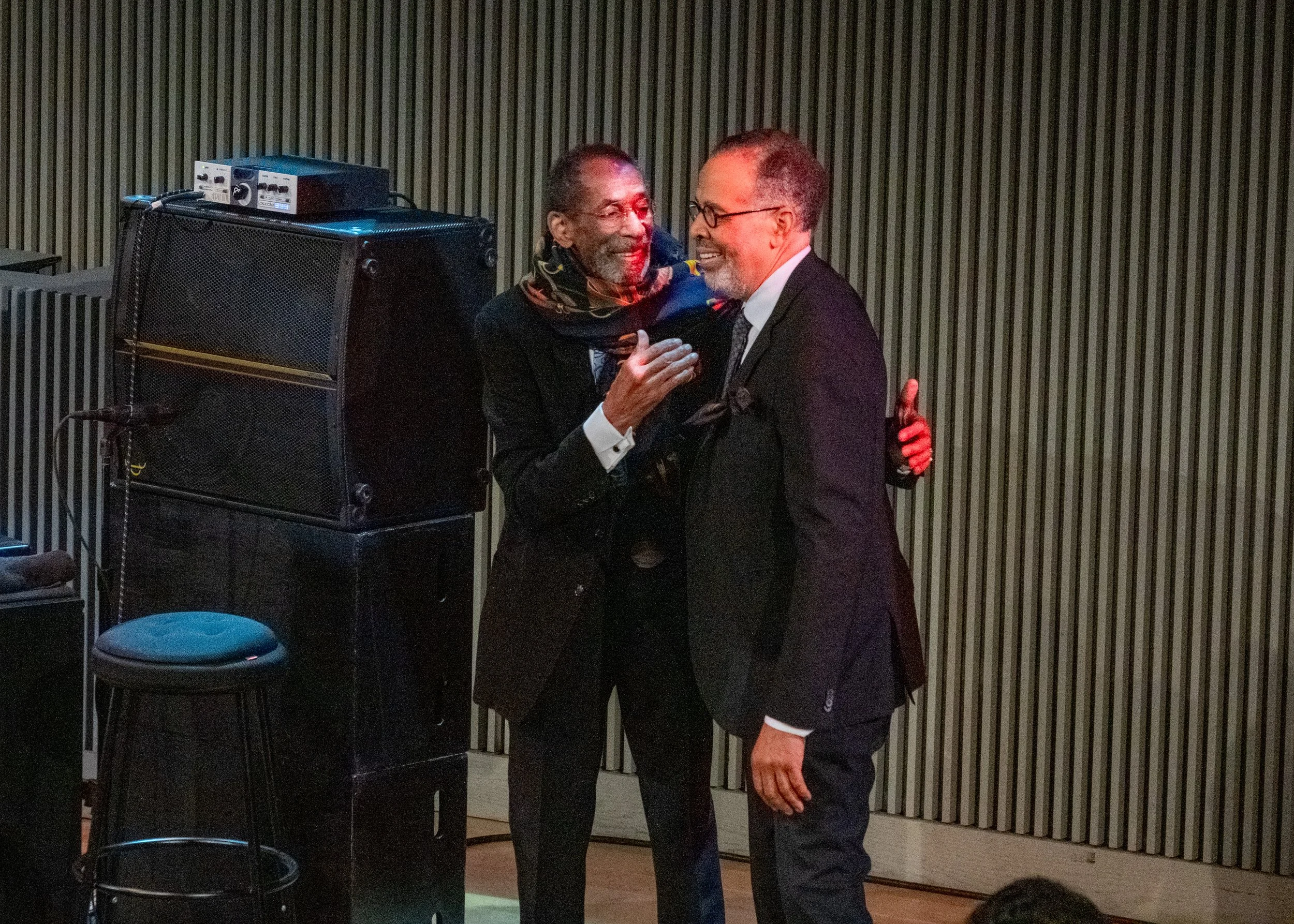
Carter retrieved his scarf and flipped it around his neck. The two embraced, waved toward the upper tiers, and left side by side.
Clarke had done all the talking, and nearly all of it had concerned Carter. Their playing gave that admiration a precise musical shape: a melody entrusted to one partner, a bass line answered by the other, and enough silence for each to hear what came next.