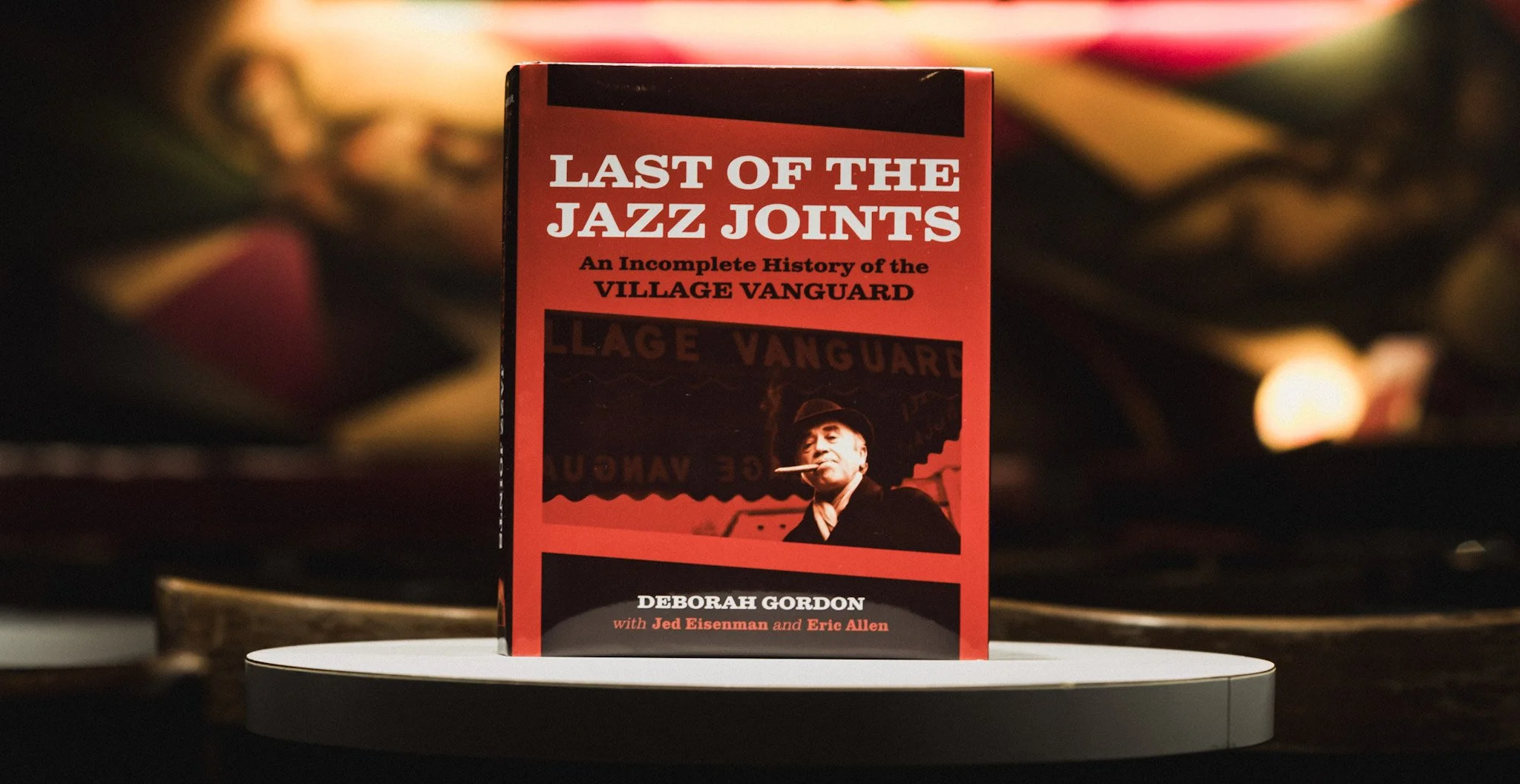
LAST OF THE JAZZ JOINTS: AN INCOMPLETE HISTORY OF THE VILLAGE VANGUARD
By Deborah Gordon, with Jed Eisenman and Eric Allen
350 pages. The Village Vanguard. $60.
A customer at the Village Vanguard wanted his money back. Miles Davis hadn’t appeared, although Wayne Shorter, Herbie Hancock, Ron Carter and Tony Williams had played. Max Gordon, the club’s proprietor, listened to the complaint, established that admission had cost $1.50, and offered three dollars—with one condition: “Don’t ever come here again.” In Last of the Jazz Joints, his daughter Deborah gives that exchange room to land. It captures the devotion, exasperation, and stubborn judgment that helped sustain the club. Those human encounters give this affectionate illustrated history its substance.
Gordon now runs the basement venue her father founded in 1935 and her mother, Lorraine, subsequently led. Her account reaches back to Max’s earlier Village Fair Coffee House and follows the Vanguard through the performers, audiences and changing tastes that shaped its identity. The familiar jazz institution emerges from a broader entertainment history, with aspiring comedians including Phyllis Diller, Lenny Bruce and Professor Irwin Corey among the people who passed through.
The Miles Davis pages bring that history down to the business of running a club. Alongside advertisements naming John Coltrane and Cannonball Adderley in Davis’s sextet, Gordon includes her father’s recollections of advances, missed appearances and bargaining over fees. When Davis asks for $6,000 to return, Max protests that the Vanguard cannot afford him. “Get yourself a bigger place,” Davis replies. The exchange exposes a tension beneath the club’s celebrated intimacy: a musician’s career could grow beyond what its small room could pay. Gordon’s willingness to include these prickly encounters gives the book texture. Her father’s devotion to jazz came with a temper, and the musicians had demands of their own.
The advertisements reward a closer look, too. One announces the Davis sextet, featuring Adderley and Coltrane, alongside singer Ethel Ennis, promoted as a Benny Goodman discovery arriving from the Brussels World’s Fair. Anita O’Day’s return appears farther down. Such details restore the musicians to a working calendar of limited engagements, matinees and competing attractions. Figures whose names now carry the weight of jazz history were also people a club had to book, advertise and pay.
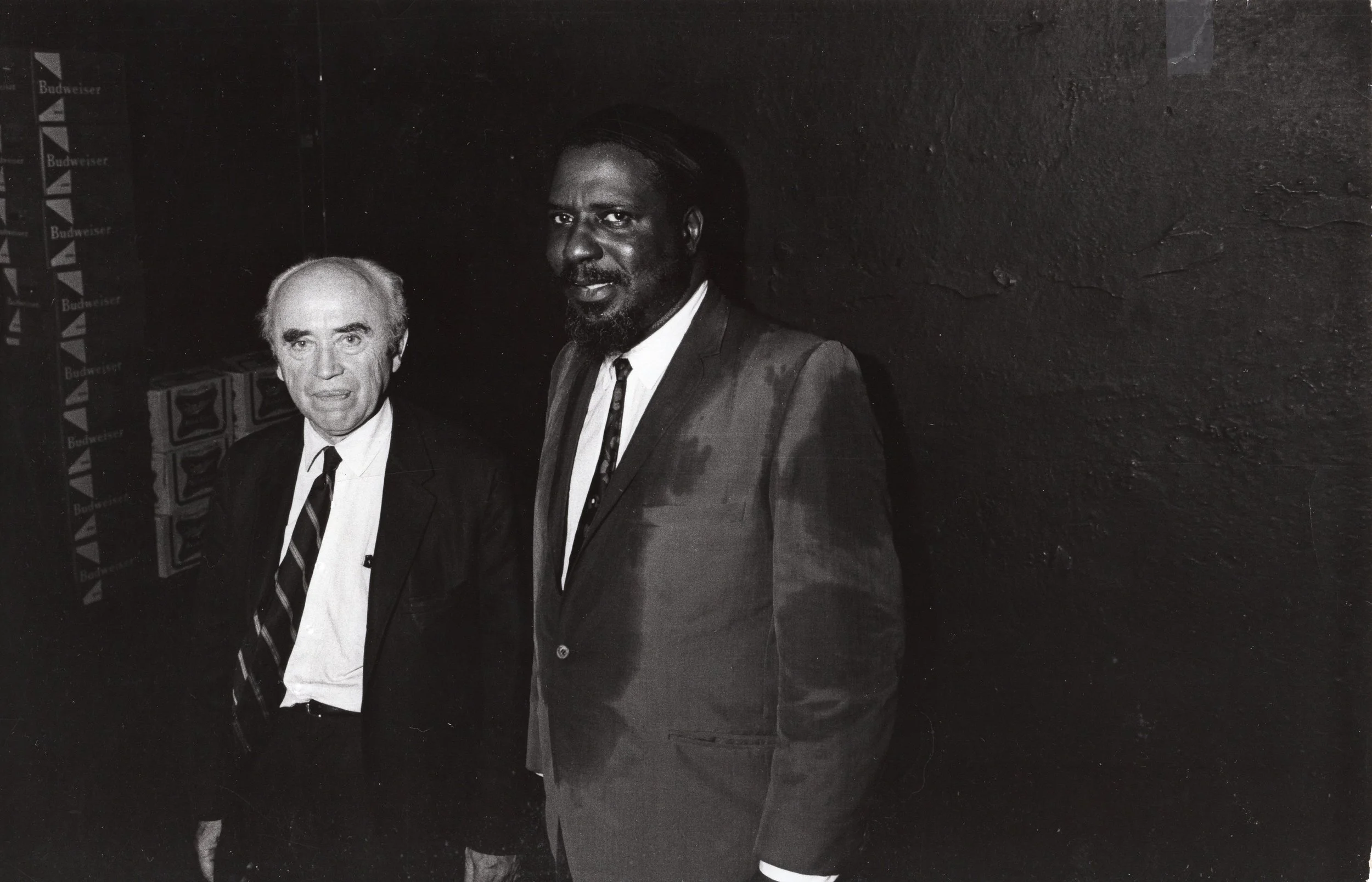
Max and Monk. Photo courtesey of the author.
Across its 22 chapters, the book combines recollections with photographs, clippings, menus and other remnants of the Vanguard’s daily life. The thick, glossy paper gives the visual material a substantial presence. This is a book to read with time to look. A reader who moves only through the prose will miss part of the argument: the documents show how the club presented itself, while the remembered conversations reveal what happened behind those announcements.
That documentary approach suits a history whose characters so often speak for themselves. The Max and Miles exchanges convey affection without smoothing away friction. They also give the proprietor a personality beyond his role as the man who supplied the stage. His judgment could be sharp, his patience limited, and his loyalty to the music stronger than his interest in pleasing every customer.
Gordon allows the practical life of the venue into the story as well. Her image of the Vanguard as sacred ground, inhabited by spirits, accommodates plumbing that fails in the middle of a set. The detail belongs here. Keeping a beloved club alive involves repairs and interruptions alongside the performances that become part of its reputation.
A discography of live recordings and a performance chronology extending from December 1938 through April 2026 give readers ways to continue exploring. They also suggest the scale of the undertaking behind the modest subtitle. No single volume could recover every evening, conversation or person who helped the place endure.
The recordings made at the Vanguard have carried its name far beyond the people who could fit inside. Gordon’s book attends to the life surrounding those performances: the bargaining, humor, work and attachments that kept the doors open. A recording preserves what happened onstage. This book helps preserve the life that made it possible.
Review copy provided by the author.
Purchase Last of the Jazz Joints directly from the Village Vanguard.
Deborah Gordon on Letting the Vanguard Tell Its Story
Interview by Steve Roby
Deborah Gordon now helms the Village Vanguard, the club her father, Max Gordon, founded in 1935. Drawing on the Vanguard’s archives and a wide range of other sources, Last Of The Jazz Joints: An Incomplete History of the Village Vanguard, traces the Vanguard’s evolution––from its origins as a home for poets, comedians, and folk singers to its emergence as one of the world's most renowned jazz clubs. A comprehensive discography of recordings made at the Vanguard and a chronology spanning nearly nine decades complement this portrait of a singular institution.
I asked how she turned that archive into the club’s story — and what she discovered along the way.

Deborah Gordon. Photo: Bob Cooley
How did you turn the club’s archive into a book?
I think the book’s title, An Incomplete History of the Village Vanguard, pretty much sums up what was on my mind. Thankfully my parents saved stuff, but things were scattered around the club in various drawers and file cabinets — photographs, old contracts, pay stubs, newspaper and magazine articles, letters, ledgers — things that we worked around every day. I had to bring it all together into one place. I realized that context was needed for all this raw material if it was going to be a book. Things had to be looked at in a different light, otherwise it would be like going through grandma’s scrapbook.
Both of my parents wrote books about the club. My father’s is somewhat episodic, and my mother’s is somewhat autobiographical. The only biography I was interested in exploring was the Vanguard’s. That’s how I thought about it. As though the club was writing its autobiography and I was the amanuensis. Most people have no idea what went on in the Vanguard prior to its emergence as a full time jazz club. I thought it was a story that was worth telling.
What did you discover about your father?
Take the chapter on calypso music, for example. I started with a 4x6 inch postcard from 1939 announcing the Exciting Calypso Recorders. How did they come to be at the Vanguard? Well, I discovered how intrepid my father could be — this was a side of him I never knew. He listens to a calypso record someone accidentally leaves at the club (I always wondered how accidental it really was), he likes the lyrics, their political poetry. He seeks out the Calypso Recorders and hires them. Not only were they a big hit, but I found a quote from an ethnomusicologist named Donald Hill saying that engagement at the Vanguard in 1939 was the “biggest catalyst to the New York calypso boom.”
How did your film-editing background shape the book?
I had been a documentary film editor for years before working at the Vanguard. That informed my process of putting this book together. I’d look at an image which would get me thinking about an idea or lead to a person I wanted to research. I was always working the images and text in tandem — one would spark the other. It was kind of a shock seeing the first chapters come back from the graphic artist, Ryan Olbrysh. I think he did a superb job making sense of what I handed him and translating it into a book which has its own set of demands, especially one like this that has so many images all throughout the pages.
Why call it an incomplete history?
How did what was happening in the world outside the Vanguard, the culture, the politics — influence what happened inside the Vanguard? I was always thinking about that — macro to micro, back and forth. That was my challenge all along the way, and of course, did I have or could I find images to back it all up. It took me seven years to try solving a big sprawling puzzle. I’m not saying I got all the pieces into place, or even that I found all the pieces, which is in part why I called it an incomplete history — there’s more to tell.
Last of the Jazz Joints: An Incomplete History of the Village Vanguard is available directly from the Village Vanguard.