Lila Downs Turns SFJAZZ Into a Celebration of Belonging
Before Grammy-winning Mexican American singer Lila Downs sang a note at SFJAZZ last Sunday, the audience was offered something practical: a reminder to know their rights.
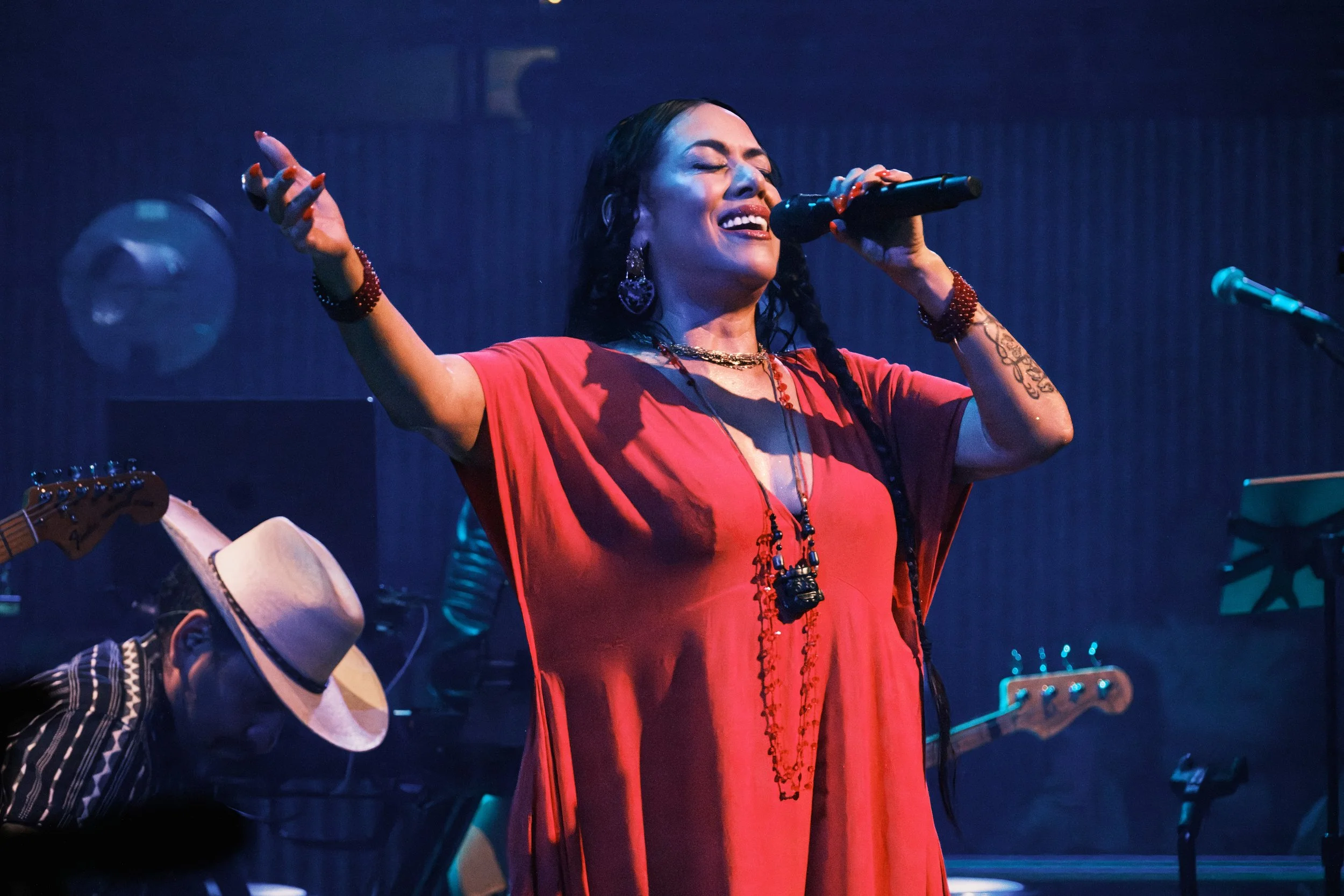
Lila Downs. Photo: Steve Roby
In a video projected above the stage, Downs spoke in Spanish about the challenges facing her community and encouraged listeners to stay informed about changes affecting their families and neighbors. She directed them to resources from the National Immigration Law Center. “The best tool for combating uncertainty is education,” she said, as translated from Spanish.
That message set the stakes for the evening. Throughout the concert, solidarity took increasingly tangible forms: familiar lyrics sung back to the stage, gifts passed from the front row, musicians moving through the audience, and Downs reaching out to shake hands as she sang.
Closing her four-night engagement, Downs faced a room of devoted listeners. Several concertgoers said they had attended every night. From my vantage point, nearly everyone in view seemed to know the words and joined in throughout the show. Individual cries of praise punctuated spaces between songs.
Low blue and red lighting and persistent stage haze created a theatrical atmosphere for the performance. Screens surrounding the stage displayed lyrics synchronized with Downs’s singing, alongside images ranging from a woman making bread and a garbage truck to artwork, an animated dancer and a jaguar. The imagery brought everyday work, the natural world and cultural memory into the same visual conversation.
Those themes also run through Cambias Mi Mundo, her current album, whose songs formed a substantial part of Sunday’s program. Alongside “El Jardín del Placer,” “La Pochota,” “Amo-Te” and the title track, the set also included “La Cigarra,” “El Último Trago” and the English-language standard “You Go to My Head.”
Downs’s seven-piece band expanded the evening’s instrumental palette with brass, accordion, guitars, keyboards, bass and percussion. Josh Deutsch played trumpet and keyboards, while George Sáenz handled trombone and accordion. Rafael Gómez played guitar, and Sinuhé Padilla contributed jarana, bajo, and zapateado, the percussive footwork that adds another rhythmic voice. Bassist Luis Guzmán, drummer Lautaro Burgos and percussionist Nakeiltha “Nikki” Campbell rounded out the ensemble.
During a pre-show interview, I asked Downs which songs felt most urgent for her to perform.
“I’ve been very angry about the racism, the discrimination, and similar situations to what ICE is doing now, as in previous decades,” she said. She explained that carrying that anger had affected her health. “I’ve looked for a peaceful way to speak my mind and my heart.”
One result was “El Jardín del Placer,” a song she described on stage as being about garbage. Its environmental concerns brought the evening’s attention to community at the level of what people consume and leave behind. The projected garbage truck gave that subject a blunt visual presence amid the show’s more lyrical imagery.
Other songs asked the audience to look more closely at things often taken for granted. Introducing “La Pesca,” Downs reminded listeners that fishermen resting on the beach at midday may have been up since four in the morning, fishing—a glimpse into the labor behind an idyllic coastal scene.
“La Pochota” approached the natural world through sensual metaphor, drawing on a tree whose earth-colored cotton evokes a lover’s skin. Across the program, plants, animals, and landscapes became part of human experience.
The evening also carried a personal dimension of renewal. Downs has spoken publicly about grieving her husband and longtime musical collaborator, Paul Cohen, who died in December 2022. In our interview, she described a difficult period without reducing it to a single cause.
“I feel like, you know, I got kicked right in the stomach, but now I’m getting stronger,” she told me.
That statement gave added resonance to the affection circulating in the room. Sunday’s concert offered ample evidence of the bond she'd built with her listeners—and her willingness to match their enthusiasm with her own.
A man in the front row offered Downs his white cowboy hat, which she wore for a song. Later, a man seated on the terrace behind the stage tossed his cap toward her and introduced himself as Mayan. Downs thanked him and acknowledged the Mayan people.
The exchanges could also become unruly. A woman in the front row began throwing individual flowers from a large bouquet at different band members before handing Downs a cluster of blooms. The commotion drew security’s attention, briefly turning the middle of the set into an unpredictable scene of airborne offerings.
Downs found a simpler expression of audience participation in a young woman dancing at her seat.
“She has the right idea,” she said, pointing up toward the solo dancer.
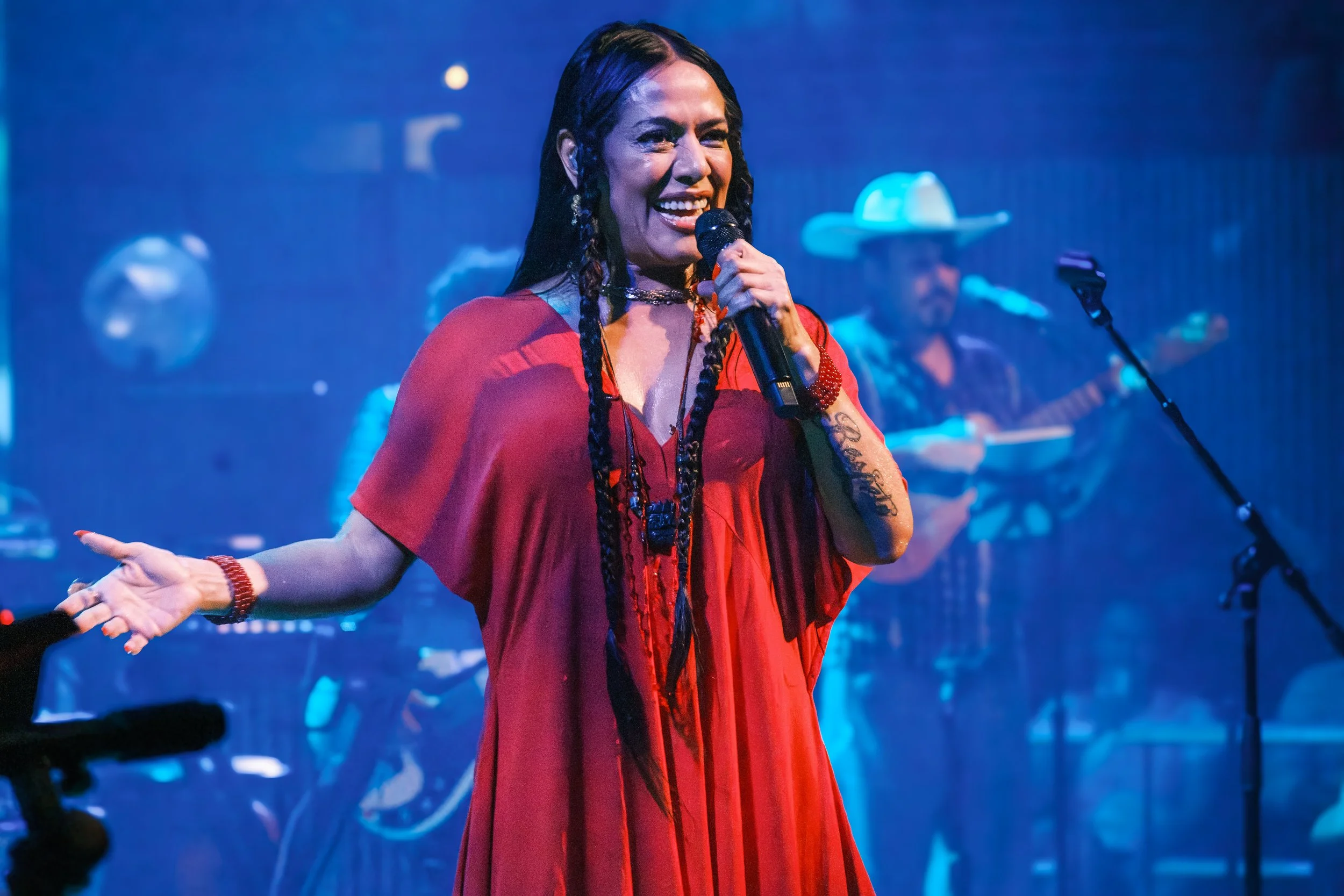
Lila Downs. Photo: Steve Roby
Soon, that idea spread. Downs stepped offstage and walked through the first several rows, continuing to sing and stopping to shake hands. Later, the acoustic guitarist, trumpeter, and trombonist also made their way through the crowd, playing as they went. Their procession helped transform the seated concert into a moving celebration. The room was on its feet, with dancers finding space wherever they could.
The line between performers and spectators blurred as the evening progressed. People sang toward Downs; she sang among them. The familiarity of the repertoire made that exchange possible, but her ease with the audience gave it warmth.
The encore sequence featured “Tortolita” and “Cariñito,” with “La Bamba” closing the celebration. As the band played, Downs lingered to take selfies with fans while security kept people from climbing onto the stage. She offered her final goodbyes, waved, and left smiling.
Earlier, she had explained why the celebration itself felt urgent.
“The celebration of cultures and the celebration of our diversity is just so important to express in this country because it’s our essence,” she told me. “It’s who we are.”
By Sunday’s end, those words had found a visible expression: a roomful of people on their feet, singing words they already knew from their shared community.
Program Notes
Artist: Lila Downs
Venue: Miner Auditorium
Location: San Francisco, California
Date: Sunday, October 18, 2026
Showtime: 7:30 PM
Personnel: Lila Downs (vocals, percussion), Josh Deutsch (trumpet, keyboards), George Saenz (trombone, accordion), Rafael Gomez (guitars), Luis Guzman (bass, synthesizer), Sinuhe Padilla (jarana, bajo, zapateado), Lautaro Burgos (drums), Nakeiltha “Nikki” Campbell (percussion)
Set List: “Icnocuicatl” (“Song of Sorrow”), “El Jardín del Placer” (“The Garden of Pleasure”), “Espina” (“Thorn”), “La Pochota” (“The Ceiba Tree”), “Amo-Te” (“I Love You”), “Mal de Amores” (“Lovesickness”), “La Pesca” (“Fishing”), “Tumba 7” (“Tomb 7”), “La Cigarra” (“The Cicada”), “You Go to My Head,” “Tu Falso Amor” (“Your False Love”), “El Último Trago” (“The Last Drink”), “Cambias Mi Mundo” (“You Change My World”), “La Cumbia del Mole” (“The Mole Sauce Cumbia”).
Encore: “Tortolita” (“Little Turtledove”), “Cariñito” (“Sweetheart”), “La Bamba.”