Kamasi Washington Delivers Personal Homily of Cosmic Jazz at Golden Gate Theatre
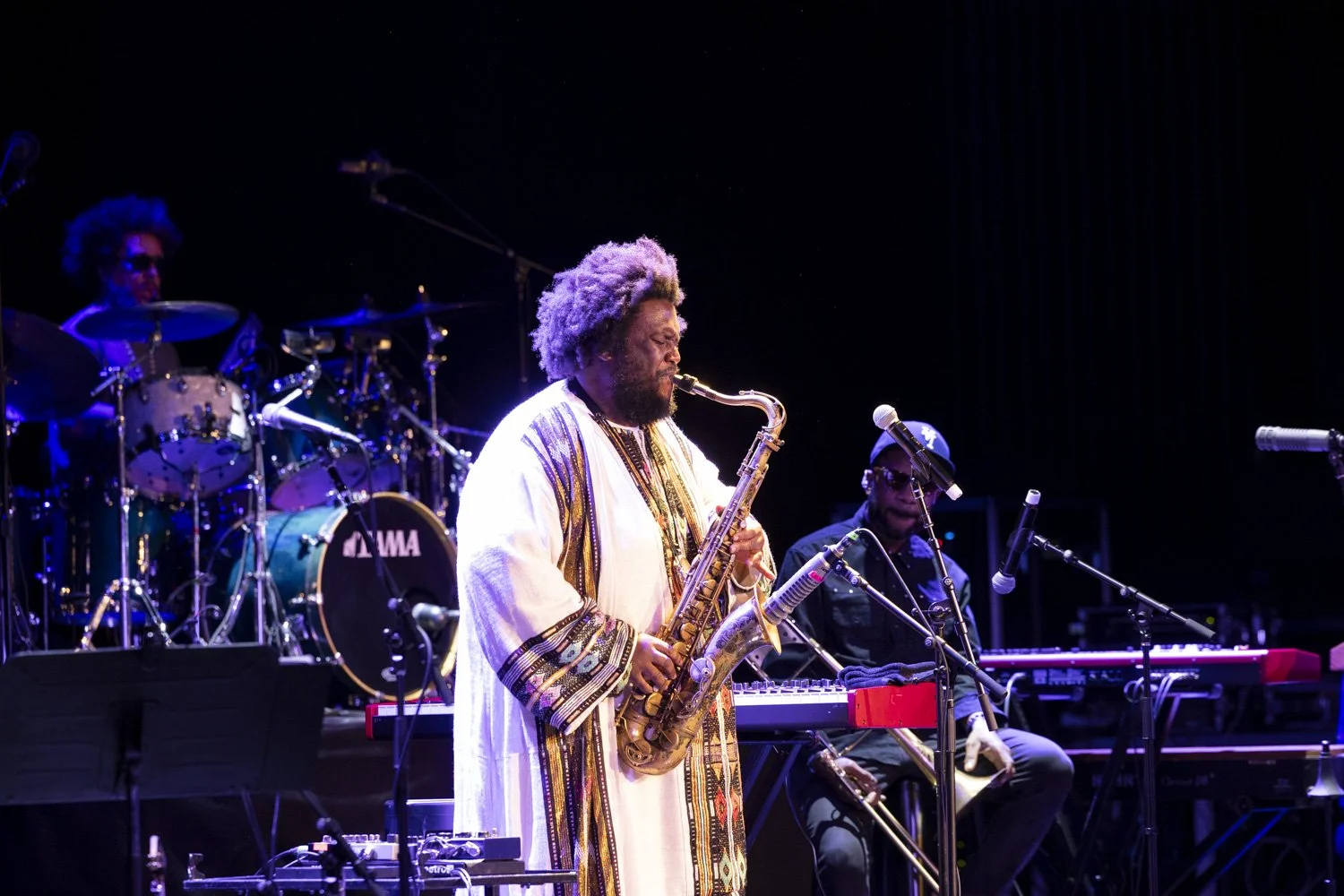
Photo by Scott Chernis
It was part big-band spiritual jazz and part family affair. Visionary saxophonist Kamasi Washington’s sold-out two-hour concert at the Golden Gate Theatre offered an evening of transcendent fusion, mixing funk, hip-hop, and masterful improvisation with surprise guest appearances.
Dressed in a pure white, loose-fitting, African-inspired robe with a green and gold, chasuble-like panel embroidered into the fabric, Kamasi Washington looked like a bishop ready to deliver his homily to his congregation. “We’re going on a little journey together,” the saxophonist declared before asking, “Everybody ready to jump?!” With that encouragement, the crowd burst into applause and cheers.
Washington and his octet began the evening with “Lesanu,” a soulful and intricate track that seamlessly blended Ethiopian devotional music with soul-funk. It began with a prayer in Ge’ez, performed by Patrice Quinn, and quickly escalated into a powerful instrumental, featuring a hypnotic rhythm and Washington’s fiery saxophone. Quinn, with prayer-like hands pointed toward the sky, gyrated in figurative dance moves as the music moved her. And then, as he often does, Washington paused the momentum for a brief sermon on the spiritual power of music.
Ami Taf Ra. Photo: Scott Chernis
“Music is such a beautiful part of being a human,” he affirmed. “It allows us to connect and stretch beyond space and time... we can just connect. That means it teaches us that we gotta take that lesson beyond the concert hall.” The crowd roared its approval of the musical manifesto, ready to follow their sax-playing shepherd on his promised journey.
This spiritual and family bond runs deep in Washington’s life and work. His father, Rickey Washington, a well-known professional woodwind player, was not only his musical mentor but also a key member of the West Coast Get Down jazz collective (Washington’s main group of L.A. collaborators). Rickey, playing directly to the right of his son, set a strong example for the family tradition, embodying the deep roots of Black musical excellence that Kamasi continues to nurture. Throughout the evening, Kamasi acknowledged his father after numerous solos, a dynamic soon broadened by the presence of other family members.
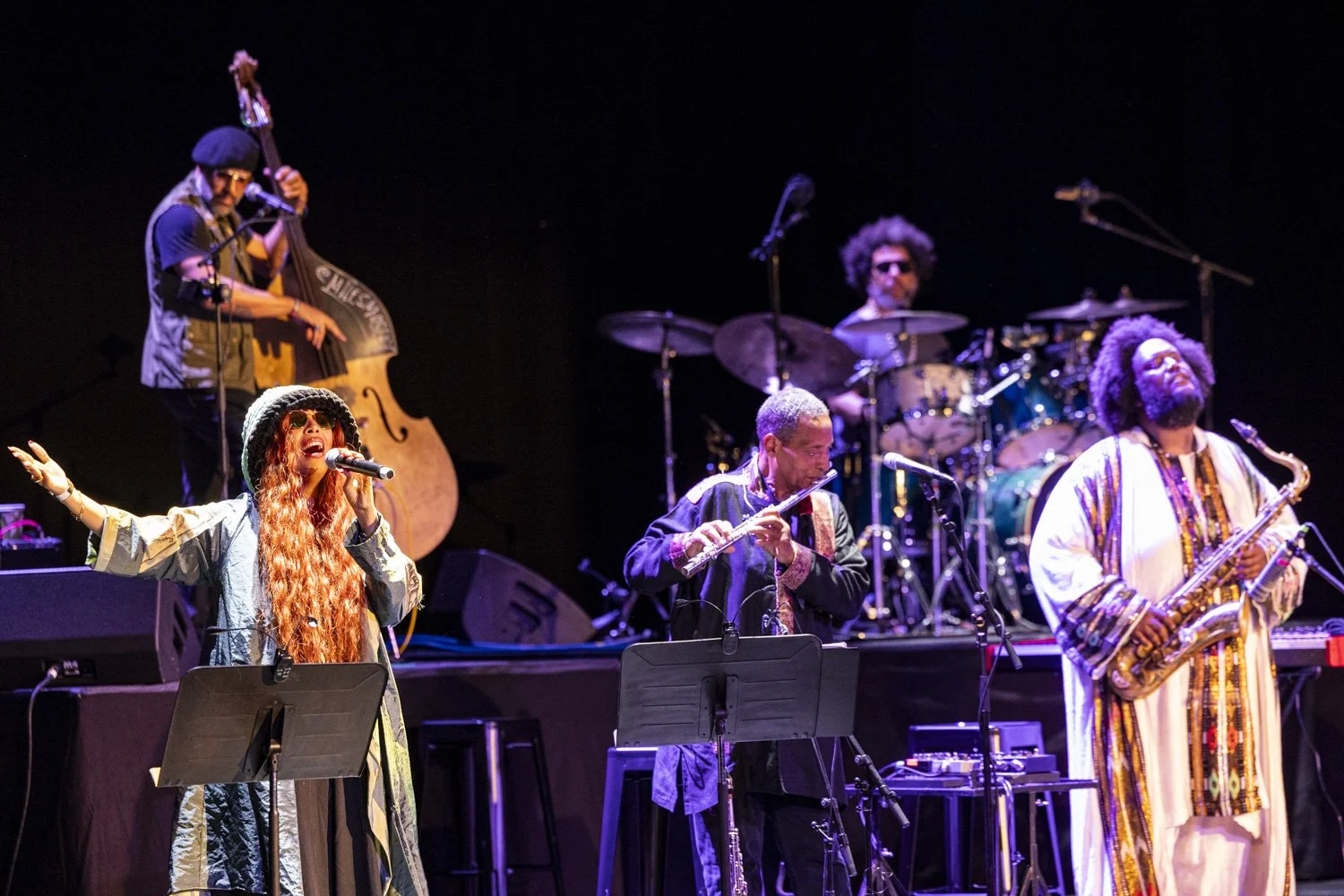
At one point in the evening, Washington introduced his wife, Ami Taf Ra, to perform the title track from her debut album, How I Became a Madman (Brainfeeder, 2025). Dressed in a green gown, with waist-length red curly hair, sunglasses, and a puffy cap, she delivered a stunning, elegant vocal performance. Washington then explained the song’s literary origin, setting the stage for the deeply personal piece: “I worked on a record that was recently released with a very special artist... the love of my life, Miss Ami Taf Ra. The song is a tribute to the great writer Khalil Gibran, inspired by his books The Prophet and The Madman.” After their intimate collaboration, the focus shifted from Washington’s partnership to his role as a father, as he introduced a composition inspired by the youngest member of his musical family.
Saxophonist Ayo Brame. Photo: Scott Chernis
The family spotlight then shifted to the youngest generation. Washington introduced the song “Asha the First” from his 2024 album Fearless Movement (Young), sharing a heartfelt story about its origin. He explained that his daughter, Asha, wrote the melody when she was just two years old: “She would get up early every morning and play the piano... One day, she went to the piano and played this [melody], and it suddenly dawned on her that if she played the same keys, the same notes would come out. She had the idea of composing music in that moment.” Washington recorded her spontaneous improvisation and built the intricate track around it, showing how inspiration for his work often begins at home. After sharing this family story, Washington then focused outward, inviting a rising and talented musician from Oakland onto the stage to continue the jazz tradition.
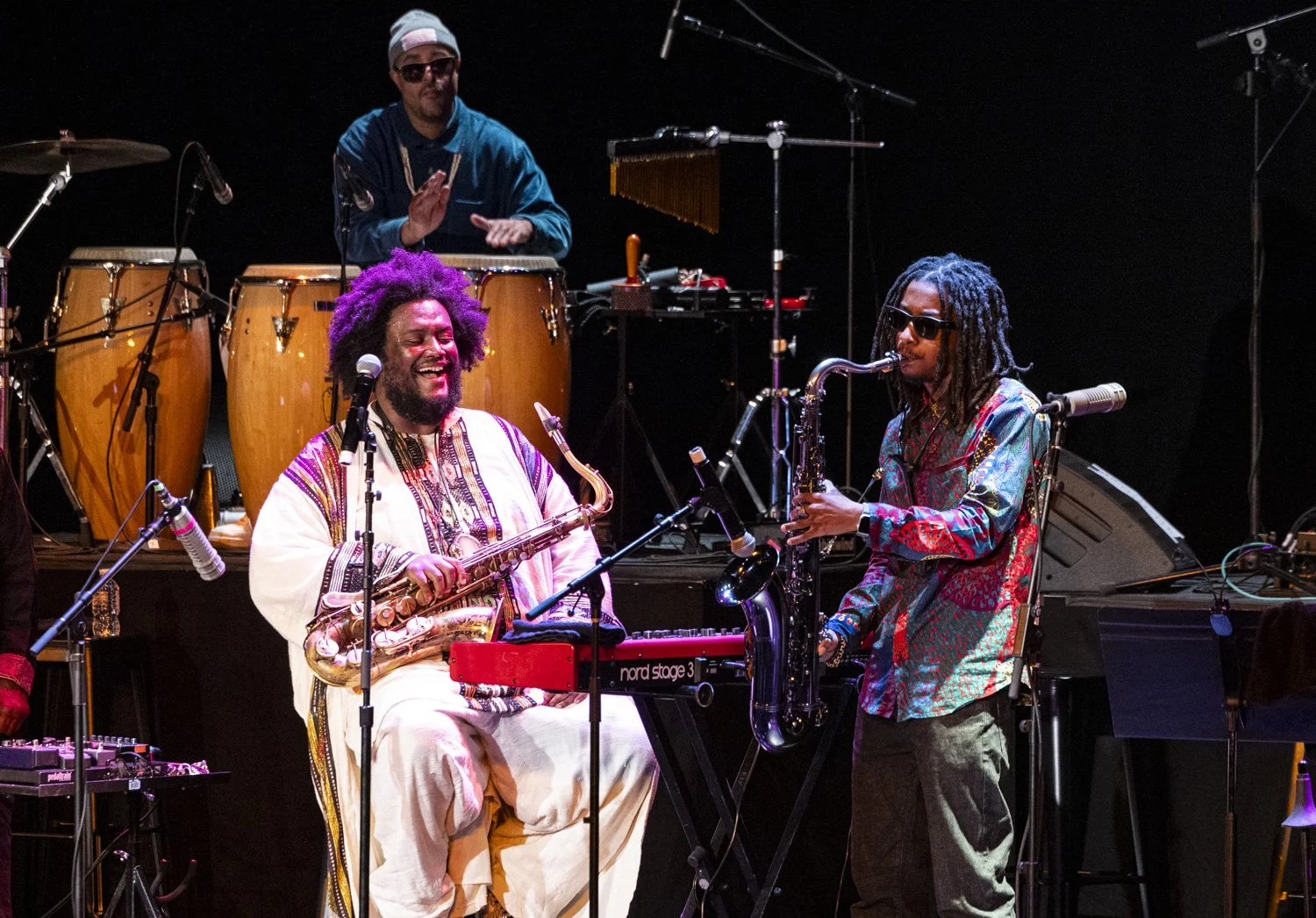
The stage then welcomed the next generation: 19-year-old tenor/soprano saxophonist Ayo Brame from Oakland. Brame, known for drawing influences from jazz legends like John Coltrane and Sonny Rollins, walked on with the confidence of a seasoned player, dressed in a vibrant, multi-colored shirt and sunglasses. They performed “Askim,” a dynamic track that blends spiritual jazz with a driving, hard-funk rhythm. The song’s serene, Coltrane-like spirituality fused with a contemporary, hip-hop-inspired groove, offering a perfect showcase for Brame’s powerful and expressive solo. Washington watched, smiling and visibly impressed, a testament to his dedication to both the tradition and the future of the music. With the mentorship moment complete, the ensemble turned its attention to the final, transcendent chapter of the evening.
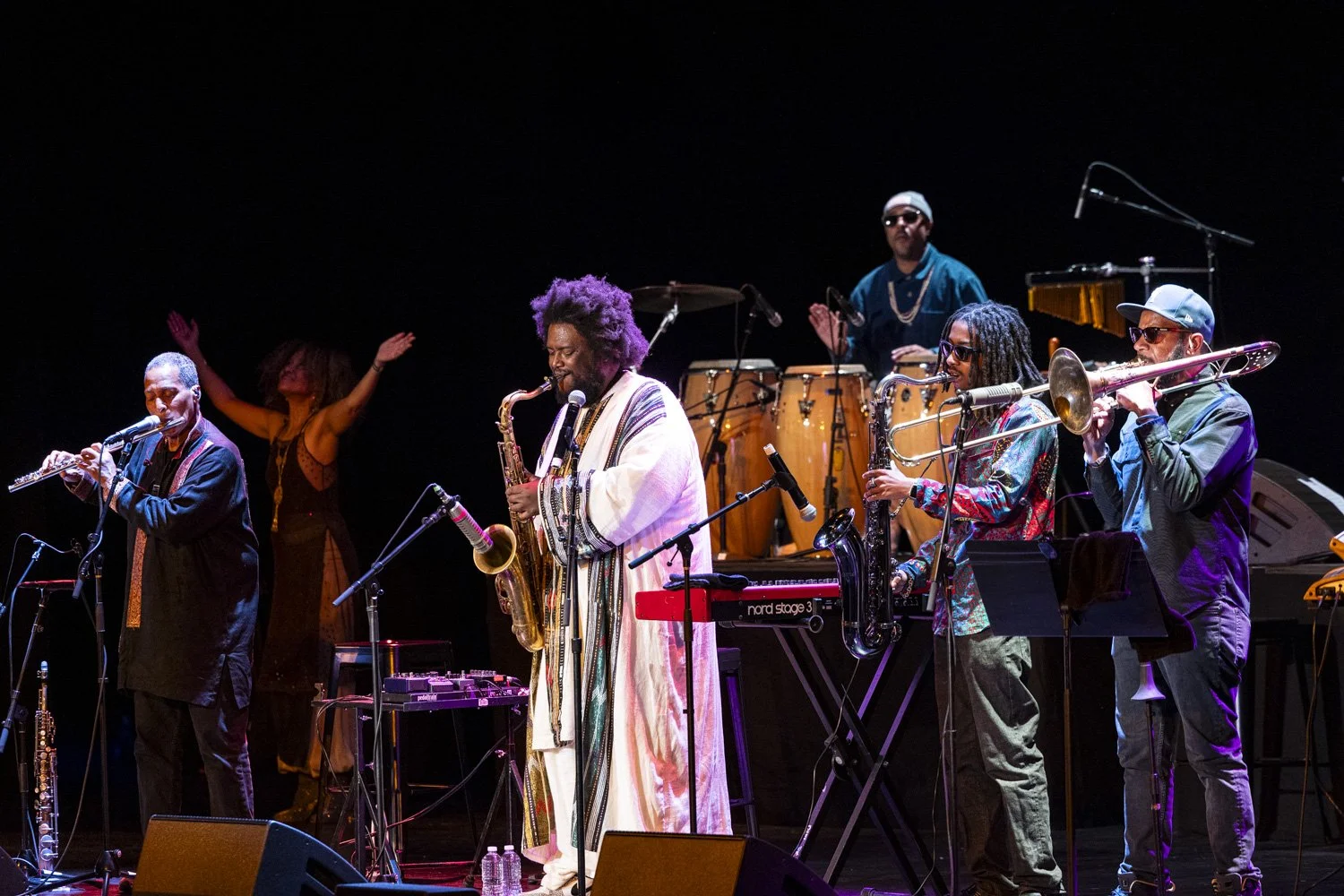
Photo: Scott Chernis
As the concert reached its final song, “Vi Lua Vi Sol,” the audience was at its peak of excitement. The band received spectacular final solos: Miles Mosley amazed everyone with another innovative upright bass solo, blending his bow and wah-wah pedal, and drummer Tony Austin delivered a powerful performance. Ryan Porter added his distinctive, soulful voice through the trombone. During these closing moments, the audience itself became part of the music. This was no polite performance. The crowd stood cheering, cameras raised, reflecting a diverse mix of people, from seasoned jazz fans and families at their first show to hip-hop enthusiasts who discovered Washington through Kendrick Lamar and regulars on the San Francisco concert circuit. In the vast space of the Golden Gate Theatre, Washington’s large-scale, spiritually charged jazz felt immediate and deeply shared.
With the house lights briefly dimmed and the stage empty, the audience’s sustained applause successfully called Washington back for an encore. He delivered a powerful final statement with “Prologue.”
Looking out at the ecstatic crowd, Washington and his ensemble reached their highest goal. We saw a band trying to make grandeur feel personal, and they succeeded: the vast, cosmic sound became profoundly human.
PROGRAM NOTES
Event: Kamasi Washington – Fearless Movement Tour
Date: Saturday, November 15, 2025
Showtime: 8:00 PM
Venue: Golden Gate Theatre, San Francisco, CA
Presented By: SFJAZZ
Photos: Scott Chernis.
SETLIST
The repertoire drew heavily from Kamasi Washington’s 2024 album Fearless Movement, with earlier material from The Epic and Heaven and Earth, plus “How I Became a Madman” from Ami Taf Ra’s debut The Prophet and The Madman.
“Lesanu”
From the album Fearless Movement (2024). Opening the evening with a prayer in Ge'ez (an ancient Ethiopian language), this piece serves as a spiritual invocation. It is a dedication to a late friend of Washington’s, blending traditional Ethiopian musical modes with modern jazz fusion to explore themes of loss and renewal.
“Re Run”
From the album The Epic (2015). A fan favorite from Washington’s breakout triple album, this track features driving, complex rhythms that highlight the ensemble's "telepathic" interplay—a result of the band members playing together since childhood in South Los Angeles.
“Asha the First”
From the album Fearless Movement (2024). Composer: Kamasi Washington, Akili Asha Washington, Taj Austin, Ras Austin. A testament to musical heredity, this piece is built around a melody composed by Washington’s daughter, Asha, when she was just two years old. The live performance captures the joy of that first musical discovery.
“Askim”
From the album The Epic (2015). A monumental spiritual jazz piece often used to showcase the ensemble's stamina and individual virtuosity. Tonight’s performance features a special guest appearance by 19-year-old saxophone prodigy Ayo Brame.
“How I Became a Madman”
From the album The Prophet and The Madman (Brainfeeder, 2025). Performed by Ami Taf Ra. A special preview of vocalist Ami Taf Ra’s upcoming debut album. The piece is inspired by the writings of Kahlil Gibran (The Prophet, The Madman) and features lyrics that explore the liberation found in stepping outside societal norms.
“Road to Self (KO)”
From the album Fearless Movement (2024). An extended, improvisational journey that Washington describes as a musical exploration of the subconscious. It is designed to be different every night, reflecting the shifting nature of the self.
“Vi Lua Vi Sol”
From the album Heaven and Earth (2018). Translated loosely as "Seen Moon, Seen Sun," this high-energy closer features a distinctive dual-drum attack and aggressive bowed bass solos, symbolizing the balance between light and dark.
ENCORE
“Prologue”
From the album Fearless Movement (2024). Composer: Astor Piazzolla | Arranger: Kamasi Washington. Originally titled "Tango apasionado," this reimagining of the Argentine tango master’s work bridges the gap between dance music and jazz—a central theme of the Fearless Movement era.
THE COLLECTIVE (West Coast Get Down)
Kamasi Washington (Bandleader / Tenor Saxophone)
A multi-instrumentalist and composer from Los Angeles, Washington has revitalized cosmic jazz for the modern era. His work includes the award-winning The Epic, the score for the Michelle Obama documentary Becoming, and collaborations with Kendrick Lamar, Florence + The Machine, and Herbie Hancock.
Rickey Washington (Flute / Soprano Sax)
Kamasi’s father and first teacher. A fixture of the Los Angeles jazz scene, Rickey has performed with legends like Earth, Wind & Fire and The Temptations. His presence on stage underscores the multi-generational theme of the evening.
Ryan Porter (Trombone)
A founding member of the West Coast Get Down and a childhood friend of Washington. Porter is a prolific bandleader (notably for his album The Optimist) known for his soulful, precise articulation that anchors the horn section.
Miles Mosley (Upright Bass)
Often called the "Jimi Hendrix of the upright bass," Mosley is renowned for running his double bass through effects pedals (delay, wah, distortion) to create a sound that rivals an electric guitar.
Brandon Coleman (Keyboards / Vocoder)
Frequently referred to as "Professor Boogie," Coleman is a keyboard wizard who blends jazz fusion with P-Funk-style vocoder work. He provides the cinematic, space-age textures that define the band's "cosmic" sound.
Tony Austin (Drums)
The heartbeat of the ensemble. Austin is not just the drummer but also a key sound engineer for the group, having mixed and engineered much of Washington's studio work, including The Epic.
Patrice Quinn (Vocals)
The band’s spiritual anchor. Quinn’s ethereal voice and interpretive stage presence have been a defining element of Washington's live shows for over a decade, bridging the gap between jazz instrumentation and lyrical storytelling.
Allakoi Peete (Percussion)
A master percussionist who adds a crucial layer of polyrhythms to the band's sound, expanding the music's roots into Afro-Latin and African traditions.
SPECIAL GUESTS
Ami Taf Ra (Vocals)
A vocalist and composer whose work explores spiritual and literary themes. Her debut album, The Prophet and The Madman, is slated for release on Brainfeeder in 2025.
Ayo Brame (Saxophone)
A 19-year-old saxophone prodigy from Oakland, CA. Brame is quickly making a name for himself in the Bay Area jazz scene, known for a sound that honors the traditions of Coltrane and Rollins while pushing the music forward.