Inside Immanuel Wilkins’ SFJAZZ Residency
At SFJAZZ’s Listening Party, Immanuel Wilkins offered audiences a first look into his residency week: the questions behind Recitations, the mentors who influenced him, and the deeper purpose of inviting listeners into the work before the concerts started.

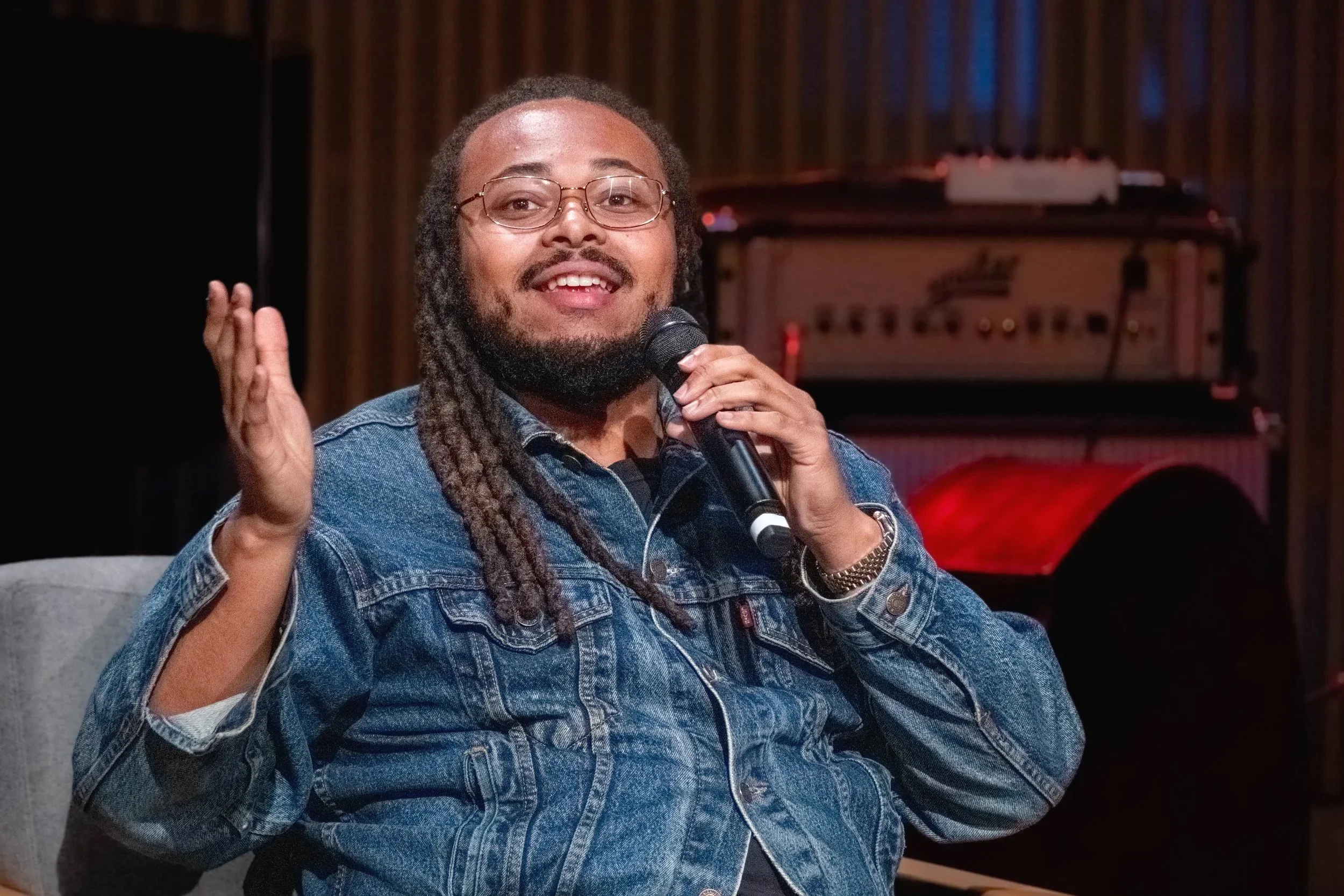
Immanuel Wilkins and Ross Eustis. Photo: Steve Roby
An SFJAZZ residency offers more than just a series of performances. The Listening Party platform gives concertgoers the opportunity to preview shows in advance and become familiar with the Artistic Resident before the music sets the tone for the week. The Listening Party format is designed for this kind of access: an onstage conversation where the artist shares stories, plays excerpts, and offers insight into the upcoming work. On Wednesday night, Immanuel Wilkins shared that insight in conversation with Ross Eustis, SFJAZZ’s Director of Digital. Wilkins approached the evening as a serious step in preparing for the upcoming residency.
What emerged over the hour was a vivid portrait of an artist contemplating form, audience, history, and responsibility simultaneously. Wilkins discussed growing up in Philadelphia, learning within a culture of mentorship, hearing Amina Claudine Myers as a catalytic influence, and creating his SFJAZZ commission, Recitations, as a piece that demands more from a room than passive listening. He repeatedly emphasized his broader goal: to change the dynamics between bandstand and audience.
Philadelphia as Formation
Wilkins’s account of Philadelphia set the tone for everything that followed. “I think it was a blessing to grow up in Philly,” he said. “Philadelphia is one of those places where that old-school type of mentorship still feels possible.” He spoke with affection about organist Trudy Pitts, who “really took me under her wing,” and about Lovett Hines at the Philadelphia Clef Club, where generations of Philadelphia musicians passed through before him. “She really saw something,” Wilkins said of Pitts, and the phrase carried a quiet strength. It conveyed the feeling of being recognized early by elders who helped shape a young musician’s sense of possibility.
That sense of formation deepened when Wilkins described his childhood experiences with the Sun Ra Arkestra. He played with the group when he was still very young, sitting beside Marshall Allen, absorbing sound and presence before fully grasping the magnitude of the company he was keeping.
One lesson stayed with him. Wilkins remembered trying to imitate Allen’s language, only to hear the elder altoist tell him, “Play like yourself.” The comment landed as permission and a challenge in the same breath. Wilkins said those early experiences taught him that a great ensemble could be built from “a bunch of different individual voices” moving together.
That memory matters because it helps explain the larger framework of the residency. Wilkins views lineage as something active, passed from one person to the next. He values elders as collaborators, catalysts, and sources of influence. The Listening Party conveyed that ethos clearly before the residency’s first note.
Amina Claudine Myers as Catalyst

When the conversation shifted to Recitations, Amina Claudine Myers quickly took center stage in the story. Wilkins remembered first hearing her at Muhal Richard Abrams’s memorial service and realizing then that he wanted to make music with her. When the SFJAZZ commission came, the path became obvious. “This is actually the perfect occasion to work with her,” he said. Then he emphasized her role strongly: “She was really the foundation and catalyst for all this music.”
That line centered the commission around a human element. Wilkins said he had “no idea what this was going to sound like,” but he knew “it would sound like Amina Claudine Myers.” That suggests the piece began as an act of listening to her tone, her history, her emotional climate, and her way of carrying sound through a room. Recitations features Wilkins’s quartet alongside Myers, Marvin Sewell, Holland Andrews, and Brontë Velez, and the lineup alone underscores a project built around grain, voice, and spiritual depth.
“Dissolving the Bandstand”
The most powerful part of the evening was when Wilkins explained what Recitations aims to do. “I’m constantly thinking about the ways that we can reconstitute the terms of engagement of the bandstand,” he said. He wants to “dissolve the bandstand,” to change the old setup where artists perform and audiences watch from a safe distance. His model was partly inspired by the Black church, which he described as a place of intellectual rigor and radical gathering, and partly from kirtan songs, with their simple melodies repeated until something happens. “I wanted to turn this into, like, a spiritual space and also a space for intellectual rigor,” he said.
He was clear about the mechanics. The audience will receive booklets. They will read aloud together. The goal is to confront language publicly, to sit with “tough facts,” and to experience the work as a shared act rather than a stage presentation. Wilkins’s urgency was evident with notable directness: “Let’s just actually get to it,” he said. “I think it’s really important during this time to really just lay things out there.”
One of the evening’s most powerful moments happened when Wilkins admitted, “I am generally anti-audience participation.” The crowd laughed, but he continued. He isn’t interested in routine sing-alongs or simple crowd work. He’s after something more intense. He described watching Carrie Mae Weems engage an audience in collective recitation and feeling the emotional impact in the room. “There is something that happens a few minutes into that kind of work,” he said, “where the audience actually starts to feel connected to one another in a transformative way.” A few moments later, he made the clearest statement of the residency’s deeper goal: “I’m chasing a performance — a gathering — where the audience is experiencing the exact same thing that the musicians are.”
Heroes in the Room

The conversation also clarified how much this residency means to Wilkins as a chance to bring his heroes into worlds he has created. Talking about David Murray, who joins him on Friday’s Joe Henderson Lab program, Wilkins remembered the first time they played together. “I was afraid,” he said. “I was scared.” Then came the moment that made the memory real: “I was so excited by that feeling as well.” That blend of fear and excitement felt central to the entire evening. Wilkins seeks music that raises the room’s energy, music that demands more from those inside it.
“I feel like a kid in the candy shop, because I get to build these worlds that my heroes get to exist in.” That sentence revealed the heart of the residency. It is about craft, certainly. It is about composition, ensemble, and argument. It is also about gratitude, access, and the rare chance to hear a living lineage in motion. “These are moments that we can’t take for granted,” he said. By the end of the Listening Party, that idea felt firmly planted in the room.
Show Information
Immanuel Wilkins’s SFJAZZ residency takes place from March 25 to 28, 2026. It kicks off with a Listening Party in Miner Auditorium on Wednesday, March 25. The residency continues with Recitations: Immanuel Wilkins Quartet featuring Amina Claudine Myers and Marvin Sewell on Thursday, March 26, at 7:30 p.m. in Miner Auditorium. It then moves to the Joe Henderson Lab for The Immanuel Wilkins Quartet with special guest David Murray on Friday, March 27, at 7:00 p.m. and 8:30 p.m., followed by The Immanuel Wilkins Quartet: CD Release Celebration on Saturday, March 28, at 7:00 p.m. and 8:30 p.m. Show details and ticket information are available through SFJAZZ.
Photos: Steve Roby