Take 6 and the Architecture of Harmony
Four decades in, Take 6 still builds its sound on close listening, disciplined arranging, shared history, and a belief that melody outranks everything else. Across an afternoon masterclass, a conversation with founder Claude McKnight, and the closing night of a four-night SFJAZZ residency, the group laid out the blueprint. Then six voices showed how to make it stand.
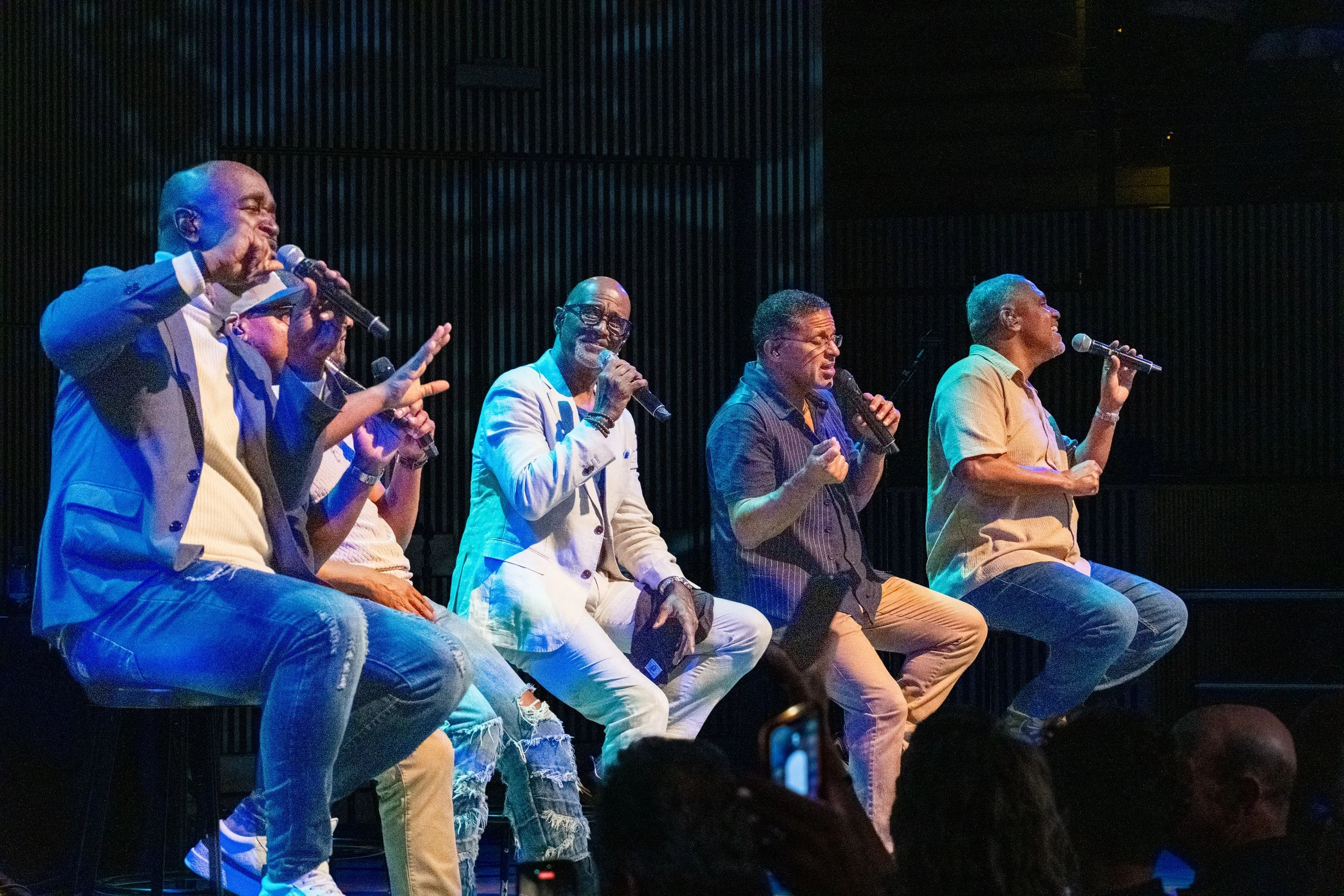
Take 6 at Miner Auditorium, August 16, 2026/ Photo Steve Roby
On a Friday afternoon in San Francisco’s Mission District, Take 6 traded SFJAZZ’s Miner Auditorium for a room seating about 30 people. The Aug. 14 masterclass at Muddy Waters Café & Lounge put producers, arrangers, singers, and beginning students within arm’s reach of a group whose six-part harmonies have influenced vocalists for two generations. Take 6 dismantled its sound, piece by piece.
From a College Bathroom to Six Voices
In 1980, McKnight formed a quartet at Oakwood College in Huntsville, Alabama, where a cappella singing was a staple of campus life. Mark Kibble, hearing the group rehearsing in a bathroom, stepped in and added another line.
“Once he joined the group, he pretty much started arranging for us,” McKnight told me. “That gave us a sound that was distinct from everybody else’s.”
Each added voice broadened the harmonic vocabulary. The eventual six-part format allowed tight clusters, jazz voicings, rhythmic counterpoint, and gospel inflection to coexist. Yet the mission remained simple: spread love. The phrase became one of the group’s signature songs and, according to McKnight, still describes what Take 6 wants its music to accomplish.
The Five Commandments

Joey Kibble at Muddy Waters Cafe. Photo: Steve Roby
At Muddy Waters, history gave way to craft. Take 6 calls its arranging principles the Five Commandments, with enough humor to acknowledge that musical rules are meant to be tested.
First, affiliate with a group. An arranger needs a laboratory where ideas can leave the page, enter actual voices, and return with honest feedback. Second, listen at least as much as you write; stylistic range gives an arranger a broader vocabulary. Third, work from broad to specific, settling the feel, density, and balance between lead and ensemble before individual voicings. Fourth: conserve musical ideas. The group compared arranging to baking. Dumping the entire spice cabinet into the cake does not improve it. Experience teaches an arranger which ideas a song needs, and which can wait.
Then came the fifth governing principle: melody is king. Six voices can create formidable harmonic density, but the listener still needs a song to follow. “If you lose the melody, the arrangement doesn’t matter,” McKnight told the room.
That principle also frames Rhapsody, Take 6’s next album, due in early 2027. The record draws on standards such as “Rhapsody in Blue,” “Blue Skies,” “A Night in Tunisia,” and “It Don’t Mean a Thing.” Familiar material poses a particular challenge: preserve what listeners know while making the arrangement unmistakably Take 6.
What Forty Years Buys
That balance between identity and restraint helps explain the group’s durability. Take 6 has moved through gospel, jazz, R&B, and pop while maintaining a recognizable harmonic language. The current lineup, McKnight, Mark Kibble, Joey Kibble, David Thomas, Alvin Chea, and Khristian Dentley, still draws on the vocabulary developed in Huntsville.
McKnight also rejects a fixed-stage routine. Songs may remain in the book for years, but the way they are approached changes. “We look at each other, we frown, we laugh,” he said. “Every performance is so different that it’s part of what keeps it fresh for us.”
Sunday night supplied the evidence.
Closing Night at Miner Auditorium
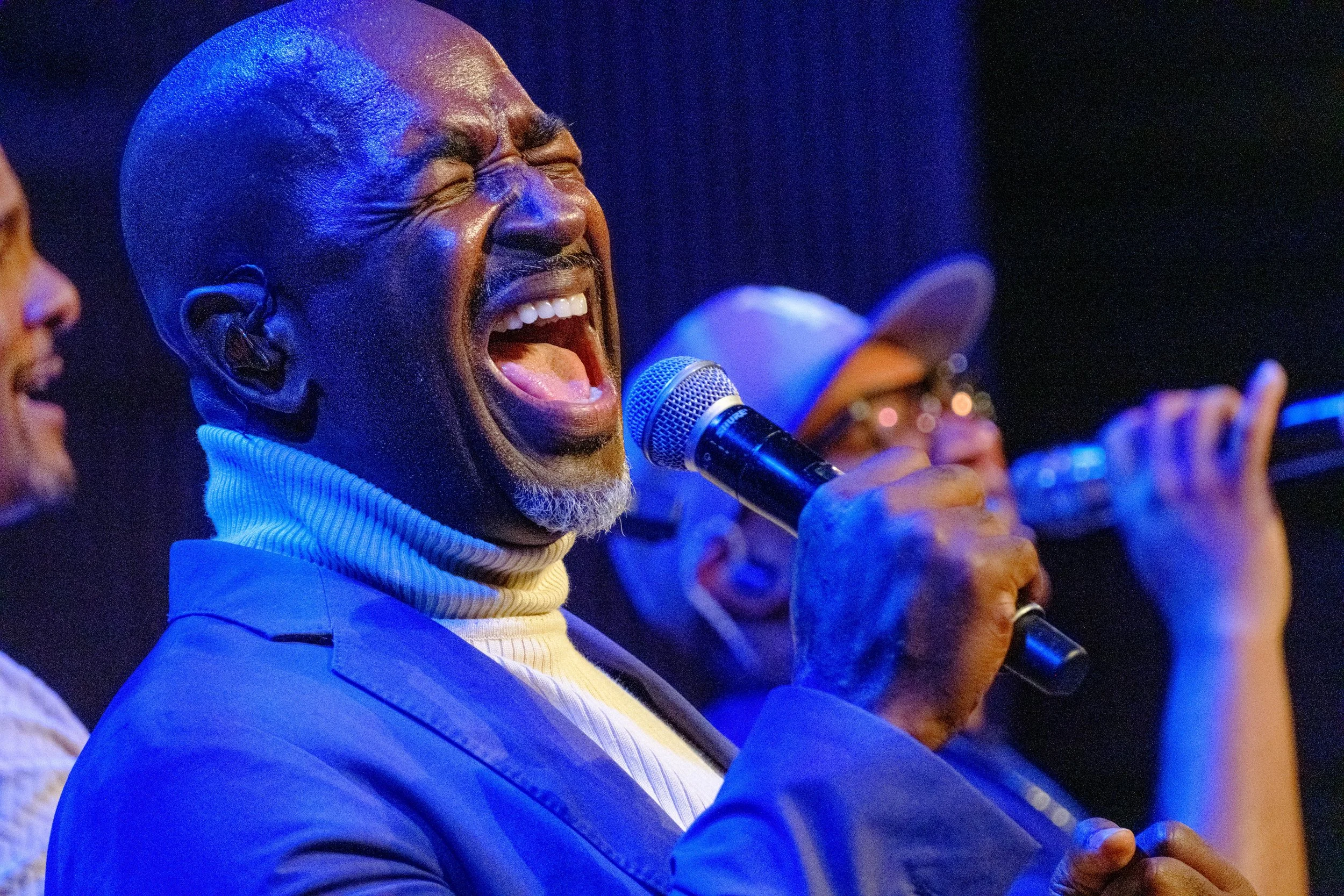
Alvin Chea. Photo: Steve Roby
The most revealing moment arrived in “The Windmills of Your Mind.” Joey Kibble introduces Michel Legrand’s song from The Thomas Crown Affair, joking that Take 6 would gladly offer its arrangement for the closing credits of a third version of the film, which he says is in development. Then the six voices weave the familiar melody through layers of harmony so dense that the commandment to conserve ideas seems briefly endangered.
They get away with it because the tune remains legible. The melody keeps surfacing through moving inner voices, rhythmic syllables, and chords that seem to change color even as they continue to sound. Here the masterclass becomes audible: broad design first, detail second, technique in service of recognition.
The same principle shapes a preview of “God Bless the Child” from Rhapsody, Take 6’s first studio album since Iconic. The standard retains its identity, while the voicings, pacing, and vocal textures carry the signature McKnight described two days earlier.
Elsewhere, the set traces the group’s history. “Spread Love” reconnects the mission with the repertoire. “Mary, Don’t You Weep” and “I Wanna Go to Heaven and Rest” draw the Sunday-night crowd toward the church roots that underlie the group’s sophistication. “Yo’ Jeans” evokes a different kind of memory. The group recalls touring with Al Jarreau when its members were young enough to play basketball and ride bicycles before sound check, while Jarreau was already guarding his sleep. Thirty-five years later, the joke lands differently, and their arrangement carries affection without slipping into imitation.
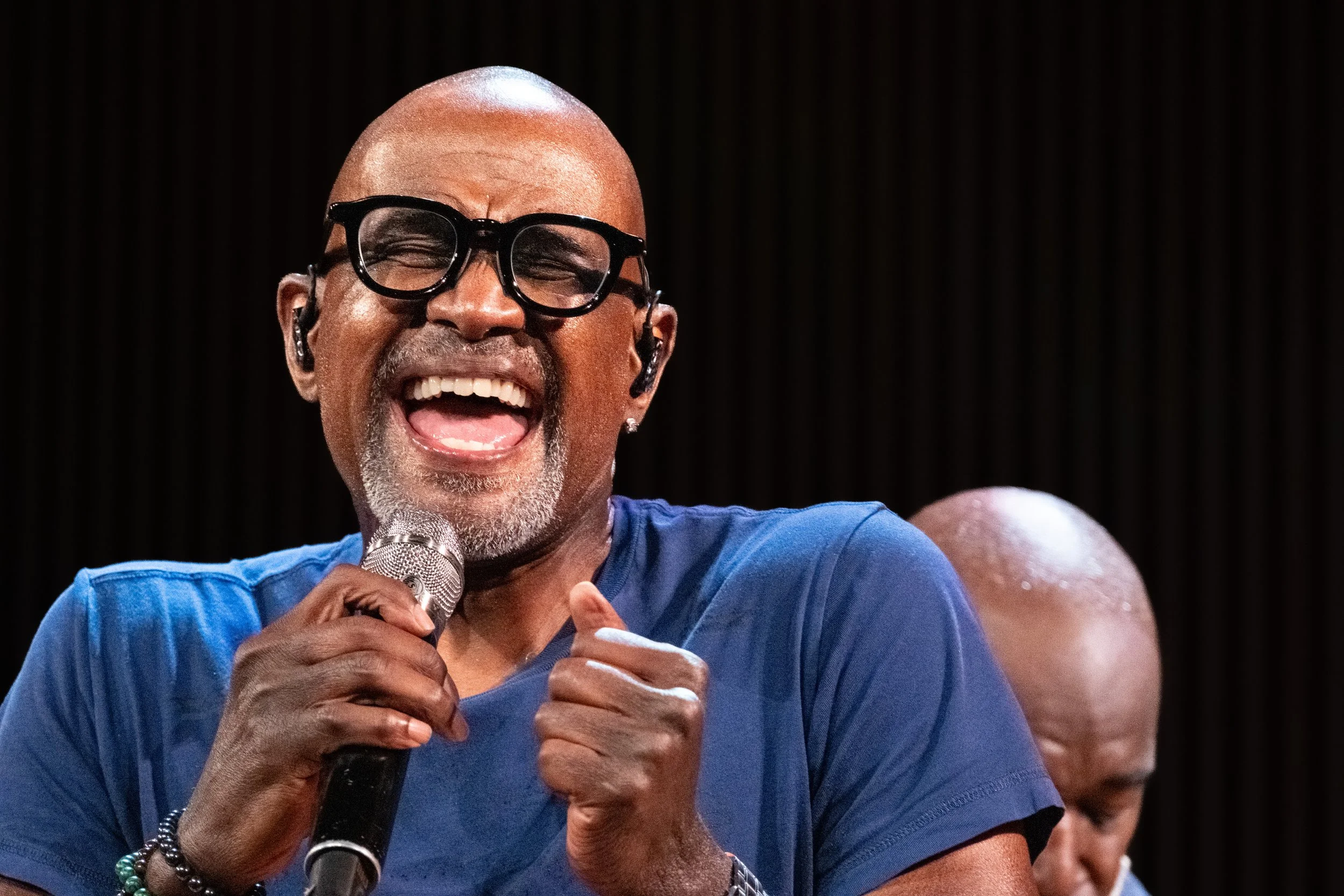
The between-song interplay validates McKnight’s description of rehearsal-room behavior spilling onto the stage. Members tease one another with gestures, trade stories, and let the evening breathe. A long anecdote about once posing unknowingly with Nelson Mandela resolves into a lesson on treating the person beside you as a potential “world changer.” The audience follows the instruction, turning to strangers and shaking hands. In the room, the gesture connects directly to McKnight’s mission to “spread love.”
For the main-set finale, “Stand By Me” turned Miner Auditorium into something between a choir loft and a block party. The audience stands, claps, waves, and sings the familiar refrain as the arrangement makes participation part of the music. The encore widens the family circle when Mark Kibble’s daughter, Chloe Kibble, joined the group from the audience for “Biggest Part of Me.”
Forty-six years after McKnight’s college quartet began singing into bathroom tile, Take 6 still treats harmony as a structure built within listening: to melody, to one another, to the history inside a song, and to the room before them. The closing night at SFJAZZ revealed an architecture sturdy enough to hold the past and flexible enough for a standards album still ahead.
Program Notes
Artist: Take 6
Event: SFJAZZ Summer Sessions 2026, four-night residency, Aug. 13–16, 2026
Date/Showtime: Sunday, Aug. 16, 2026, 7 p.m.
Venue: Miner Auditorium, SFJAZZ Center, San Francisco
Personnel: Claude McKnight (first tenor), Mark Kibble (second tenor), David Thomas (tenor/high lead, guitar), Joey Kibble (tenor/high lead, guitar), Khristian Dentley (baritone, piano), Alvin Chea (bass, keyboards), and Chloe Kibble (guest vocals on “Biggest Part of Me”).
Set list: “Back n Love,” “Got to Get You into My Life,” “Feels Good,” “Every Day I Have the Blues,” “Spread Love,” “Mary Don’t You Weep,” “Yo’ Jeans,” “Overjoyed,” “The Windmills of Your Mind,” “Homeless,” “Sailing,” “God Bless the Child,” “I Wanna Go to Heaven and Rest,” “Stand By Me,” “Roof Garden.”
Encore: “Biggest Part of Me”
Podcast Interview: https://www.backstagebayarea.com/interviews/take-6-still-spreads-the-love-after-four-decades