Stewart Copeland: An Earful Of Everything
The Police drummer and film composer packs fifty years into one Presidio Theatre night, and barely stops to breathe.
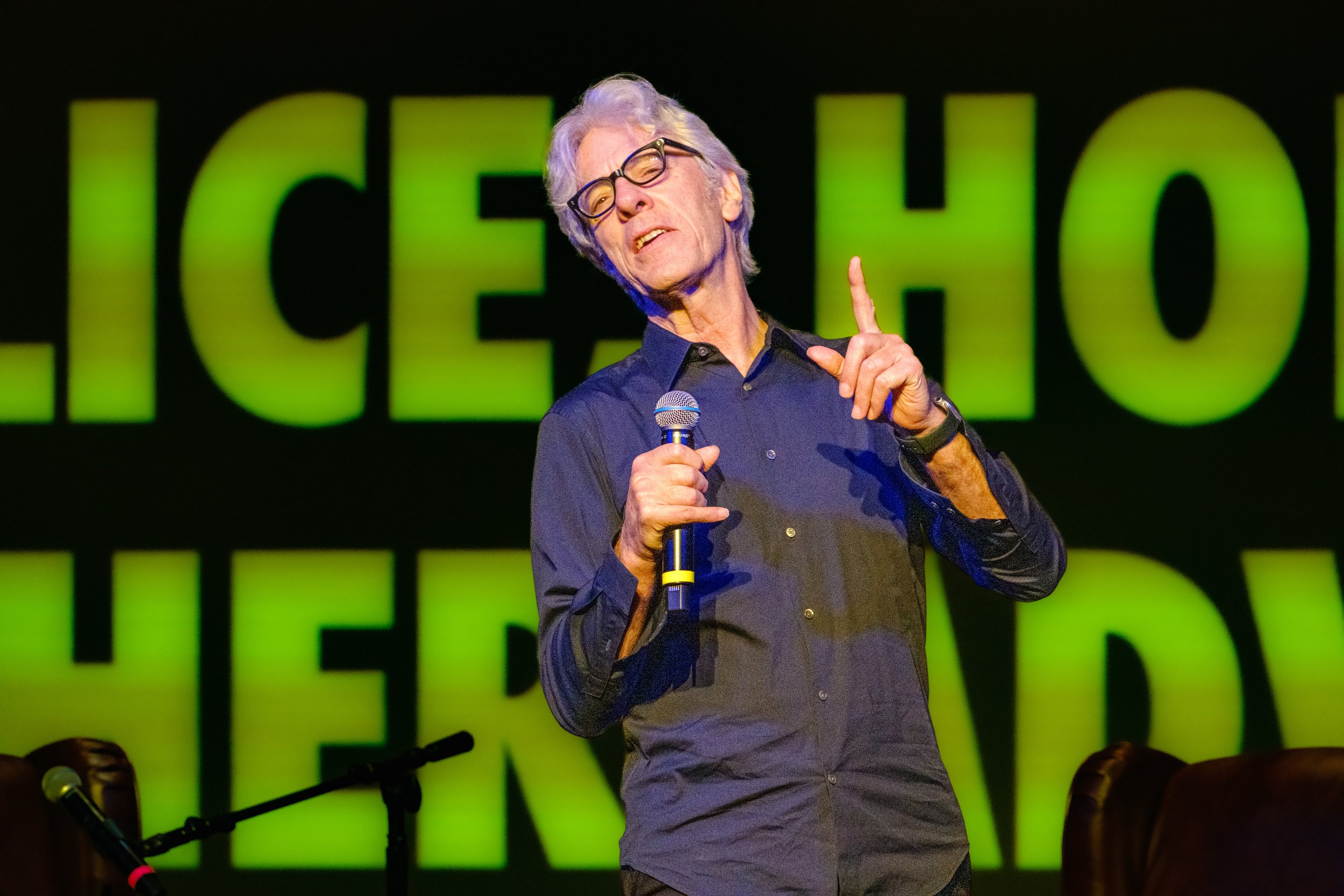
Stewart Copeland at the Presidio Theatre. Photo: Steve Roby
Stewart Copeland strode onto the Presidio Theatre stage Saturday night, ordered a sold-out house to “talk and roll,” apologized for the cliché, then used it anyway. Fair warning. Across two acts and a twenty-minute intermission, spanning the better part of two and a half hours, the night marked the San Francisco stop on his first American conversation tour, Have I Said Too Much?, named for Johnny Morgan’s 2025 biography of him and drawn from the same vault. Copeland revealed a generous portion of it onstage.
He tells stories the way he plays fills: fast, sideways, slightly ahead of the beat. He manspreads in the chair, worries the floor lamp like a prop he can’t place, and free-associates from Beirut roots to Tuscany to a recording booth in San Rafael before snapping back with his running punchline, “What was I just talking about… oh yeah, right.” Riding shotgun was moderator Rachel Gil de Gabaja, whom Copeland introduced as the disciplinarian hired to keep the train on the tracks. She kept it there and little else, clicking through slides, laughing on cue, steering him toward the next chapter, and, at times, acting as a senior-moment course corrector. The harder questions were saved for the audience.
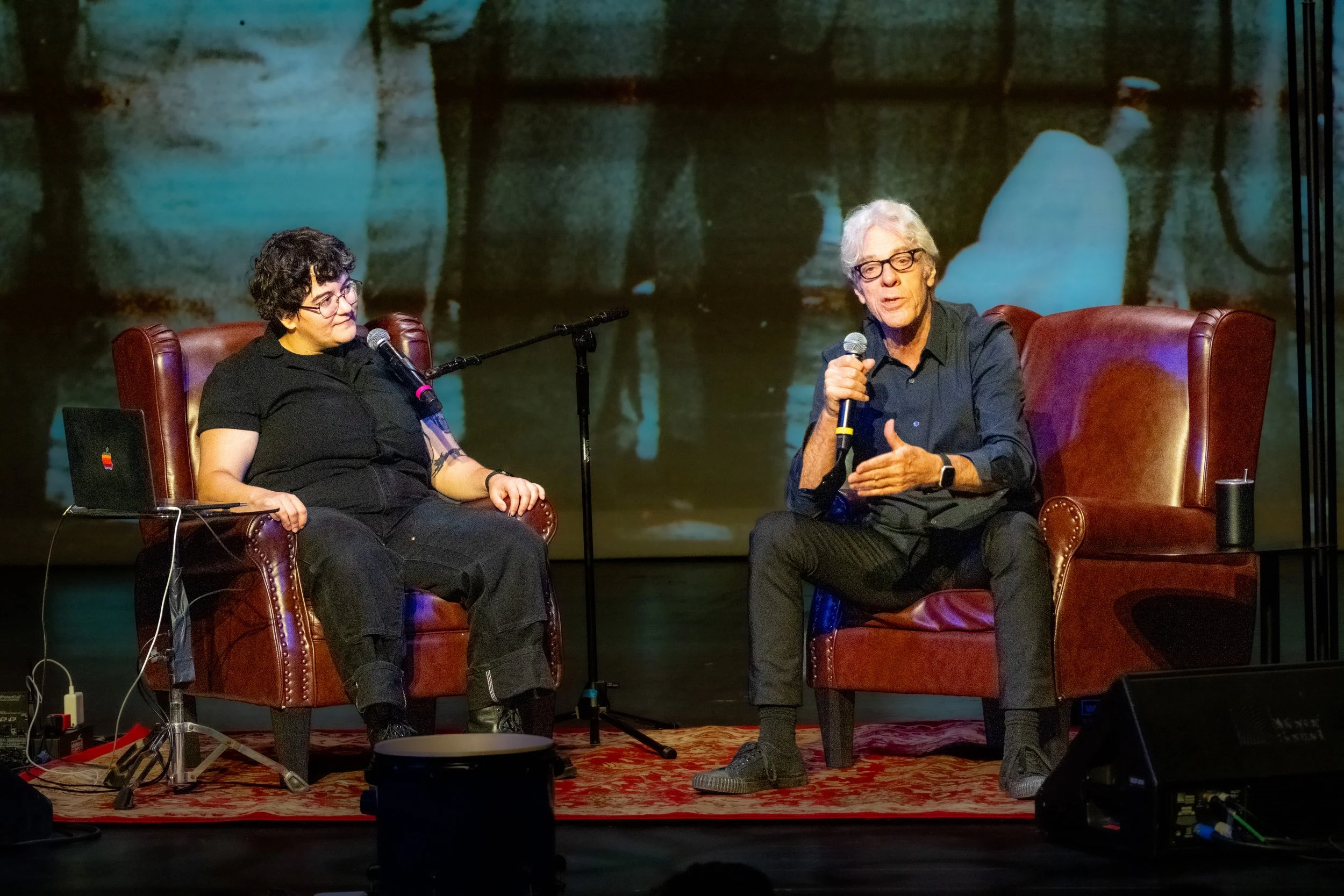
Rachel Gil de Gabaja and Stewart Copeland. Photo: Steve Roby
The arc opened in the Middle East, where Copeland grew up as the son of a CIA officer who, in his telling, helped install a dictator before lunch. He inventoried the family quickly: brothers Miles and Ian, who grew up to become among the most powerful managers and agents in rock, and a childhood soundtrack of Arabic rhythm that lands on the third beat and skips the one. That detail did real work. He traced a straight line from the music of his Beirut boyhood to the reggae-adjacent feel that would define the Police, with a detour through the history of the backbeat and the invention of the bass-drum pedal. He found the drums by sneaking onto brother Ian’s borrowed kit and discovering he outranked the coolest kid in the family at the one thing that mattered. His verdict on his own technique became the evening’s thesis: “I’m doing it wrong,” he decided, “and that has been my secret sauce ever since.”
The origin story he told is as much a business-school case study as a rock myth. Years of roadie and tour-manager work for his brothers’ bands taught Copeland how the machine ran; punk handed him a do-it-yourself model cheap enough for three people to split. He found his singer in a Newcastle jazz club, drawn less by the bass playing than by “an unmistakable golden ray of celestial light.” He landed Sting by phone with one instruction from him, “keep talking” — which, Copeland noted, kept him on the job for the next two years while the band starved. Andy Summers arrived through a session for the prog rock band Gong, and a chance meeting at the Oxford Circus tube stop, and his harmonic vocabulary unlocked Sting as a songwriter. Copeland marked the shift with a detail only a drummer would notice: the set lists stopped appearing in his handwriting and started appearing in Sting’s. He called that the best thing that happened to the band.
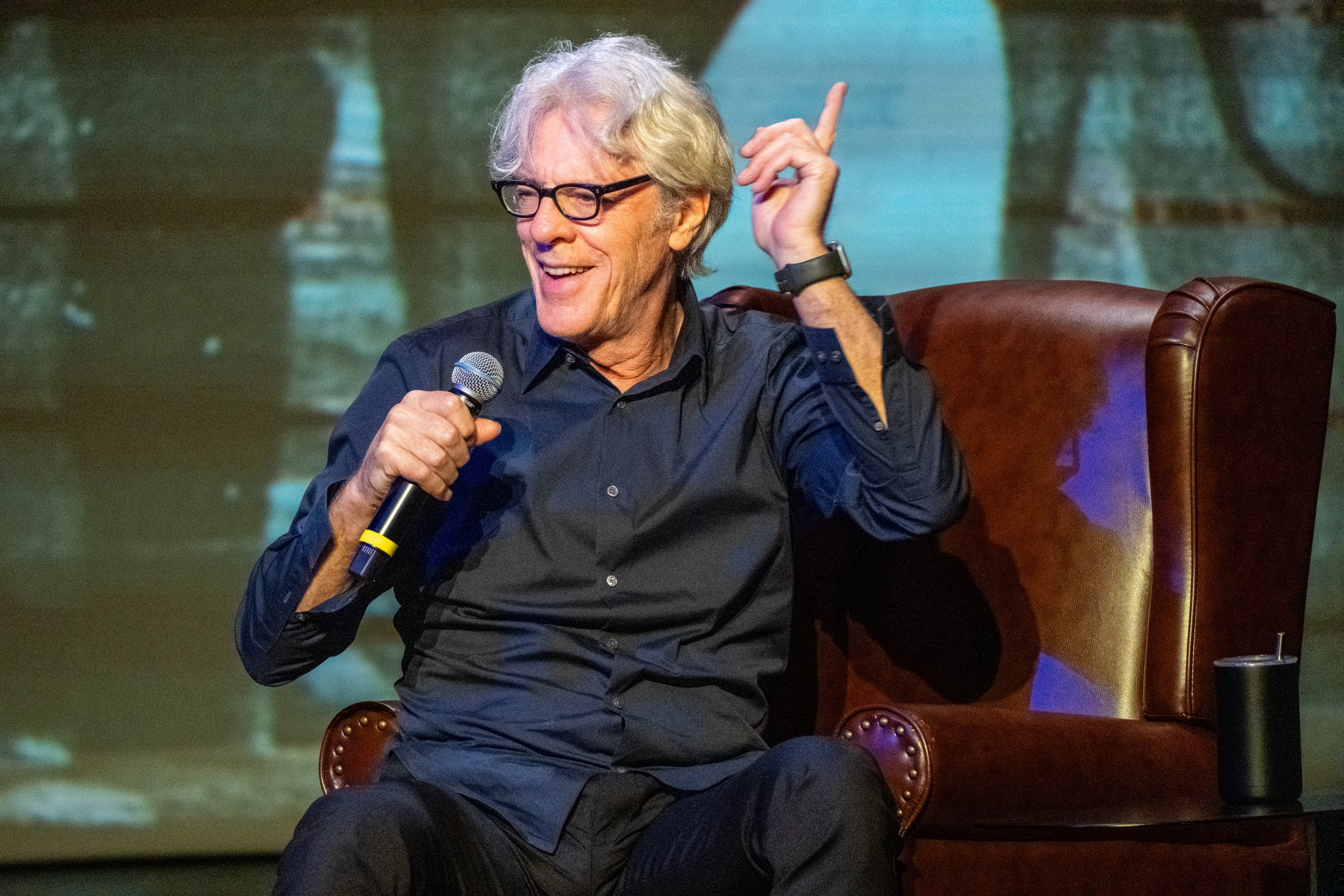
The tour’s title also had an origin story. As 70s band Curved Air’s new drummer, hungry for press, Copeland flooded the music papers with fake fan letters in disguised handwriting, ensuring his own name in print. Melody Maker took the bait. He had, in his words, said too much, and he has been saying it ever since. The first act closed with the story of Klark Kent, his masked alter ego who charted a single and reached Top of the Pops, where the BBC painted his face rather than let him hide behind a mask. The payback came decades later at Sting’s dinner table, where his wife Trudie Styler still loves to cue the story of the night Sting mimed bass in a gorilla mask behind Klark Kent’s national-TV debut.
An empty drum barrel sat at the lip of the stage throughout intermission, swallowing audience questions on folded slips of paper. Copeland returned for part two.
Francis Ford Coppola brought him to California to score Rumble Fish, and Copeland scored it the way a rock drummer would — by ear, by instinct, by making it up as he went. The education came when the strings arrived. Where a rock guitarist trades ideas with band members over an afternoon, the orchestra, in contrast, read his charts and finished in twenty minutes flat, and he fell for the efficiency on the spot. Two decades of film and television followed, and the sharpest stretch of the night was his lecture on what music does to a scene: lay a sinister chord under a moonlit “I love you,” and the audience knows the man is lying; swap the melodic cue under a car crash and terror flips to slapstick. Copeland has thought hard about steering an audience, and he is candid about the terms of the bargain — in film, the director owns the art, and the composer serves it.
Opera, he said, finally handed the composer the keys, fortuitously because the competition had died. His Italian commission, a witch-hunt drama set high in the Alps, began as two hours of misery until he reframed it through Kurosawa, telling the same events from opposing points of view and transforming condemned victims into powerful women who set the whole thing ablaze. The detour included conversations Chrissie Hynde pitching lyrics about witches with flames shooting from their chests, a wrinkle Copeland flagged for plot logic. The opera became a genuine hit, staged across Italy. Coming from “the Nashville of opera,” he counted that as the bigger trophy.
The Police reunion took the most road to reach. It began with fifty-odd hours of Super 8 film Copeland shot as a tourist during their band travels, abandoned in shoeboxes for thirty years. Digital editing let him cut it into Everyone Stares: The Police Inside Out, which blindsided him when it landed at Sundance. Their three blond heads at the same festival drew a blizzard of flashbulbs, and the reunion offer followed within weeks. Copeland has a stock line to describe the band — “a Prada suit made out of barbed wire,” handsome and miserable to wear — and he repeated the mantra that carried him through four months of rehearsal at Sting’s Tuscan estate: “I am nothing, I am no one.”
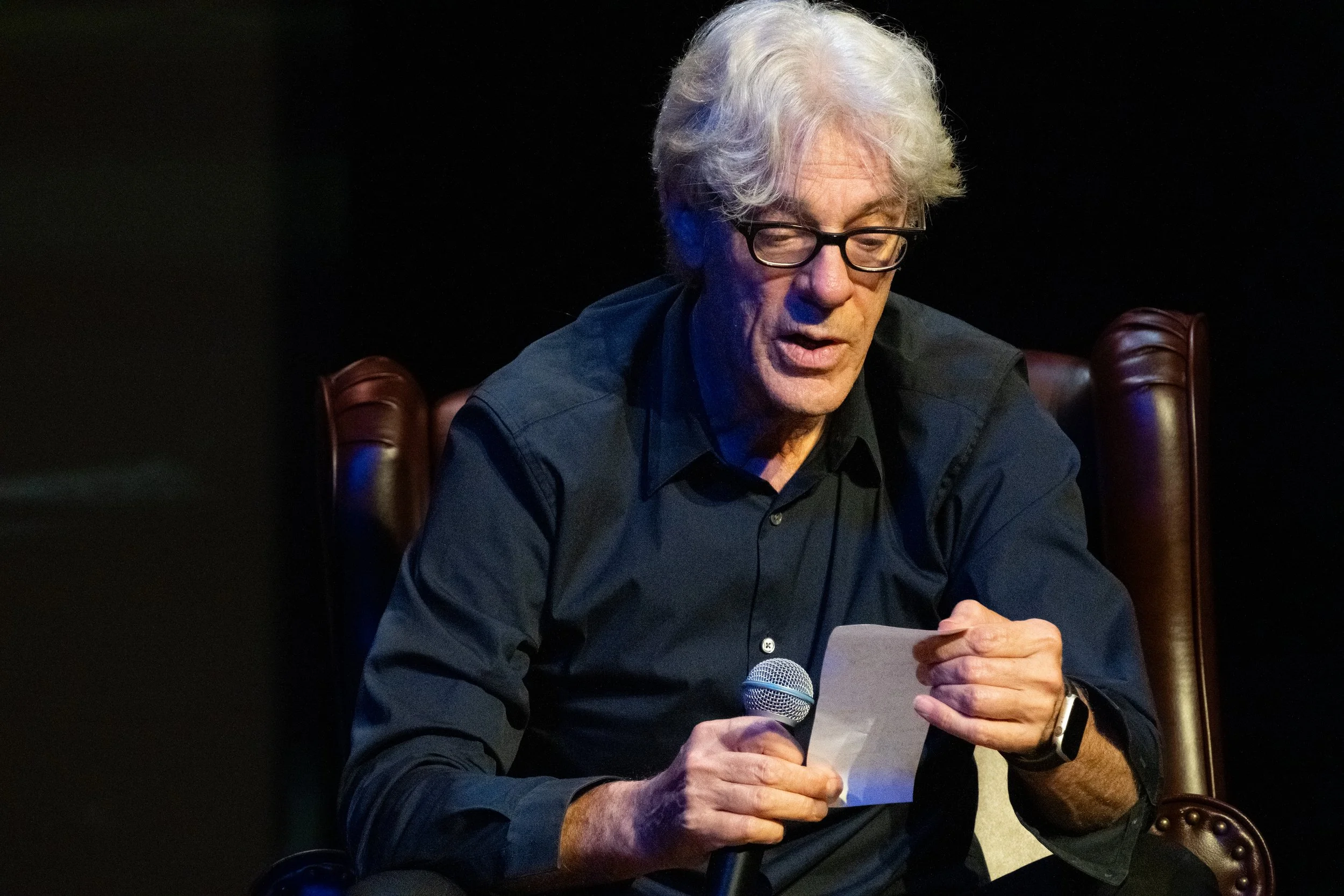
Copeland reads two audience questions. Photo: Steve Roby
The payoff arrived as a confession. Two musicians who adored the songs and loathed the process, screaming through sound checks, were rescued each night by an audience that served as a referee. Band therapy on cushions in Sting’s New York apartment produced the real revelation: the two of them fought because they made music for opposite reasons, and that friction was the creative engine. Copeland delivered the show’s actual argument plainly — the barbed wire is what made the Police the Police. He owes the sound to the misery.
The onstage drum gave up two questions at the end. A fifteen-year-old drummer asked which part he would re-record. Copeland, who built those parts on the spot without knowing where the chorus would land, chose to leave them alone, keeping spontaneity intact. The second came from a fan with other priorities: “What hotel are you staying at? Because I need to know where to pick my mom up in the morning.” A laugh. A giggle. Copeland stood, waved to the house, and walked off with an adoring ovation.
Read our 2026 concert review of Stewart Copeland at Miner Auditorium here.