Marcus Machado Fills the Lab With Voltage
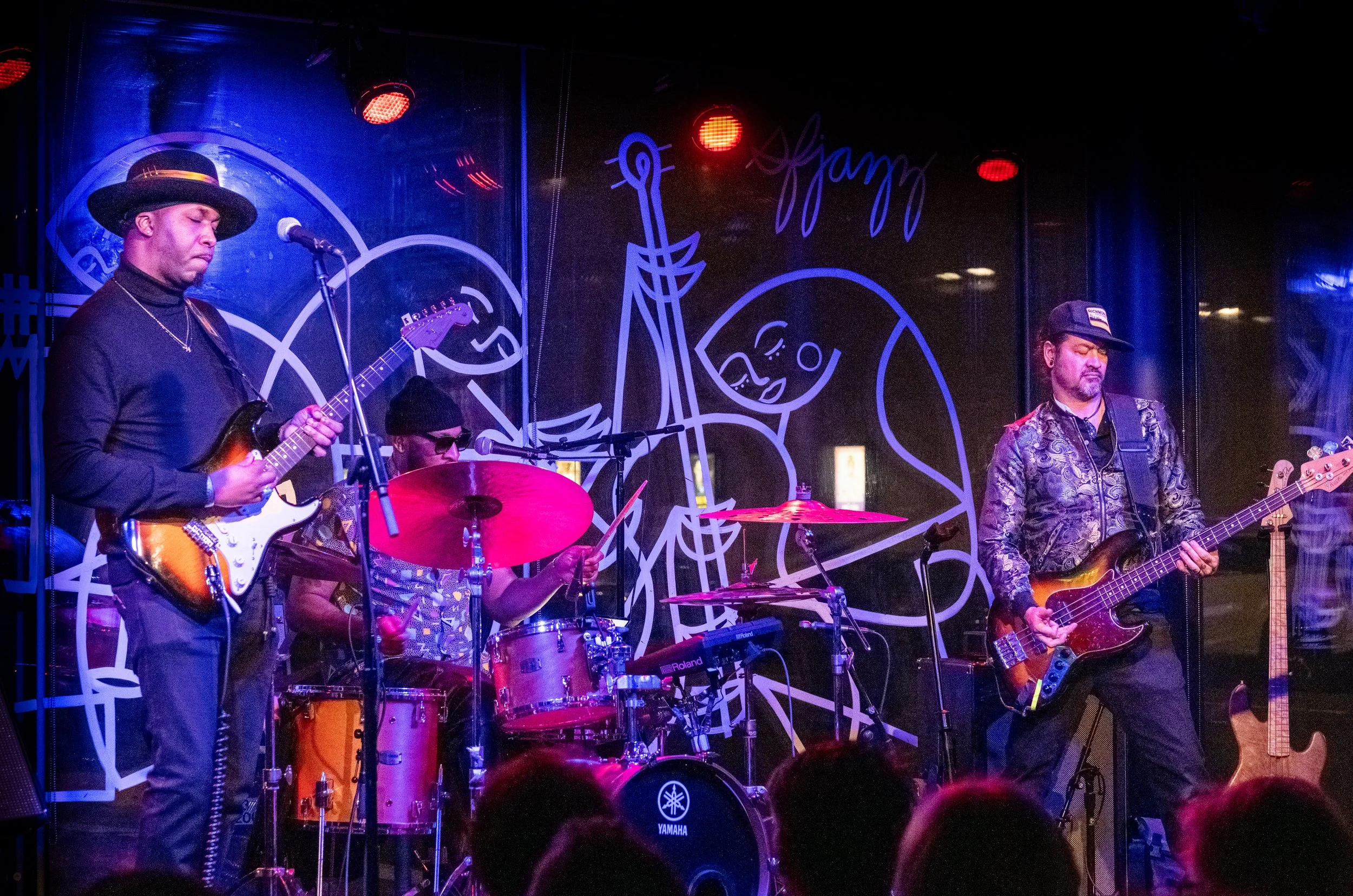
At his headline debut at the Joe Henderson Lab, Marcus Machado and his Traces of Purple trio shaped funk, psychedelia, and groove into a one-hour study of density, sustain, and controlled volume. The Thursday night early set sold out. Teenagers took the front row—one filming, another with a notepad—while a young woman in a miniskirt and fishnets held her phone steady. Behind them, gray heads filled the back rows, bodies angled forward in anticipation.
Machado stepped onto the riser, instantly recalibrating the room’s scale. Standing 6’4”—and further elevated by his shoes and a gold-banded black fedora—he almost brushed the Lab’s low ceiling. He loomed over the seated audience as a towering guitar god, yet his first words focused on shaping a shared space. “Yeah, we’re just gonna, you know, vibe. Let’s make this our own world,” he said. He immediately flagged what that world might demand: “It might get a little loud, so bear with us. We can always turn it up.” A voice shot back from the dark: “Don’t turn it down!” Machado laughed. “That’s what I’m talking about!”
He turned, lifted his Fender guitar, and opened with “Are You Experienced.” Where the Hendrix standard usually offers abrasion and a heavy-metal grind, Machado opted for a soft, echoing prelude. Reverb blurred the guitar’s outline, floating the tone and recalling the dreamlike passages of “1983” and “One Rainy Wish,” where melody dissolves into vapor before reassembling. Drummer Damon Jamal Taylor answered with a slow, almost martial pulse, treating the beat as a ceremony.
This choice set the night’s core condition: volume functioned as architecture, and the Lab’s audio clarity exposed each layer. Machado’s sustained notes stretched thin and luminous, while bassist Uriah Duffy widened the low end with modulation, occupying more than a single register. The texture pressed outward; Taylor placed time deliberately, keeping the space active between strikes.
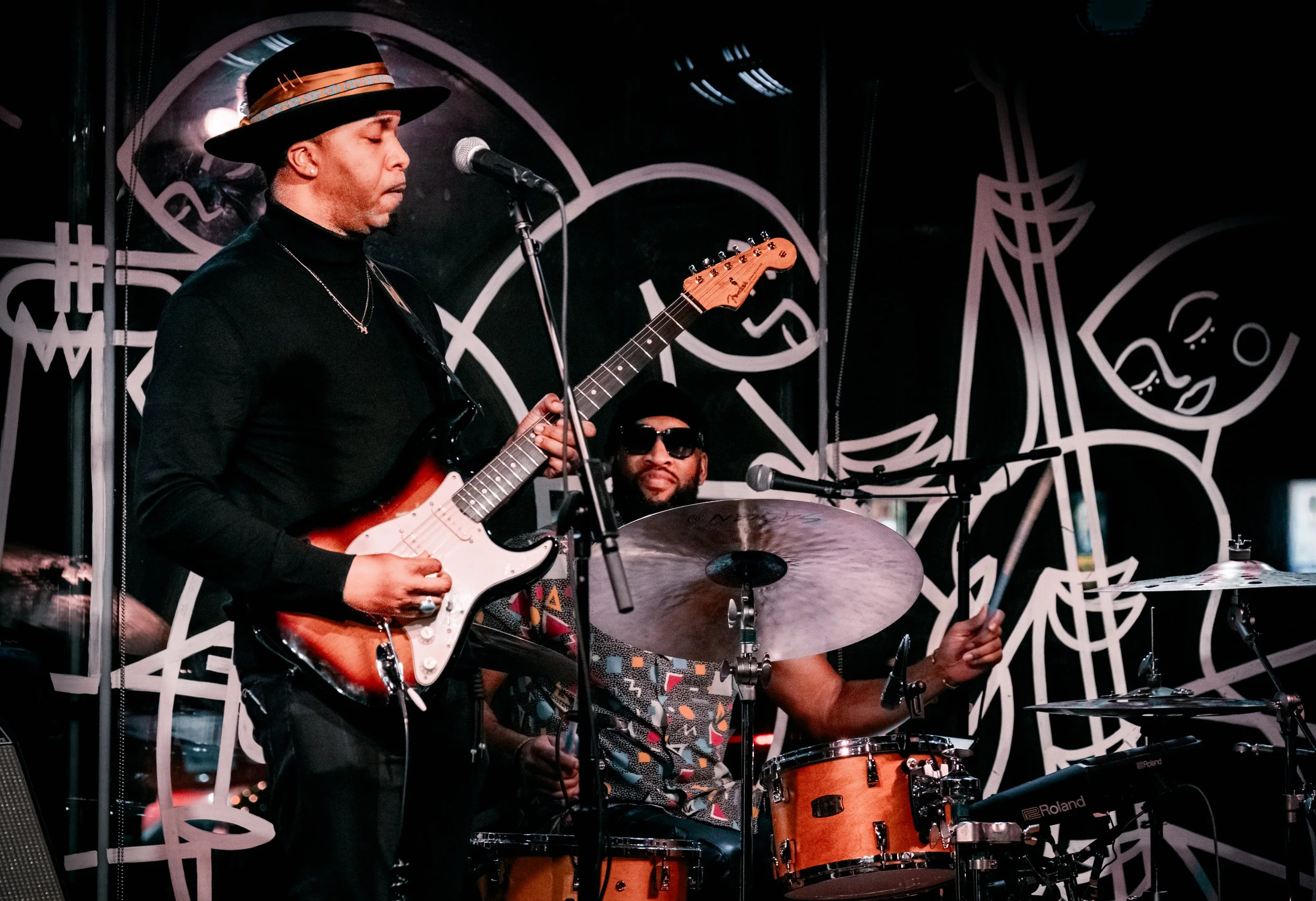
Marcus Machado and Damon Jamal Taylor. © Steve Roby
Machado noted that the set would draw from his albums Aquarius Purple and Blue Diamonds, then the trio pivoted into “Let’s Play,” a soul-heavy instrumental that anchored the band in the pocket. Duffy established a broad, buoyant center while Taylor sketched around it. Machado layered clipped rhythmic figures over longer bends, creating friction between movement and suspension. The sound accumulated, thickening the room with every addition.
“Get By” arrived next. Introduced as a pandemic-era composition recorded during the 2020 unrest, Machado described the title as a tool for awareness. He framed the piece as melody-driven and endurance-oriented: “Whatever you’re going through, there’s always light at the end of the tunnel.” The trio treated the piece as a gradual ascent. Machado opened sparsely, stating the theme with restraint and leaving clear pockets of silence. Duffy softened the harmonic edges with chorus and flanger, creating a faint blur around the melody, while Taylor nudged the groove forward with subtle shifts in placement. As the piece thickened, Machado’s phrasing expanded outward, rising through register and density before settling back into the theme.
Throughout the set, Machado built his solos from narrow material—short figures, repeated tones, and bends with the whammy bar—then extended them. His longer arcs favored sustain and decay; notes carried through the room, faded, and left residue. In this space, endings rang as clearly as attacks.
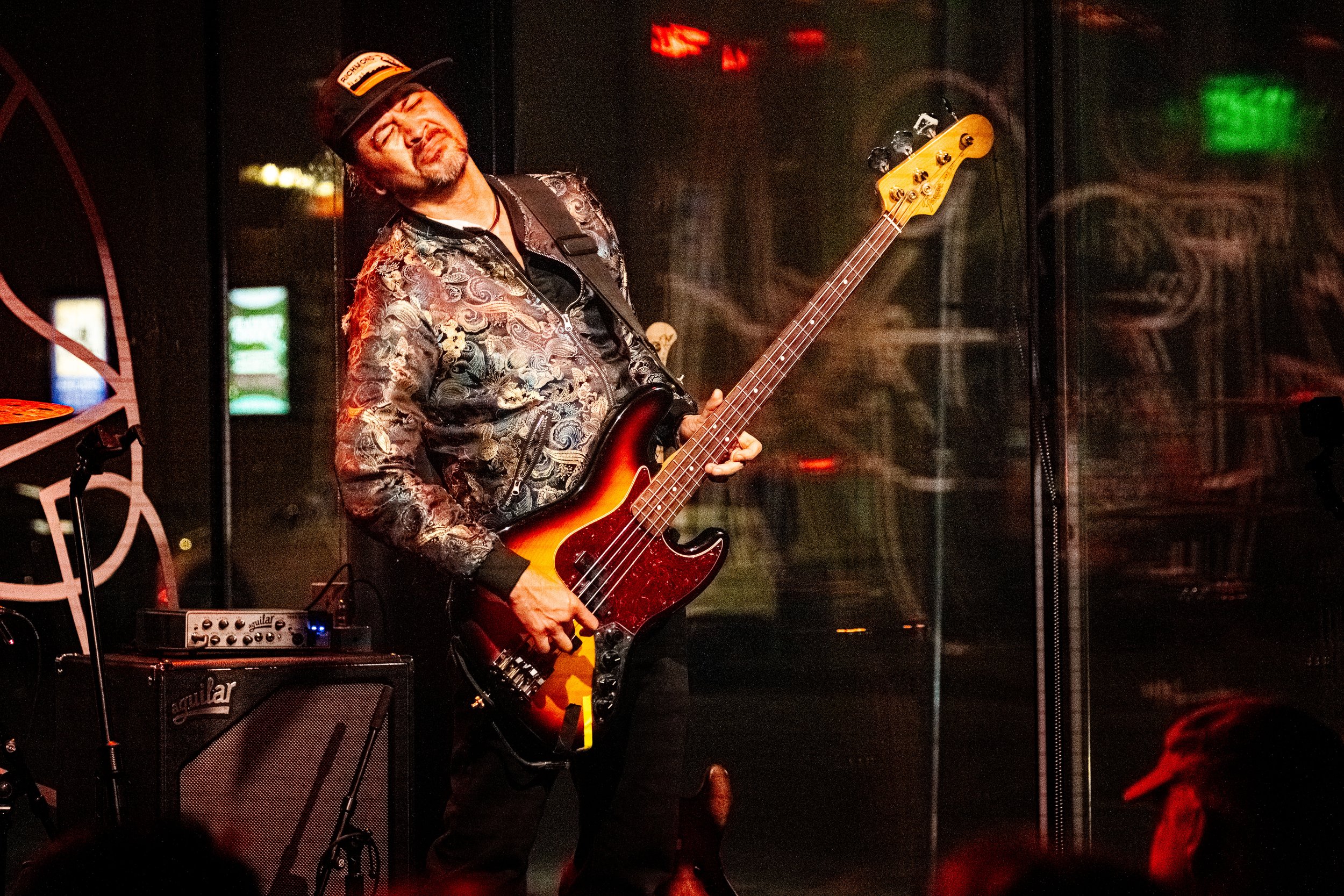
Uriah Duffy. ©Steve Roby
Midway through the hour, Machado adjusted the temperature. “I want to change the vibe a little. I want to break things down,” he declared. Acknowledging the strain of recent years, he dedicated the next song to the legendary Bob Weir, D’Angelo, and “anybody who’s lost anyone.” He named the piece “Tomorrow Never Knows.”
The trio reduced its footprint, with Duffy and Taylor retreating to minimal support so Machado could stand largely alone in the sound. The piece traced its lineage to Eddie Hazel’s sustained lamentations, channeling the logic of exposure found in “Maggot Brain.” Machado’s opening gambit favored upper-register cries and fractured intervals. Development came through timbral change: grit drawn from the strings, followed by cleaner, trembling lines. Floating without a dense rhythmic grid, each note found its own boundary before the next emerged.
When the groove returned, it carried weight. “Running” and “Dig” restored motion and density. Taylor deepened the pocket, and Duffy thickened the low end, while Machado reintroduced funk grammar—short stabs, percussive muting, and rhythmic repetition—before reopening the harmonic field. Although the printed setlist listed “Foxy Lady” as a closer, the ending shifted. “Dig” sealed the set, its cyclical form providing a stable floor for Machado’s final expansions.
Machado thanked the crowd and marked the night as his first performance of the new year. The audience responded with sustained attention, the kind of listening that registers texture as much as spectacle.
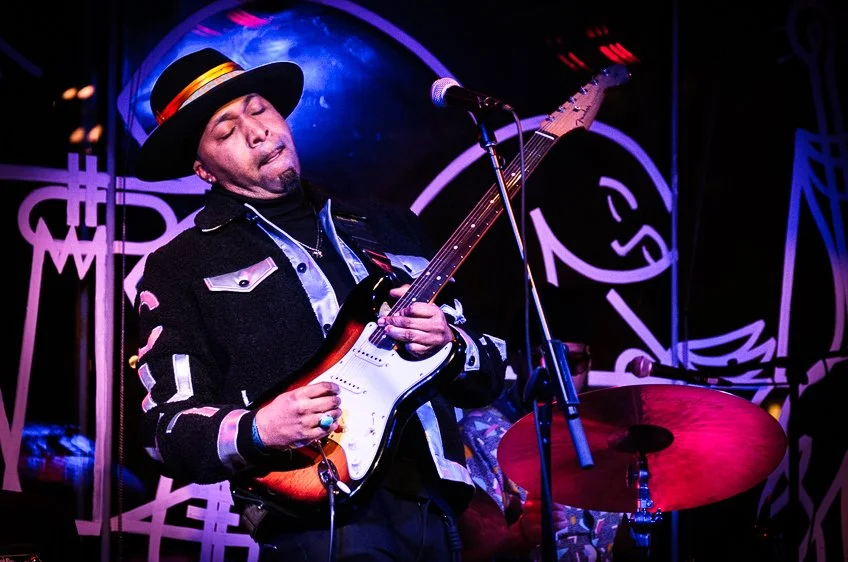
Marcus Machado. ©Steve Roby
Ultimately, the concert embodied controlled accumulation. Machado and Traces of Purple treated volume as physical material, focusing on building density, pressure, and release. Funk supplied the spine, psychedelia the color, and jazz logic organized the flow. By the final notes of “Dig,” the sound had gathered, thickened, and settled. Machado stepped back from the riser into an environment the trio had built deliberately over the hour, closing the set with those conditions still fully intact.
Program Notes
Marcus Machado and Traces of Purple
Thursday, January 22, 2026
Joe Henderson Lab (SFJAZZ Center)
Showtime: 7:00 p.m. (early set)
Personnel
Marcus Machado (guitar), Uriah Duffy (bass), Damon Jamal Taylor (drums)
Setlist: “Are You Experienced,” “Let’s Play,” “Get By,” “Solo Guitar Vibe,” Protocol,” “Her,” “Tomorrow Never Knows,” “Running,” “Dig”
Listen to our interview with Marcus Machado here.