Lee Ritenour Revisits the Road to Fusion at Miner
At SFJAZZ, a career-spanning set unfolds through memory, lineage, and lived experience

Lee Ritenour performing at Miner Auditorium, SFJAZZ Center. Photo: Steve Roby
Lee Ritenour began with a story.
At Miner Auditorium, the guitarist framed his return to San Francisco through memory—checking into the Fairmont Hotel earlier that day and being handed a book noting that Tony Bennett had stayed there. “I thought, ‘How’d they know that I played with him’” he said, recalling his teenage years on the road backing Bennett, Lena Horne, and Peggy Lee. “I was just 18 years old… and I’m far from that now.” The line drew laughter and set the evening’s framework: a musician measuring the present against an accomplished past.
The concert took form as a guided passage through that history. Ritenour moved easily between anecdote and performance, often placing context ahead of the music itself. By the time a piece began, it arrived with its lineage already attached—where it came from, who shaped it, and why it remained in rotation.
The opening stretch leaned toward mid-tempo ballads, harmonically rich and unhurried. Ritenour’s tone, still precise and lightly burnished, emphasized clarity and control. His lines settled into the band’s center of gravity, with Otmaro Ruiz shaping the harmonic field and Melvin Davis providing a steady, grounded foundation on seven-string bass. On drums, his son, Wesley Ritenour, supplied forward motion with a firm yet measured pulse, a presence that grew as the set opened up.
That expansion came into focus with “Stone Flower,” an Antônio Carlos Jobim composition that Ritenour described as “not one of his more famous tunes… but a great one.” The performance stretched past the ten-minute mark, unfolding with patient, layered logic rooted in his long engagement with Brazilian music. His phrasing stayed close to the melodic contour while introducing subtle rhythmic displacement, allowing the groove to deepen and circulate. The performance sustained atmosphere and continuity, holding the room in a steady, evolving current.
Throughout the evening, Ritenour returned to the theme of accumulation. He spoke about the range of influences that shaped him—Wes Montgomery, Jimi Hendrix, Eric Clapton, B.B. King—and how that breadth led directly to his early work as a studio musician. “I had a chance to fall in love with the guitar and play all those styles,” he said, tracing a path from Los Angeles session work to a decades-long recording career. The stylistic range in the set followed naturally: funk, fusion, Brazilian music, and jazz all delivered within a single, continuous vocabulary.

Lee Ritenour, Wesley Ritenour, and Melvin Davis. Photo: Steve Roby
Midway through the performance, the band’s introductions extended that narrative. Ritenour described Ruiz’s dual teaching roles at UCLA and USC with admiration and humor, then turned to Davis, recalling how a longtime collaborator had first recommended him. The details accumulated into a portrait of a working network shaped by years on stage and in the studio.
The set’s center of gravity shifted again with “Waltz for Carmen,” a ballad from his 1990 Stolen Moments recording. Before playing, Ritenour joked about his method for avoiding memory loss: keeping track of every session, every player, and every detail. The humor underscored a deeper point. His catalog remains an active repertoire—music he revisits, reshapes, and recontextualizes in performance.
That perspective came into sharper focus as he looked back on the long arc of his career. “You go through phases where you play some of the stuff, and then you put it away… and then you come back to it,” he said. The comment led directly into “Captain Fingers,” the high-energy fusion piece that defined his early rise. Introduced with a self-aware aside—“It’s hard, it’s a lot easier not to play it”—the tune arrived as both a technical test and a personal request from his son.
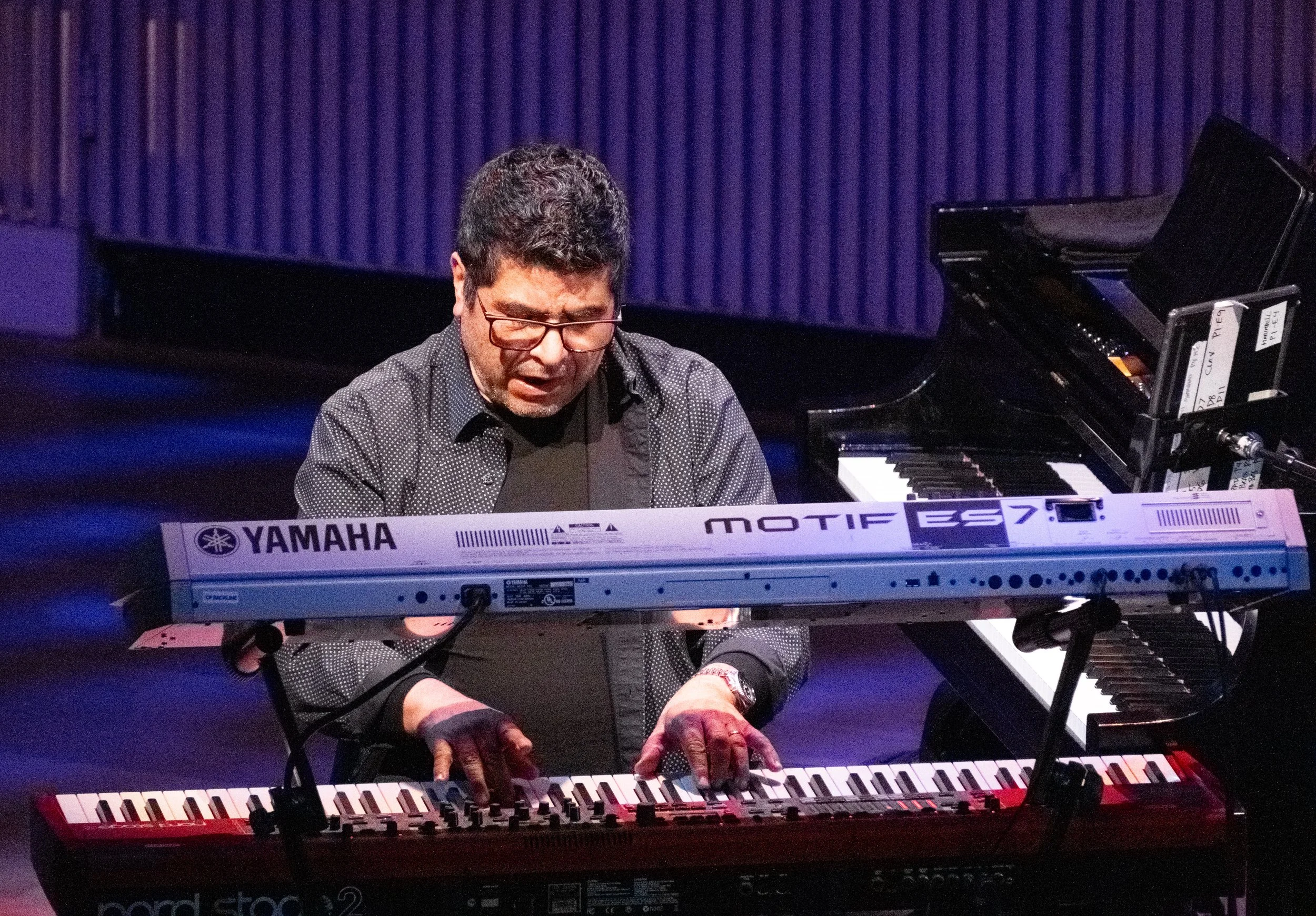
Otmaro Ruiz. Photo: Steve Roby
Switching to a Gibson Les Paul, Ritenour shifted the set’s energy. The tone thickened, the attack sharpened, and the rhythm section responded with greater intensity. During the tune’s central passage, he stepped toward the rhythm section, locking into a tight, driving exchange with the bass and drums. At several points, he turned toward Wesley with a smile that conveyed recognition and pride, reinforcing the generational throughline across the stage.
Late in the set, a brief aside broadened the frame. “You’re so lucky to be in San Francisco… and to have this venue,” he said, then added, “We’ll stick to the music… but I’m very proud of you guys for staying strong.” The comment remained understated yet carried weight, situating the evening within a broader civic and cultural moment and eliciting strong audience gratitude.
The closing stretch leaned into funk, culminating in “Rio Funk,” where Ritenour’s phrasing tightened into short, percussive figures. Ruiz layered chords over the groove while Davis anchored the low end. The ensemble moved with cohesion, each part reinforcing the pulse.

Photo: Steve Roby
After the final number, Ritenour offered one last story, recounting a backstage exchange with Ruiz about what to play next. He suggested “Etude,” but Ruiz reminded him they had already played it. The audience laughed, and the band returned for an encore, closing with “Lay It Down,” a groove-centered piece delivered with directness and ease.
The performance carried the outline of a retrospective while remaining active and present. The stories served as structural elements, guiding how each piece was heard and understood.
Ritenour’s music continues to draw on a deep reservoir of experience, and at SFJAZZ, that experience translated into a performance grounded in memory and propelled by continuity.
Program Notes
Event: Lee Ritenour & Friends
Artist: Lee Ritenour Quartet
Date: Sunday, April 12, 2026
Showtime: 7:00 p.m.
Venue: Miner Auditorium (SFJAZZ Center)
Location: San Francisco
Personnel
Lee Ritenour: guitar
Otmaro Ruiz: piano, keyboards
Melvin Davis: bass
Wesley Ritenour: drums
Setlist: “Pearl,” “Etude,” “Stone Flower,” “Waltz For Carmen,” “A Little Bumpin',” “Captain Fingers,” “Rio Funk”
Encore: “Lay It Down”