Joss Stone: Soulful and Seated

In a pared-down residency performance, Joss Stone leaned into space, storytelling, and vocal nuance—guiding the packed room from impatient anticipation to a standing, soul-soaked release.
A light veil of fog hung over San Francisco’s Miner Auditorium, softening the hall’s clean lines and drawing the focus inward. The mood was expectant. By the end of the night, more than a few patrons lingered in the aisles, reluctant to break the spell of Joss Stone’s four-night residency performance.
The “Soulful and Seated” concept favored a cozy setting with five stools and one central chair, a side table, and two China teacups. The ensemble was pared down to guitarist and musical director Steve Down, bassist Matt Rubano, and backing vocalists Theron Thomas, Artia Emelia Lockett, and Bailey Hyneman.
Stone’s dramatic gestures motioned for less—hands lowering, fingers fluttering toward quiet—insisting on dynamic control. “Pull it back, hold it down,” she urged at one point, framing restraint as a discipline. The effect was cumulative: lyrics landed with clarity, and harmonic shifts registered fully.
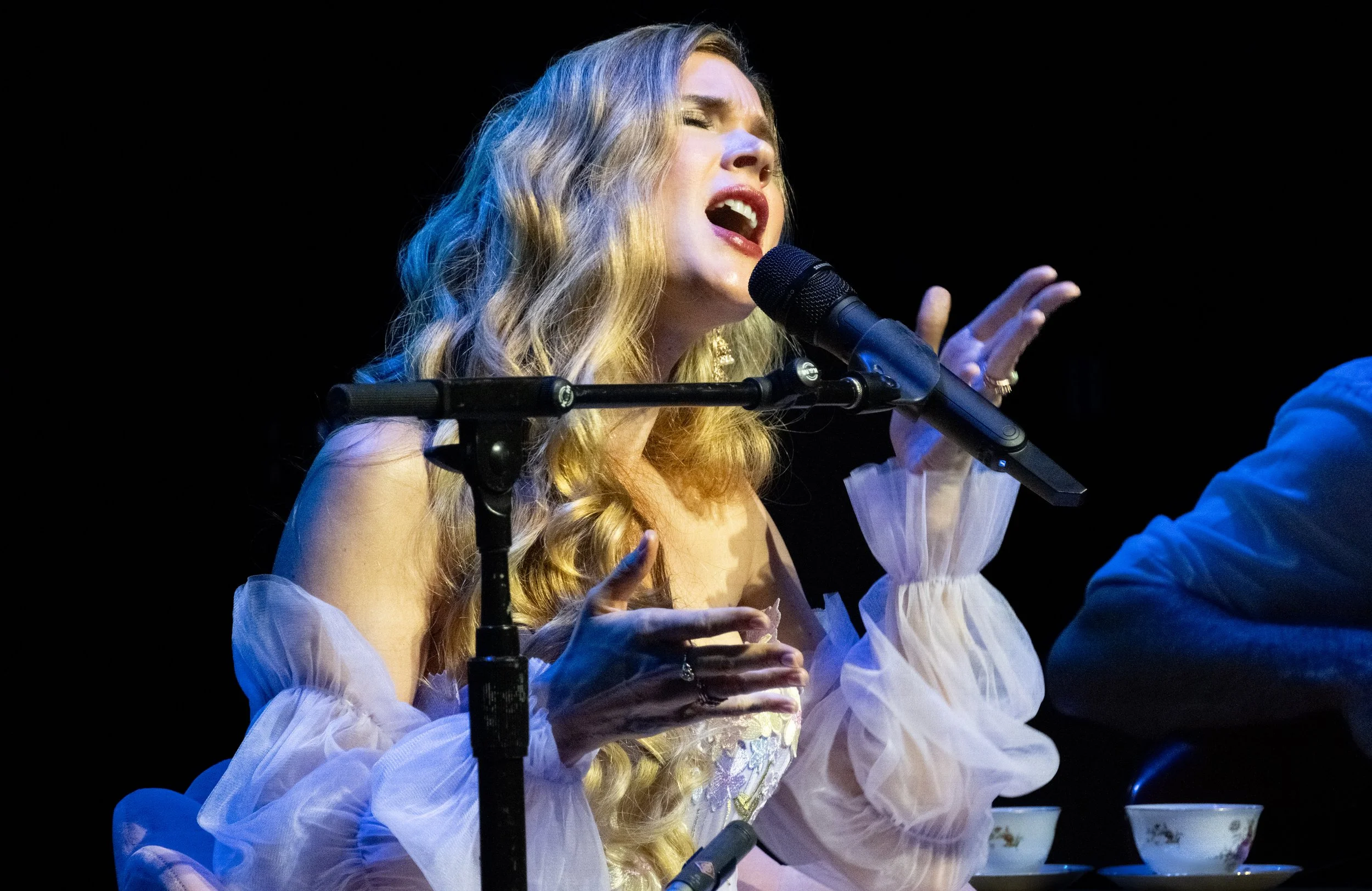
Joss Stone. Photo: © Steve Roby
The production provided contrast. Six vertical light columns shifted in color and intensity in time with guitar accents and vocal climaxes, turning the stage into a luminous grid. Stone, in a flowing chiffon gown, set a fairy princess tone with her charming British accent, and spoke to the audience as if from a living room, then sang with the authority of a seasoned soul belter.
The opener, a languid take on Sylvia’s 1973 hit “Pillow Talk,” set the pace. Stone introduced it as a “lullaby,” cautioning the crowd not to drift off. Her phrasing lingered behind the beat, teasing the groove without losing it. Rubano’s bass provided a supple pulse, while the backing trio cushioned Stone’s lines with soft, church-inflected harmonies.
Between songs, she moved easily into storytelling. She described songwriting as a kind of productive chaos, admitting she often writes in confusion and sorts out the meaning later. Touring life came up, too, particularly how absence can heighten jealousy and desire among those left at home. Her candor—earthy, funny, occasionally blunt—dissolved any lingering formality in the room. These interludes did not stall the momentum; they clarified it. The songs felt tethered to lived experience rather than stagecraft.
A decorative pot of tea was brought onstage, with a ritual feel. Stone sipped, joked about vocal maintenance, then leaned down to share a cup with a woman in the front row. She also turned the spotlight on Rubano, announcing that he was “actually in love right now,” and coaxed him to “tell me more,” drawing easy laughter from both musicians and the audience. The band responded with easy laughter, their chemistry evident, as Rubano poured his heart into a solo.
At one point, as Stone introduced what she called a “sweet little ditty,” an enthusiastic voice from the crowd shouted, “Let ’er rip!” She laughed and promised to “add some ripping in there,” then steered the song from a delicate opening into a full-throated ascent that showcased her range. The exchange underscored how elastic the evening felt—shaped as much by the room as by the setlist. That spontaneity extended to the band.

Photo: ©Steve Roby
The repertoire traced romantic optimism, disillusionment, and resilience. Before one particularly pointed breakup song, Stone advised anyone nursing fresh wounds to make a quick exit to the bar. When she delivered “Ordinary,” joined by Thomas, the interplay sharpened. Their duet moved from unison to call-and-response, each pushing the other toward fuller resonance. The backing trio, especially Lockett and Hyneman, shaped the chorus into a warm, unified swell.
A reflective high point arrived with Stone’s account of auditioning at age twelve for the British television program Star for a Night. She had chosen Carole King’s “(You Make Me Feel Like) A Natural Woman” and was told she was too young for its emotional terrain. Decades later, she returned to the song with a knowing smile: “I think I’m old enough now.” The performance carried weight without excess. She leaned into the lower register, allowed vibrato to bloom at phrase endings, and let silence frame the final lines. The hall responded with sustained applause.
A medley honoring Gladys Knight followed, acknowledging the soul records an uncle had played for her as a child. Here, the backing vocalists stepped forward, their harmonies tightening into a classic R&B blend. Stone ceded space, then re-entered with grit and lift, tracing the lineage without imitation.

Photo: ©Steve Roby
Late in the set, she left the stage while singing, weaving through the main floor and greeting fans at arm’s length. Her movement lifted the room’s already warm temperature. Upon returning to the stage, she tossed long-stemmed sunflowers to the adoring crowd. What began as attentive listening evolved into collective release. By the encore, the “seated” premise had dissolved. Stone stood, the audience rose, clapped in time, and filled the misty air with motion.
Stone’s voice remained centered throughout—elastic in the upper register, grounded below, disciplined in its dynamics. In a stripped configuration, she trusted the material, her band, and the audience’s patience. The result was soul music that felt conversational, lived-in, and fully present.
Program Notes
Joss Stone – Less is More Tour
Date: Thursday, February 12, 2026
Showtime: 7:30 p.m.
Venue: Miner Auditorium
Location: San Francisco
Personnel
Joss Stone: Vocals
Steve Down: Guitar & Musical Director
Matt Rubano: Bass
Theron Thomas, Artia Emelia Lockett, and Bailey Hyneman: Background vocals
Setlist: "Pillow Talk," "Understand," "Less is More," "Jet Lag," "Bruised but Not Broken," "Back in Style," "Free Me," "Ordinary," "Let It Go," "No Thankyou," "Sensimilla," "This Sky," "(You Make Me Feel Like) A Natural Woman," Medley: "Midnight Train to Georgia / I Say a Little Prayer / It's a Man's Man's Man's World."
Encore: Medley: “Never Too Much” / “Young Hearts Run Free” / “Get Down Tonight” / “Tell Me 'Bout It”