Hugo de la Lune’s Architecture of Identity

The Oakland vocalist turned his SFJAZZ debut into a visceral exploration of identity and ancestral legacy, stripping the ensemble down to its vocal bones.
Hugo de la Lune treated his SFJAZZ debut as a deliberate act of reconstruction. The sold-out Noise Pop 2026 Festival appearance at the Joe Henderson Lab unfolded as a meditation on lineage, faith, sexuality, and artistic survival. He entered through a side door, singing “Hugo’s Prayer” before his body fully came into view, establishing voice as the origin point. The slow walk to the stage carried ritual weight, each step measured, the room already listening.

Sunday Simon, Terry Stanley, and Muwazu Chisum. Photo: Steve Roby
The permanent seven-foot piano in the Lab dictated a close stage configuration. De la Lune embraced the constraint, assembling a drummerless, bassless ensemble: guitarist Nathaniel Burns, trumpeter Richard Benitez III, and a three-part vocal choir—Muwazu Chisum, Sunday Simon, and Terry Stanley. Breath, harmony, and electric guitar formed the rhythmic engine. Every syllable landed with precision.
Burns served as a harmonic anchor and rhythmic surrogate. He triggered pre-recorded bass tones that rumbled beneath his electric guitar, creating a low-end pulse. On “Bouda,” his clipped strumming introduced a 1970s reggae inflection, giving the set its first buoyant sway. Benitez answered with muted trumpet lines that glowed at the edges, then opened into a bright, ascending solo that sliced cleanly through the layered vocals.
De la Lune shaped the evening as narrative theater. Early in the set, he described “Hugo’s Prayer” as a tribute to his parents, who sought asylum in the United States in 1989. He sang of running farther than his father had and credited his mother with his capacity to love. His baritone carried a grain that suggested both restraint and pressure, a timbre well-suited to testimony, and pedal effects doubled the intensity.
The emotional center arrived with “Home.” De la Lune shared that only months earlier, he had contemplated stepping away from music altogether. Singing the piece marked a recommitment. “It is through love that I found music,” he told the audience, “and it’s because of music that I know how to love.” The vocal trio surrounded him in gospel-hued harmony, transforming confession into communal affirmation.
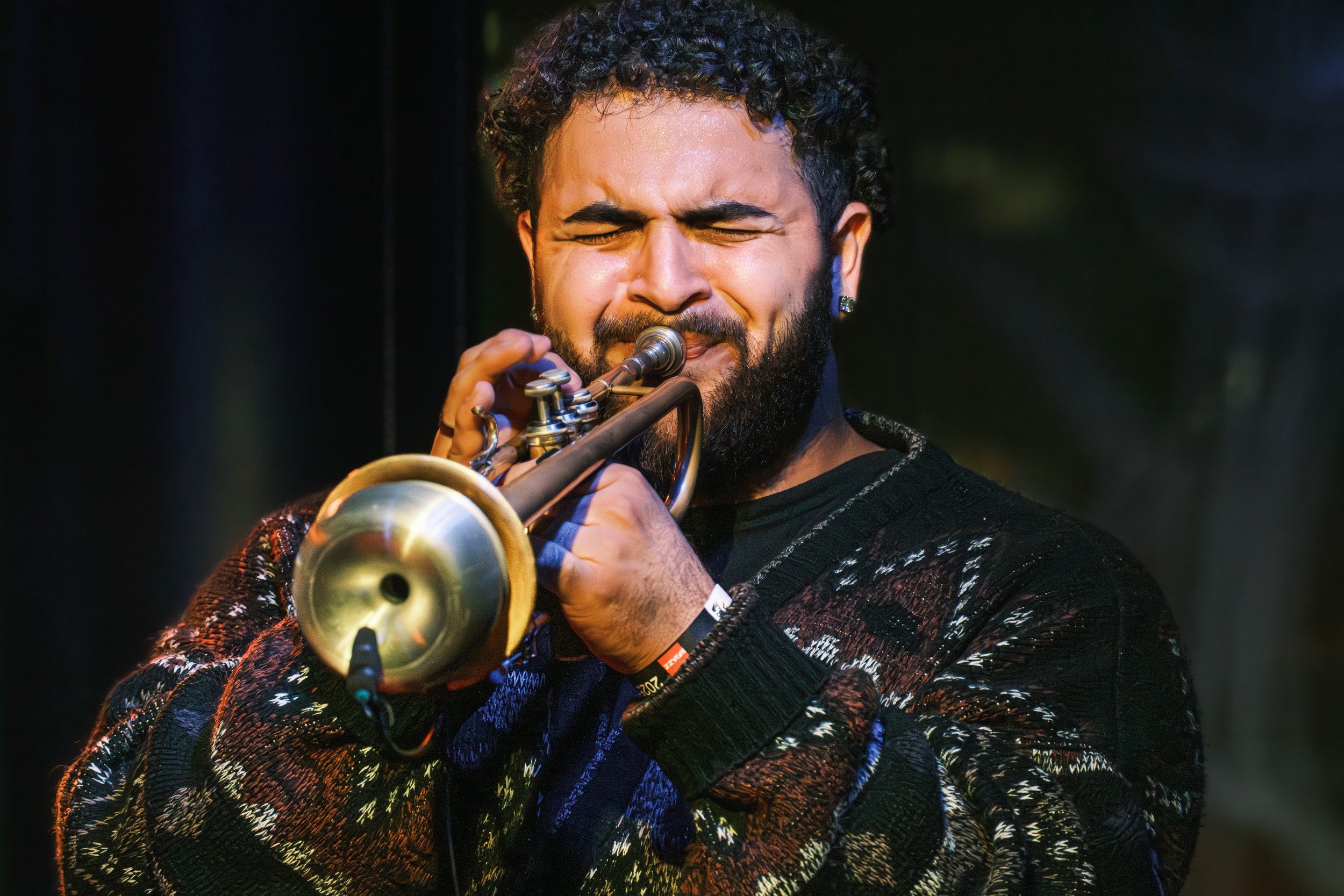
Richard Benitez III. Photo: Steve Roby
“Am I OK?” deepened the autobiographical thread. As a first-generation Ethiopian American and the son of a preacher, De la Lune spoke about growing up in concealment. He recalled being 23 and telling his brother, “I’m not okay.” The bridge revolved around that moment of self-articulation. The audience responded with an audible swell of recognition, applause cresting before the final chord resolved.
The sonic weight intensified on “Messiah,” written when he was fourteen after meeting with a Christian psychiatrist. Burns drove his guitar through fuzz distortion, while the vocalists stacked harmonies into a towering mass. The sound grew jagged and expansive, pressing against the room’s intimate dimensions.
A lighter warmth entered with “If I Was Your Man,” co-written with Burns about their partners. The unreleased track prompted playful calls of “Hit the button!”—a nod to the still-delayed album release. Burns mentioned that he and his wife danced to the song at their wedding, drawing a collective sigh from the crowd.
The set reached its apex with “I Am God (And Darling, so Are You).” De la Lune traced its origins to a Philadelphia park, where he lay beneath a canopy of leaves at the peak of an LSD experience. The song captured the dissolution of ego and boundaries. Harmonies expanded outward, trumpet lines flared, and one vocalist punctuated the climax with a percussive stomp that felt triumphant. The applause that followed was immediate and sustained.
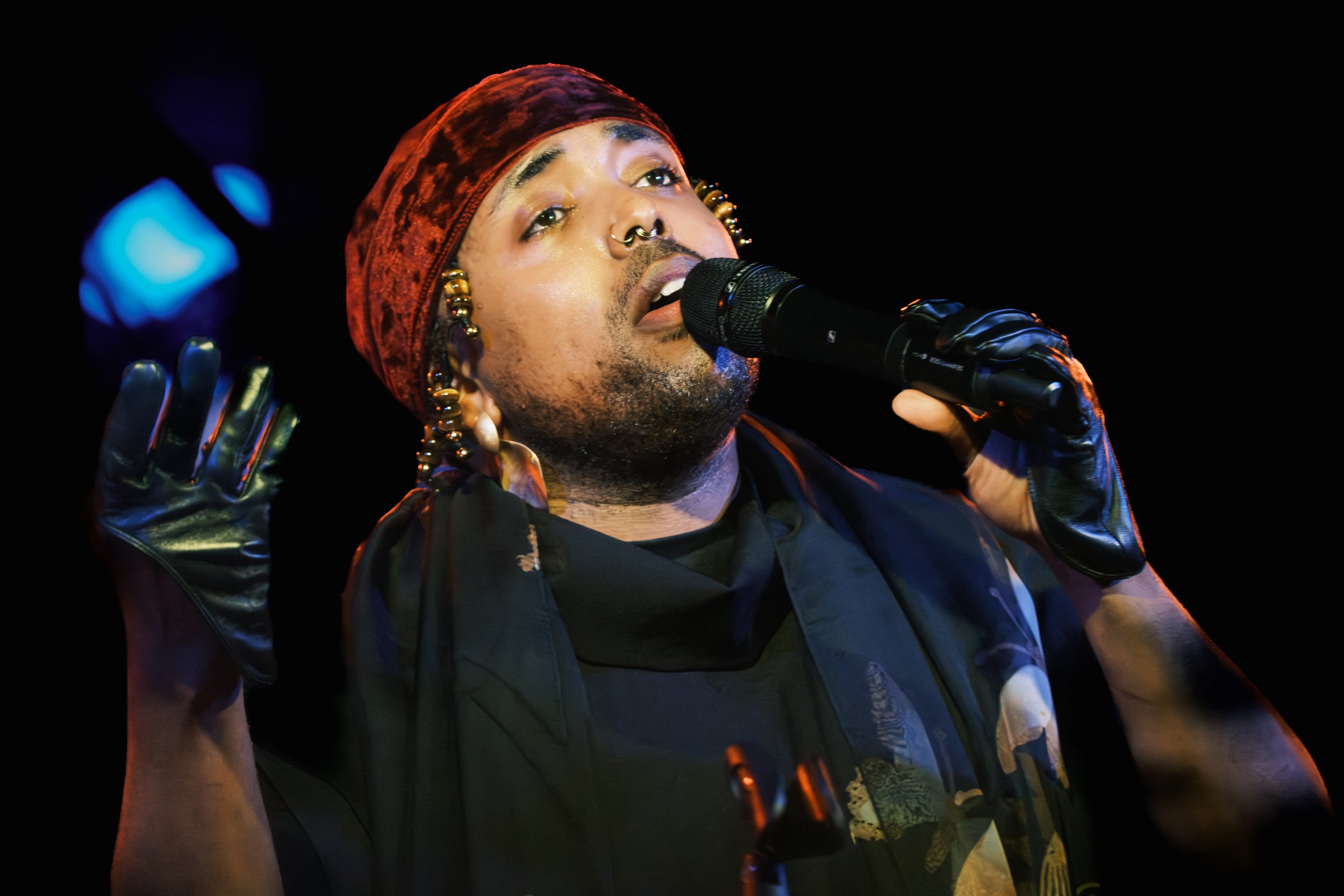
Hugo de la Lune. Photo: Steve Roby
He closed with “Down the Rabbit Hole (Whoopsie Daisy),” completing an arc that moved from invocation to rupture to reclamation. The standing ovation carried him offstage and into the lobby, where the crowd continued to gather around him at the merch table before his second set.
At the Joe Henderson Lab, Hugo de la Lune demonstrated an artist who builds form from autobiography. The performance presented identity as a living structure—voice as foundation, harmony as scaffolding, and vulnerability as a load-bearing beam. The evening affirmed his arrival as a composer and storyteller willing to risk intimacy in pursuit of clarity.
Program Notes
Artist: Hugo de la Lune
Date: Saturday, February 28, 2026
Showtime: 7:00 p.m.
Venue: Joe Henderson Lab (SFJAZZ Center)
Personnel
Hugo de la Lune: lead vocals
Nathaniel Burns: guitar
Richard Benitez III: trumpet
Muwazu Chisum: backing vocals
Sunday Simon: backing vocals
Terry Stanley: backing vocals
Setlist: “Hugo’s Prayer,” “Home,” “Am I OK?,” “Bouda,” “Messiah,” “If I Was Your Man,” “Pretty Boy,” “Envy (Working Title),” “I Am God (And Darling, so Are You),” “Down the Rabbit Hole (Whoopsie Daisy)”
Photos: Steve Roby