Herbie Hancock Turns Improvisation Into Communion at Chautauqua
At 83, the jazz icon fused funk, philosophy, and fearless spontaneity in a sold-out Boulder performance that felt both cosmic and deeply human.
Herbie Hancock. Photo: Katharina Firm
Moments after Herbie Hancock and his quartet settled onstage at Chautauqua Auditorium, a woman in the audience shouted, “Nam Myoho Renge Kyo.” The chant, central to Nichiren Buddhism, has long shaped Hancock’s approach to music and improvisation. The 83-year-old pianist smiled and responded without hesitation, saying, “That’s the secret to a happy and fulfilling life.”
The exchange set the tone for a sold-out evening that unfolded as both a concert and a communion. The crowd—an intergenerational mix of University of Colorado Boulder students and longtime jazz devotees—greeted Hancock with the familiarity reserved for an artist whose catalog spans more than six decades and multiple eras of jazz.
Outside the 125-year-old auditorium, an even more devoted contingent gathered on blankets and sleeping bags, stretched out on the grass in the cooling mountain air. The venue’s open wooden structure—gapped enough to let fresh breezes in—also carries sound outward, giving those without tickets a surprisingly vivid listening experience. Set against the Flatirons, the setting felt almost mythic, perfectly suited to Hancock’s expansive musical vision.
Hancock was joined by a formidable quartet: trumpeter Terrence Blanchard, a five-time Grammy winner and two-time Academy Award nominee; bassist James Genus, known to many for his long tenure on Saturday Night Live; guitarist Lionel Loueke, whose style blends West African traditions with modern jazz textures; and drummer Jaylen Petinaud, the group’s youngest member and its kinetic engine. Petinaud’s intensity was such that a stagehand periodically returned to secure his bass drum and cymbals, which threatened to creep off the riser under the force of his playing.
“Music is a conversation. It’s not English. It’s a world language that needs no translation.”
The band opened with an extended overture—an improvisational collage of themes and textures spanning Hancock’s career. “We just make stuff up,” Hancock told the audience. “We don’t even know where it’s going, but it’ll end up in a nice place. It’s a little bit weird, but I hope that’s OK with you.” Based on the cheers that followed, it was more than acceptable.
Seated behind his Korg Kronos synthesizer, Hancock layered pre-recorded vocal fragments—gasps, syllables, rhythmic utterances—into a pulsing groove. Blanchard soon cut through the atmosphere with swirling, funk-inflected lines, prompting grins and headshakes from his bandmates. After the 22-minute opening jam, Hancock reflected on the risk inherent in improvisation.
“I think to myself while I’m playing, ‘What would happen if I did this in front of hundreds of thousands of people?’” he said. “Music is a conversation. It’s not English. It’s a world language that needs no translation.”
A tribute followed for Hancock’s longtime friend and collaborator, Wayne Shorter, who died earlier this year. The band performed an updated version of “Footprints,” arranged by Blanchard. Hancock shared a quiet, moving recollection of Shorter’s final moments, noting that the saxophonist—also a practicing Buddhist—chanted “Nam Myoho Renge Kyo” before passing. The performance that followed was reverent yet exploratory, honoring Shorter’s spirit by refusing to stand still.
Hancock then looked back to the 1970s, performing “Actual Proof” from Thrust (1974) and “Come Running to Me” from Sunlight (1978). Loueke and Genus delivered standout solos, often using pedal effects to shape their melodic lines. Loueke tapped the strings and added clicking vocal sounds—a technique inspired by South African musicians—while Genus’ bass rumbled with tectonic force, echoing across the Flatirons.
At the conclusion of “Come Running to Me,” Hancock sang into a specialized microphone, using a vocoder to deliver an improvised, sermon-like monologue in a synthesized voice. While some words blurred into abstraction, lines such as “If you weren’t important, you would’ve never been born” and “We’re all part of one family” emerged clearly, drawing warm applause.
The unmistakable opening of “Cantaloupe Island” electrified the audience. A young woman near the front leaped from her seat to join a cluster of dancers by the stage, quickly organizing them into a conga line that wound through the venue. Hancock noticed, smiling as some dancers paused mid-groove to snap quick selfies with the band behind them.
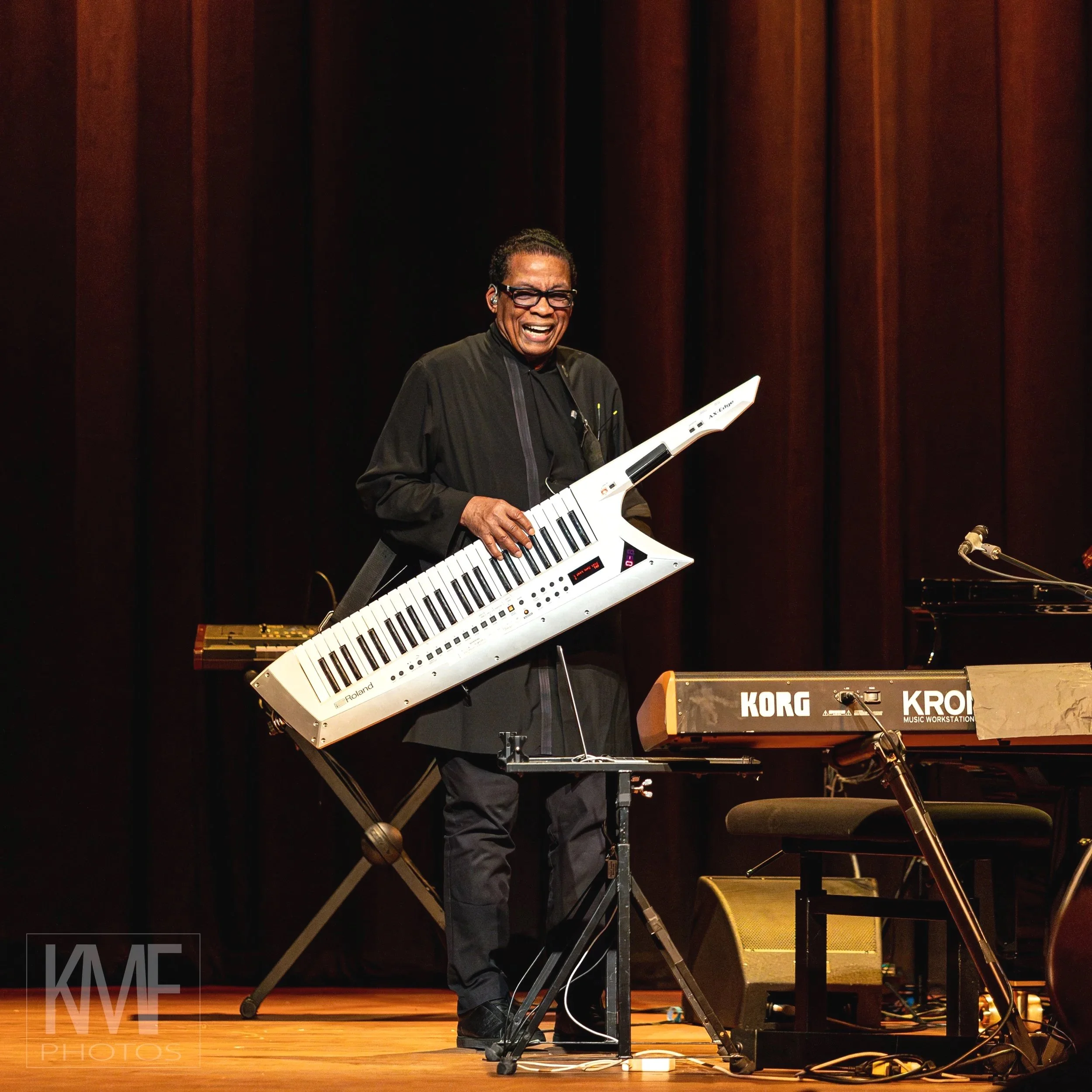
Multiple standing ovations punctuated the evening, but the loudest came when Hancock strapped on a keytar for the closing “Chameleon.” It was a fitting finale—funky, playful, and forward-looking—delivered by an artist who continues to challenge himself and his audience with fearless creativity.
At Chautauqua, Herbie Hancock didn’t just perform music. He invited the crowd into an ongoing conversation—rooted in curiosity, community, and the joy of not knowing what comes next.
Program Notes
Artist: Herbie Hancock
Venue: Chautauqua Auditorium
City: Boulder, Colo.
Date: Sept. 12, 2023
Set List: Overture; “Footprints”; “Actual Proof”; “Come Running to Me”; “Herbie’s Sermon”; “Secret Sauce”; “Cantaloupe Island”; “Chameleon.”