Trio Grande Makes a Big Sound at SFJAZZ
With Nate Wood playing drums and bass simultaneously, Trio Grande turns high-level interplay into a sound that feels twice as large. They arrive at the Joe Henderson Lab for two sets on February 11.
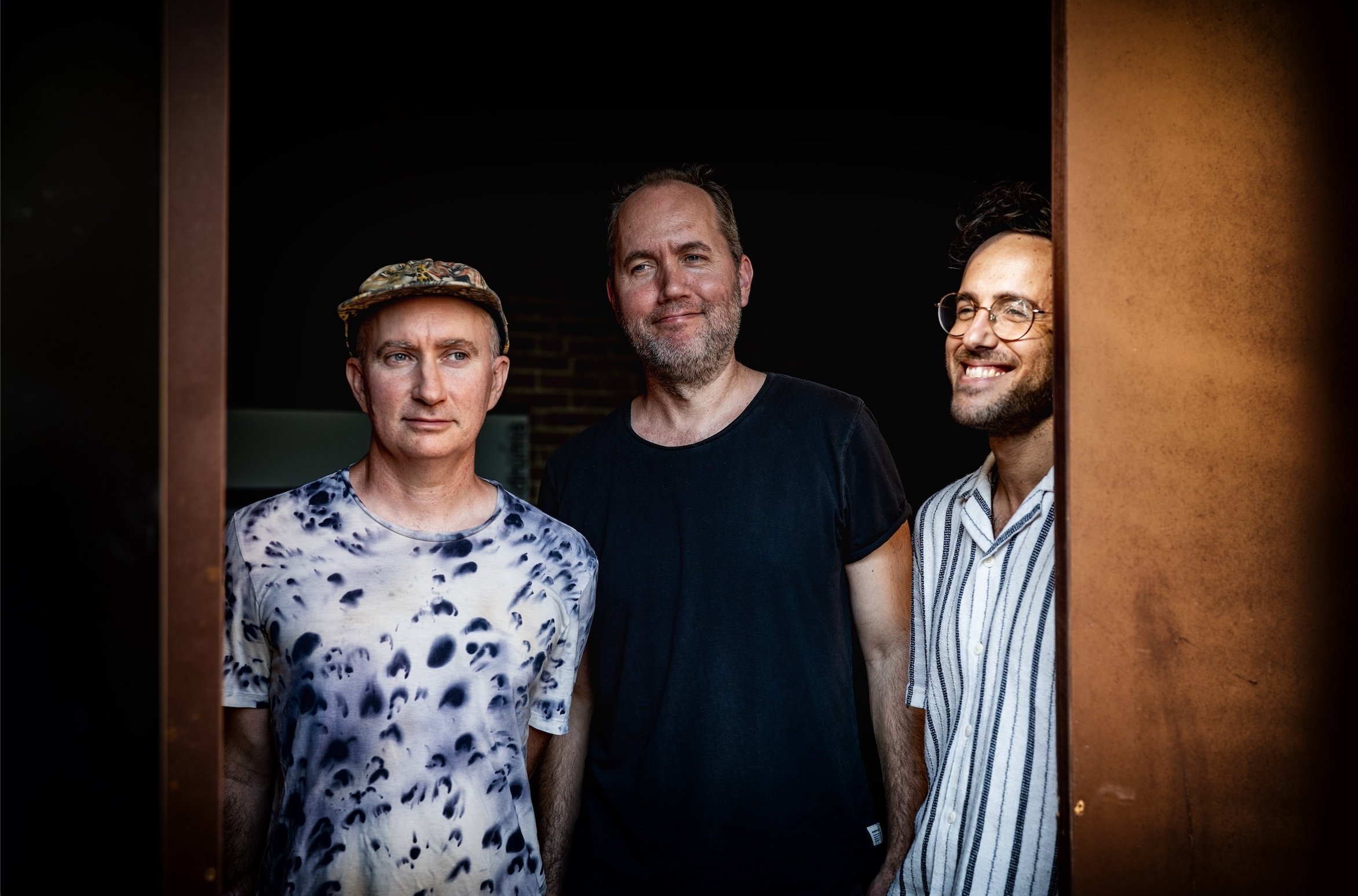
Trio Grande. Courtesy of SFJAZZ
See the full show details and ticket information at the end of this feature. Listen to the full conversation with Will Vinson below.
Trio Grande does not behave like a “small group.” It expands from the inside—through role-switching, flexible arrangements, and a shared focus on interplay.
That’s the essential thrill of the cooperative trio featuring saxophonist and keyboardist Will Vinson, guitarist Gilad Hekselman, and multi-instrumentalist Nate Wood, whom many listeners first encountered through Kneebody. Onstage, Wood performs an almost impossible feat: playing drums and bass simultaneously. But Trio Grande’s real spectacle isn’t virtuosity for its own sake. It’s how the group turns that expanded toolkit into a living, conversational music—one that can sound as big and broad as an ensemble twice its size.
On Wednesday, February 11, Trio Grande makes its SFJAZZ debut with two shows in the Joe Henderson Lab (7:00 p.m. and 8:30 p.m.). It’s an ideal venue for a band built on interaction: intimate, acoustically pristine, and close enough for audiences to see the micro-cues that guide the music.
A Trio Built on Interplay
Vinson traces Trio Grande’s origin to a fascination with bass-less trio language—specifically the Paul Motian trio featuring Joe Lovano and Bill Frisell. “I always wanted to have a group like that where there was that much interplay,” Vinson said, pointing to how removing the traditional bass chair can open up new kinds of freedom.
The band’s formation was gradual. A key moment came in New York at the (now closed) Cornelia Street Café, where Vinson heard Hekselman playing with Antonio Sanchez and Becca Stevens—again, notably without a bassist. Vinson sat in, the chemistry landed, and the next day, producer Gerry Teekens called with an invitation to record. Vinson pivoted away from a piano-heavy concept and instead made a trio record with Sanchez and Hekselman: It’s Alright With Three, released on Criss Cross.
From there, the project shifted toward a cooperative identity. After the pandemic, Sanchez’s schedule overflowed with projects, and Vinson and Hekselman began searching for the right drummer for the next chapter. The first name that came to mind was Wood. “Regardless of anything else, he’s just a great drummer,” Vinson said. “But the fact that he can add this bass component…”
How the Band Builds the Music
“Arrangements are pretty organic. They come out of us being in a room and hearing the music in its most basic form together at the same time—then making additions where they make sense.”
Trio Grande’s music-making process is about giving three musicians the right amount of information—and letting the room do the rest.
Vinson and Hekselman write the repertoire, but they bring it in as a skeletal framework. “We begin with a piece of music that’s usually like one or two pieces of paper long,” Vinson explained. “It’s very bare… skeleton arrangement. And we take an additive process rather than beginning with everything and then trying to make sense of it.”
The trio’s power comes from what happens when the parts are loose enough for the musicians to reassign responsibilities on the fly: guitar sliding into bass function, saxophone moving into keyboard textures, and drums splitting into percussion and low-end foundation.
“If you have a complete sound in your head,” Vinson said, “the best case scenario… is that they’re gonna realize that sound. But what’s much more valuable… is seeing what happens when those people are unleashed to contribute whatever they are hearing.”
The Nate Wood Factor
Any Trio Grande performance inevitably draws attention to Wood’s split role. Even Vinson still sounds amazed by it. “Even though we’ve done dozens of gigs,” he said, “it still blows my mind every time I see it.”
The musical impact is what Wood’s dual function unlocks: a new kind of trio elasticity. When the bass is embedded in the drummer’s physical motion, the music’s center of gravity can shift at the speed of thought. That, in turn, frees Vinson and Hekselman to move between melodic lead, counterline, and harmonic support without losing the low-end anchor.
The Set as a Living Organism
Trio Grande’s sets are built like narratives, but not like scripts. Vinson said the band thinks in broad contrasts, but leaves the deeper decisions to the moment.
“You wanna start with something that gets attention,” he said. “One way to draw the listener in is to make them have to try. If you do something more abstract, or even start with a ballad, just to set the tone.”
From there, the band stays alert to what the room is asking for. Sometimes, someone throws a curveball—shifting tempo, feel, or density in a way that forces the group to reorient in real time. “It almost wipes the slate clean for us to decide what we’re gonna do next,” Vinson said.
What to Expect at SFJAZZ
Vinson has never played the Joe Henderson Lab, but he’s eager for what the room offers. “If it’s anything like the other shows that we play,” he said, “you can look forward to a lot of energy… and you’ll see a lot of interplay in the way that we mix up our roles.”
Despite the group’s sold-out European and Australasian touring behind 2023’s Urban Myth, this is the trio’s first full U.S. tour behind the record.
In the Joe Henderson Lab, that introduction should land exactly where Trio Grande thrives: close enough to hear the details and feel the band thinking in real time.
Show Details
Genre: Contemporary Jazz/Fusion/Funk
Trio Grande plays SFJAZZ in the Joe Henderson Lab on Wednesday, February 11, with two shows: 7:00 p.m. and 8:30 p.m.
Get Tickets: https://www.sfjazz.org/tickets/productions/25-26/trio-grande/
Trio Grande on Bandcamp: https://triogrande-whirlwind.bandcamp.com/album/trio-grande