Terence Blanchard on Honoring Miles Davis and Coltrane Without Imitation
At an SFJAZZ soundcheck without Ravi Coltrane, Terence Blanchard made the clearest case yet for honoring the past without repeating it.

Terrance Blanchard at SFJAZZ’s Open Soundcheck event. Photo: Steve Roby
About fifty people had gathered outside the SFJAZZ Center on a Thursday afternoon, waiting to be admitted to Miner Auditorium for the Open Soundcheck—a ticketed, behind-the-scenes hour with the band before the evening’s show. Rebeca Mauleón, the Center’s Director of Education and Community Engagement, was about to deliver her standard welcome when the stage manager pulled her aside with two pieces of news: the guitarist was running late, and Ravi Coltrane had missed his flight.
He addressed the room before she could. “They should know,” he said, “this is what a jazz soundcheck is really like.”
It was May 28, the first night of a four-night residency celebrating the centennials of Miles Davis and John Coltrane—a pairing rescheduled from January so it would fall closer to Davis’s May 26 birthday. Coltrane would make it in time for the evening performance. But for the soundcheck, it was just Terence Blanchard, four members of his band, and a room with people who had come prepared to watch something and instead got something better: an hour with a musician willing to say exactly what he thinks.
What He’s Building
Blanchard holds two distinct yet related roles simultaneously. As a trumpeter and composer, he has spent decades developing a voice that balances lyricism with structural ambition—from his years in Art Blakey’s Jazz Messengers to a long collaboration with filmmaker Spike Lee to the opera Fire Shut Up in My Bones, which became the first work by a Black composer performed on the Metropolitan Opera’s main stage. As SFJAZZ’s Executive Artistic Director, he now leads one of the country’s most visible jazz institutions at a charged moment for the art form.
The two roles have begun to rhyme. SFJAZZ’s 2026-27 season will be called Forward Motion—a phrase Blanchard used that afternoon to describe what the organization is working to become: “an incubator of creativity and the go-to place for jazz, not only in San Francisco but around the world.” It’s the same philosophy he applies onstage.
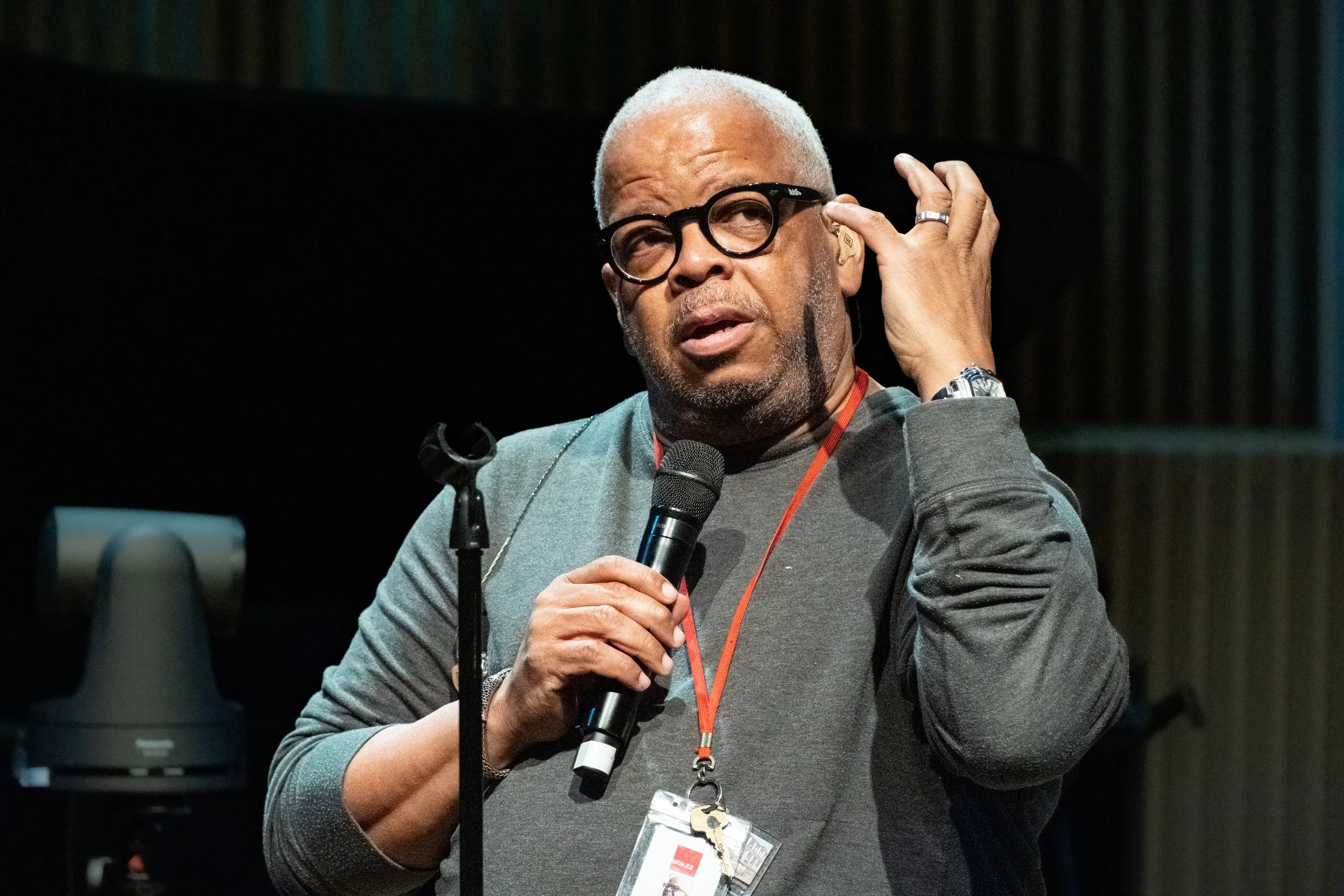
Terrence Blanchard answering audience questions. Photo: Steve Roby
The Music Before the Questions
When the auditorium doors opened, Blanchard walked in and directed the band straight into Miles Davis’s “In A Silent Way.” Guitarist Charles Altura had entered through a side door moments earlier, unzipped his pedal bag, and plugged in. The rhythm section—Tom Oren on piano and keyboards, Alex Smith on bass, Mark Whitfield on drums—was already in place. After the Davis classic, they moved into “Wandering Wonder,” one of Blanchard’s own compositions, and when the Q&A began, he told the story behind it for the first time in a long while.
He wrote it after leaving Blakey’s band, when success was just beginning. What he kept thinking about were the musicians he grew up alongside in New Orleans—people with just as much talent, maybe more, who never found their lane. “We’re the ones that became successful,” he said, “but we’re one of many with that level of talent. When I left New Orleans, it just made me think about all those people wandering around the city, trying to find their way.” The shifting rhythms in the piece, the way it resists settling—they came from that image. It was the kind of explanation that reframes a piece of music before you’ve even finished hearing it.
On Honoring Without Mimicking
Despite all the centennial framing, Blanchard was careful to clarify what this residency isn’t. When asked how each night of the four-show run would differ, he was direct: “If you came here to hear the records, I’m sorry—this is not that.” He then explained. “I think the most disrespectful thing to their legacy would be to try to mimic them. They were innovative. They were forward thinkers. So we have to think forward.”
The standard he kept returning to came from Wayne Shorter, whose question— “What do you have to say?”—has stayed with Blanchard for years. The band plays compositions from the period when Davis and Coltrane worked together, but through their own arrangements and instincts. The goal isn’t recreation. It’s a conversation across time that only works if the participants have something genuine to contribute.
That philosophy shapes the nightly experience in practical terms. The set list won’t change over the four nights. But a set list and a set are different things. “These guys start beating on something,” Blanchard said, “and the next thing you know we’re off into a whole other section. Don’t ask them to do it again, because it ain’t gonna happen.”
Ravi and the Problem of Inheritance
When an audience member asked about Coltrane—who was expected to arrive until just before the evening show—Blanchard’s answer was both affectionate and precise. He described the particular difficulty of developing an original voice on an instrument when your father redefined it for a generation. “Everybody else who plays the same instrument tries to play like his dad,” Blanchard said. “Think about that.”
In his view, the real achievement is that Ravi Coltrane absorbed that influence without being consumed by it. “He found a way to develop his own voice. He has his own voice on the saxophone, and that’s an amazing thing to witness.”
It’s the same standard Blanchard applies to his own band, which he describes not as a backing ensemble but as a collective. What he looks for isn’t only technical ability—it’s the capacity to listen without ego. “Sometimes people listen through their ego,” he said. “These guys don’t do that.” He put himself in the beneficiary’s seat: “I always tell people I got the best seat in the house because I’m right up here while they’re doing it.”
Forward Motion
The residency, in its way, is a proof of concept for the broader vision Blanchard is pursuing at SFJAZZ. He wants the organization to be a place where the art form is treated seriously enough to evolve—not preserved under glass but extended, tested, and sent somewhere new. The season title isn’t decorative. It’s a position statement.
On a Thursday afternoon in Miner Auditorium, with the headliner stuck at an airport and the guitarist still setting up his pedals, Blanchard made that case without ceremony. He wasn’t performing. He was just talking.
Terence Blanchard and Ravi Coltrane’s four-night residency at SFJAZZ’s Miner Auditorium runs May 28—31, 2026. For information about upcoming SFJAZZ programming, visit sfjazz.org.