Greg Osby Brings Minimalism to the Joe Henderson Lab
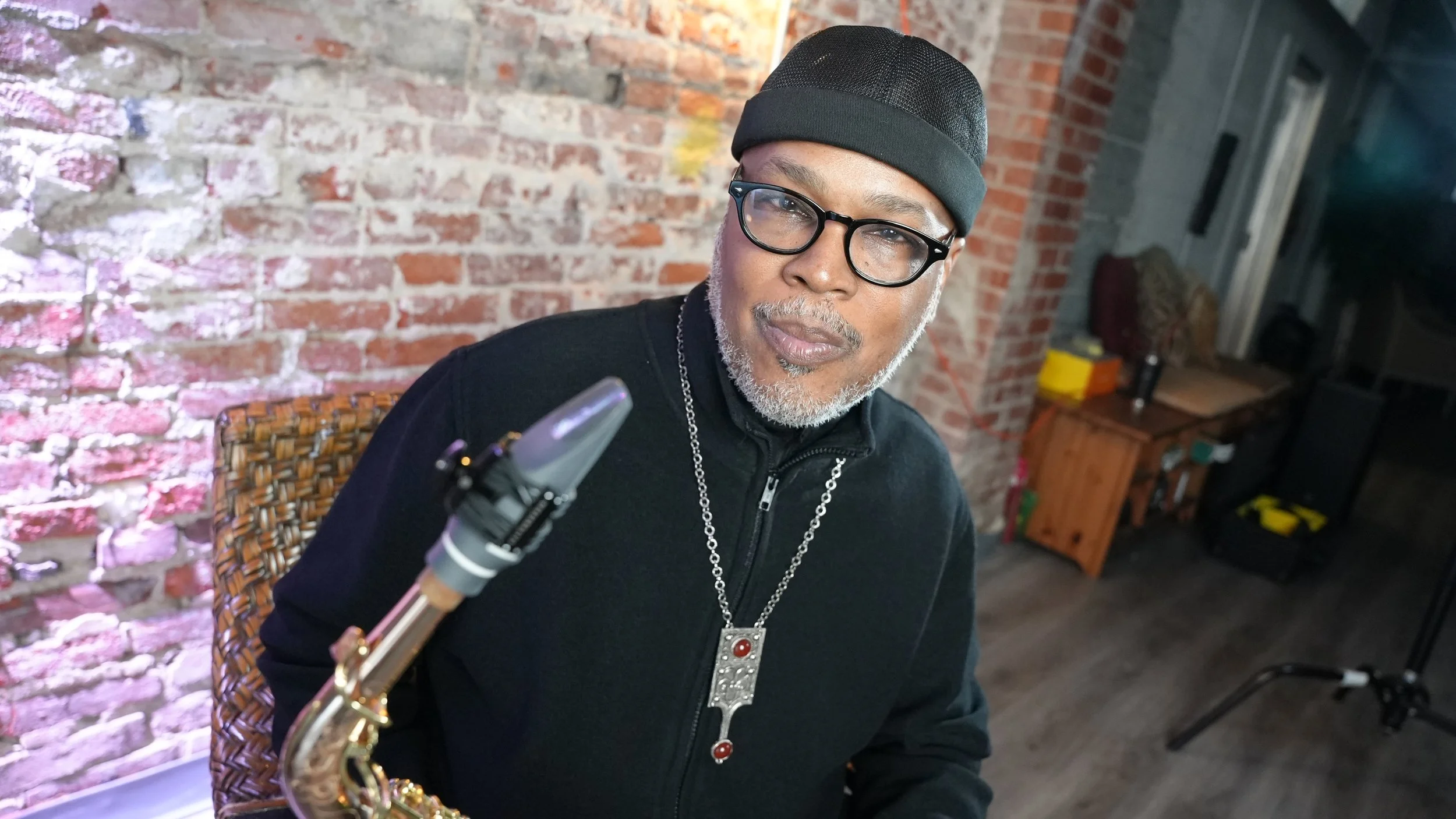
The influential saxophonist and M-BASE architect arrives at SFJAZZ with music shaped by focus, mentorship, and a renewed commitment to direct musical communication.
See the full show details and ticket information at the end of this feature. Listen to the full conversation with Greg Osby below.
For more than four decades, Greg Osby has occupied a singular place in modern jazz: as a virtuoso alto saxophonist, thinker, builder, and mentor whose work treats music as an evolving cultural system. A founding member of the M-BASE collective, a longtime Blue Note artist, and a collaborator with figures ranging from Herbie Hancock and Dizzy Gillespie to Jack DeJohnette and Andrew Hill, Osby has made a career of asking structural questions—about sound, community, authorship, and listening itself.
Those questions sit at the center of his recent album, Minimalism, a project that reframes his compositional process around focus, accessibility, and restraint. When Osby brings this music to the Joe Henderson Lab at SFJAZZ, he arrives with a new set of pieces and a sharpened philosophy of what it means to communicate through sound.
From Sonic Wallpaper to Creative Calling
Osby’s musical instincts were shaped early by his environment. Growing up in St. Louis, he absorbed live music as part of daily life. “The neighborhood had bars, taverns, and speakeasy places,” he recalled. “All of these places had either a very loud jukebox, a Hammond B-3 organ where they could have an instant band, or a full band. It was a very musical situation where music and live music forged the backdrop, the sonic wallpaper for all of us growing up.”
Equally formative was what came home each day. Osby’s mother worked for a record distribution company, and the steady flow of promotional vinyl cultivated both curiosity and range. “Every day she would come home with an armload of vinyl,” he said. “So, we had mountains of music to listen to. And that kind of cultivated a non-biased appreciation for any music of any genre as long as it was good.”
Those stacks of records steered him toward the saxophone. “I gravitated toward the instrumental saxophone players, the more soulful ones,” Osby said, citing Hank Crawford, Wilton Felder, Junior Walker, and Grover Washington Jr. “And then, incidentally, I wound up playing saxophone later.”
The decision to pursue music professionally crystallized not through abstraction but through experience. “The turning point was when I realized that in one weekend, I was getting paid more than my teachers at school,” he said. “And not only that, but the immediate response of the audiences… they fuel the band. They give you the motivation, the psychological cattle prod to push you into arenas that you probably wouldn’t pursue on your own.”
Relearning How to Leave Space
That audience relationship sits at the heart of Minimalism. The album emerged from an unusually direct catalyst: a conversation with his younger sister. “She said, ‘Your music sounds like mad clown music to me,’” Osby recalled. “She felt bombarded by too much information she couldn’t process… like a three-ring circus.”
The comment lingered. “If she said that and she loves me, I can only imagine what people who are naturally detractors would think,” he said. “And that made me understand why some people didn’t really get it after so many years.”
The result was not a stylistic retreat but an editorial one. “I would go on to rerecord things and minimize the content, just so I could reach more people,” Osby explained. “I wanted to reach laypeople, the common people… not only the standardized jazz intelligentsia.”
For Osby, minimalism became a method rather than a doctrine. “Musicians who’ve studied at a conservatory often feel this dire need to include everything, including the kitchen sink,” he said. “You’re pelting people with so much information that they feel like they’re in a sonic firing squad.” His response was to listen to his own work “as a fan, as a listener,” allowing space to become a communicative tool rather than an omission.
The album title arrived only after the music was complete. “I normally don’t give titles until the end,” he said. “Then it all comes together to tell the story.”
Music as a Living Transmission
Osby’s concerns extend beyond his own catalog. Throughout the interview, he returned to the view of mentorship as a moral practice rather than a professional obligation. “I feel morally, socially, and strategically obligated to pass the baton,” he said. “So many people indulged my greenness and bestowed upon me gems of information that can’t really be found in any encyclopedia.”
That inheritance shapes how he views the current generation. “We’re in good hands,” Osby said. “The internet and digital access have afforded young people the information at their fingertips. They’re developing faster, younger, and at a dizzying pace.” What they lack, in his view, is not knowledge but proximity. “The only thing they lack is apprenticeship… being under the wing of somebody who’s seen how the mechanism works.”
Even stylistically, he hears a historical shift underway. “I would like to say we’re in the post-hip-hop generation,” he observed. “When I hear the way young people play, they came up in an era where music was put together in snippets and constructs… and they also came up in this digital age where everybody’s walking around with a supercomputer in their pocket.”
The Joe Henderson Lab as Listening Space
Osby’s upcoming performances at the Joe Henderson Lab place this music in a room built for nuance. Preparing a set, he said, remains responsive rather than fixed. “Sometimes we’ll prepare things in advance, then we’ll have to make adjustments on the fly based on the responses or lack of responses from the patrons.”
For this run, Osby brings longtime pianist Tal Cohen alongside Bay Area musicians Jemal Ramirez on drums and David Ewell on bass. “I just want to take the audience on a journey,” he said. “There’ll be some historical references. There’ll be familiar things, but they’ll all be filtered through my lens and reworked to be personalized.”
The guiding principle remains transformation. “There must be a radical augmentation of the means for me to be satisfied and inspired as an artist,” Osby said. “I think people will enjoy our presentation.”
TICKET INFO
Greg Osby brings Minimalism to the Joe Henderson Lab for an evening shaped by reflection, structure, and deep listening. Audiences can expect a program that draws on lineage while reframing it through Osby’s evolving compositional lens, presented in one of SFJAZZ’s most intimate and acoustically revealing rooms.
Show Details
Personnel: Greg Osby Trio
Date: Sunday, February 1
Venue: Joe Henderson Lab at SFJAZZ
Showtimes: 6:00 p.m. and 7:30 p.m.
Tickets: https://www.sfjazz.org